IELTS Academic Preparation: Your 2026 Roadmap to a High Band

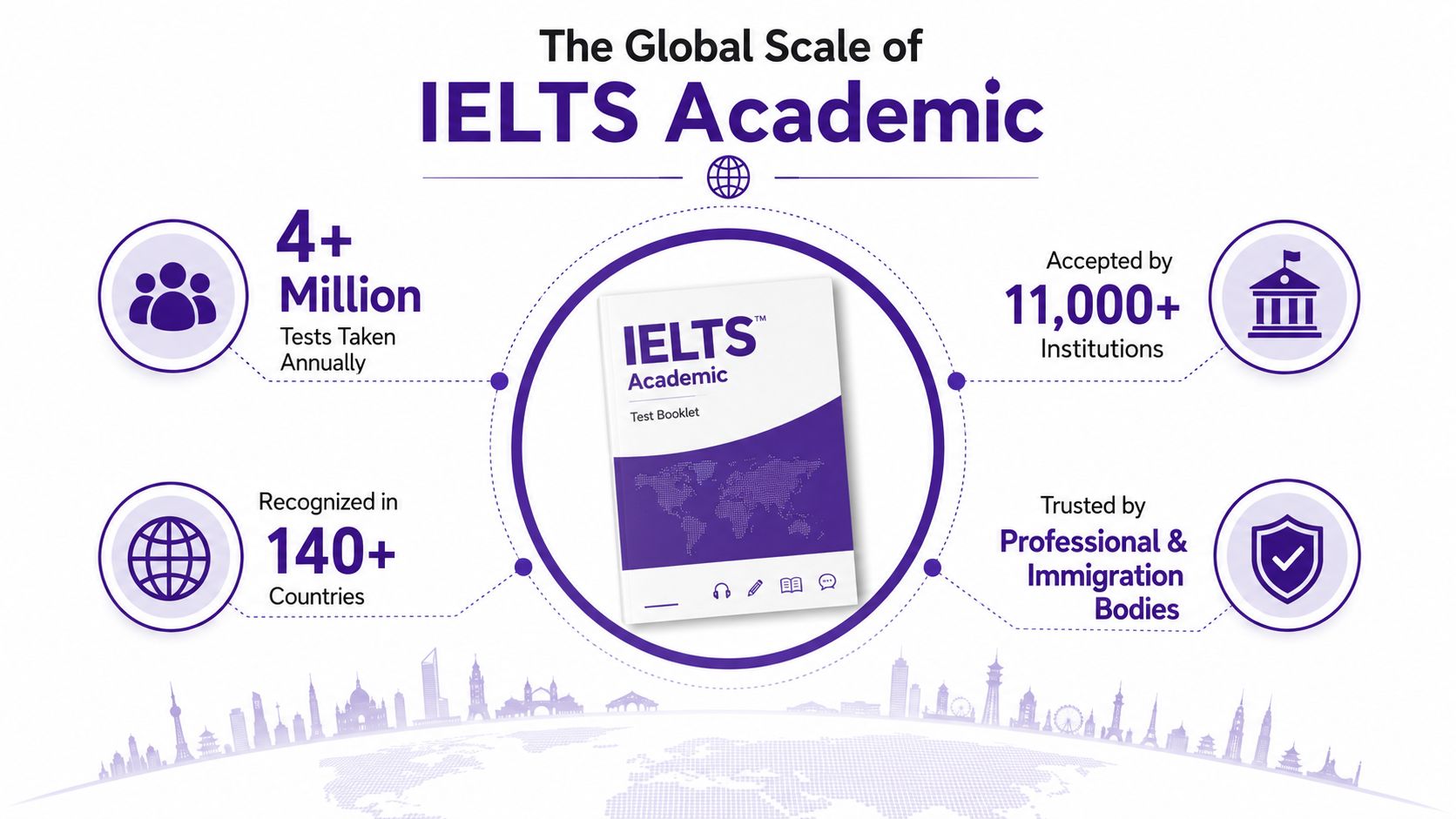
More than 4 million IELTS tests were taken worldwide in 2023, with the exam available through a large global network across more than 140 countries (free IELTS tests for refugees). That scale changes how you should approach IELTS Academic preparation. This isn't a casual English course or a collection of practice questions. It's preparation for a standardized decision about university admission, professional opportunities, and international mobility.
A strong result rarely comes from studying longer. It comes from identifying where marks are being lost, targeting the relevant scoring criteria, rehearsing the exact exam format, and reviewing mistakes before repeating them. The roadmap below treats preparation as a practical system: establish your current level, define the required band, allocate your time intelligently, and use timed practice and focused feedback to close the most important gaps.
Table of Contents
- What IELTS Academic Really Tests and Why Preparation Matters
- The Four Skills and How Each One Is Actually Scored
- Stop Practicing Harder and Start Targeting the Right Criteria
- An 8-Week Study Plan You Can Adapt to Your Timeline
- Mock Tests, Feedback Loops, and What to Do With the Results
- How AI Tools Can Speed Up Every Stage of Preparation
- Common Traps, Current Topics, and Your First 48 Hours
What IELTS Academic Really Tests and Why Preparation Matters
IELTS Academic is intended for candidates applying for higher education or professional registration. General Training serves different purposes, commonly involving migration, work, or training. Listening and Speaking are shared across both versions, while Academic Reading and Writing use more academic content and task demands. Everyday English practice alone therefore leaves an important part of the Academic test uncovered.
As of mid-2026, another format issue matters for planning. IELTS states that from mid-2026 it will no longer offer paper-based IELTS, moving test delivery to computer across markets over time, with rollout timing that varies by market (updates to IELTS test delivery). IELTS also says that in selected countries and markets, candidates taking IELTS on computer will be able to choose Writing on Paper, which means handwriting the Writing section while the rest of the test remains on computer (updates to IELTS Writing test delivery mode). The skills tested and scoring standards remain the same, but screen reading, typing, handwritten planning, note handling, and time management can feel different on test day.
Start with the gap, not the goal
IELTS results use a 0 to 9 band scale, including whole and half bands such as 6.5 and 7.5. Your target may be an overall band, a minimum in every skill, or both. A candidate with strong Reading and weak Writing needs a different schedule from someone whose scores are evenly distributed.
Begin with three questions:
Where are you now? Take a complete, timed diagnostic rather than estimating your level from general conversation.
What band do you need? Check the exact requirement from your university, professional body, or immigration authority.
What is causing the gap? Separate language problems from exam-management problems, such as misreading instructions, losing time, or leaving part of a prompt unanswered.
A useful diagnosis works like a medical check-up. The score shows the symptom, while error analysis identifies the cause. If Reading mistakes cluster around matching headings, practice that question type and examine why each choice was accepted or rejected. If Writing loses marks through unclear progression, review that criterion before writing another full essay.
Preparation becomes easier to manage once the target is translated into weekly behaviors. Replace “improve English” with tasks such as completing a timed essay, reviewing one Writing criterion, analyzing a specific Reading question type, and recording a Speaking response for review. Timed drills then show whether the behavior survives pressure, while feedback prevents you from repeating the same error.
Practical rule: Give the most study time to the weakest score-producing behavior, not automatically to the skill you enjoy practicing.
Results are generally accepted as valid for up to two years by many institutions and authorities, because second-language ability can change over time (verifying IELTS results). Always confirm the exact policy of the organization receiving your score. Plan your test date and application deadlines together. Building a score too early can create an avoidable timing problem if you delay submitting it.
The Four Skills and How Each One Is Actually Scored
The Academic test takes 2 hours and 45 minutes in total. Official timing allocates about 30 minutes to Listening, 60 minutes to Reading, 60 minutes to Writing, and 11 to 14 minutes to Speaking (Academic test format in detail).
Each skill tests a different kind of control. Listening and Reading reward accurate processing under pressure. Writing tests whether you can communicate and organize ideas in an academic context. Speaking tests whether you can respond naturally, extend answers, and remain understandable in a live interaction.
| Skill | Time | Questions / Output | Scoring Basis |
|---|---|---|---|
| Listening | About 30 minutes | Responses to recorded conversations and talks | Accuracy across the Listening questions, reported on the band scale |
| Reading | 60 minutes | Responses to Academic texts and question types | Accuracy and the Academic Reading band scale |
| Writing | 60 minutes | Task 1, at least 150 words; Task 2, at least 250 words | Task-specific criteria and the public band descriptors |
| Speaking | 11 to 14 minutes | Interview, extended response, and discussion | Performance across the Speaking assessment criteria |
Listening and Reading
Listening requires more than understanding general meaning. You need to follow changes in topic, recognize the question type, anticipate the kind of answer required, and record information accurately. Spelling, numbers, and grammatical form can matter even when you understood the recording. A useful source of format-focused work is this IELTS Listening practice test guidance.
Reading creates a different challenge. You must process academic passages while making decisions quickly. Matching headings tests the relationship between ideas and paragraph purpose. True, False, Not Given requires careful separation of contradiction from missing information. Sentence completion demands close attention to both meaning and grammatical fit.
Writing and Speaking
Writing consists of two tasks completed in one hour. Task 1 requires at least 150 words, while Task 2 requires at least 250 words (IELTS Writing band descriptors). Writing Task 2 carries twice as much weight as Task 1 in the overall Writing band, so it deserves proportionally more preparation time.
Task 1 is assessed through Task Achievement, Coherence and Cohesion, Lexical Resource, and Grammatical Range and Accuracy. Task 2 uses the same four dimensions, with Task Response replacing Task Achievement.
Task 2 deserves particular attention because each criterion contributes equally to the task score. A wide vocabulary range won't compensate fully for an essay that answers only part of the question. Likewise, a clear position can still lose marks if paragraphs don't develop ideas or grammar repeatedly obscures meaning.
Speaking is not a speech to memorize. You need to answer questions directly, extend ideas, manage pauses, and respond to follow-up discussion. Practice should therefore include spontaneous responses, not only prepared topics. Record yourself when possible, then review whether your answer is complete, organized, and easy to follow.
The four official Speaking criteria are Fluency and Coherence, Lexical Resource, Grammatical Range and Accuracy, and Pronunciation. Reviewing your recordings against those four areas makes Speaking practice much easier to diagnose.
Stop Practicing Harder and Start Targeting the Right Criteria
“Practice more” sounds sensible, but it doesn't tell you what to change. A candidate can complete essay after essay while repeating the same unclear thesis, weak explanation, or inaccurate complex sentence. More exposure may build familiarity, but without diagnosis it can also reinforce inefficient habits.
Writing Task 2 makes the problem visible because the assessment separates performance into Task Response, Coherence and Cohesion, Lexical Resource, and Grammatical Range and Accuracy. Treat each criterion as a separate training target.
Turn vague weakness into an observable problem
A Task Response issue might look like a position that changes halfway through the essay or an example that doesn't explain the main idea. Coherence and Cohesion problems often appear as paragraphs with no clear controlling idea, abrupt progression, or linking words used mechanically. Lexical Resource weaknesses may include repeated collocations or imprecise word choice. Grammatical Range and Accuracy problems can involve sentence boundaries, agreement, articles, or complex structures that become difficult to understand.
Reading needs the same precision. A score report that says “Reading is weak” isn't actionable. A log showing repeated errors in True, False, Not Given questions points to one kind of reasoning problem, while matching headings may reveal difficulty identifying the central purpose of a paragraph.
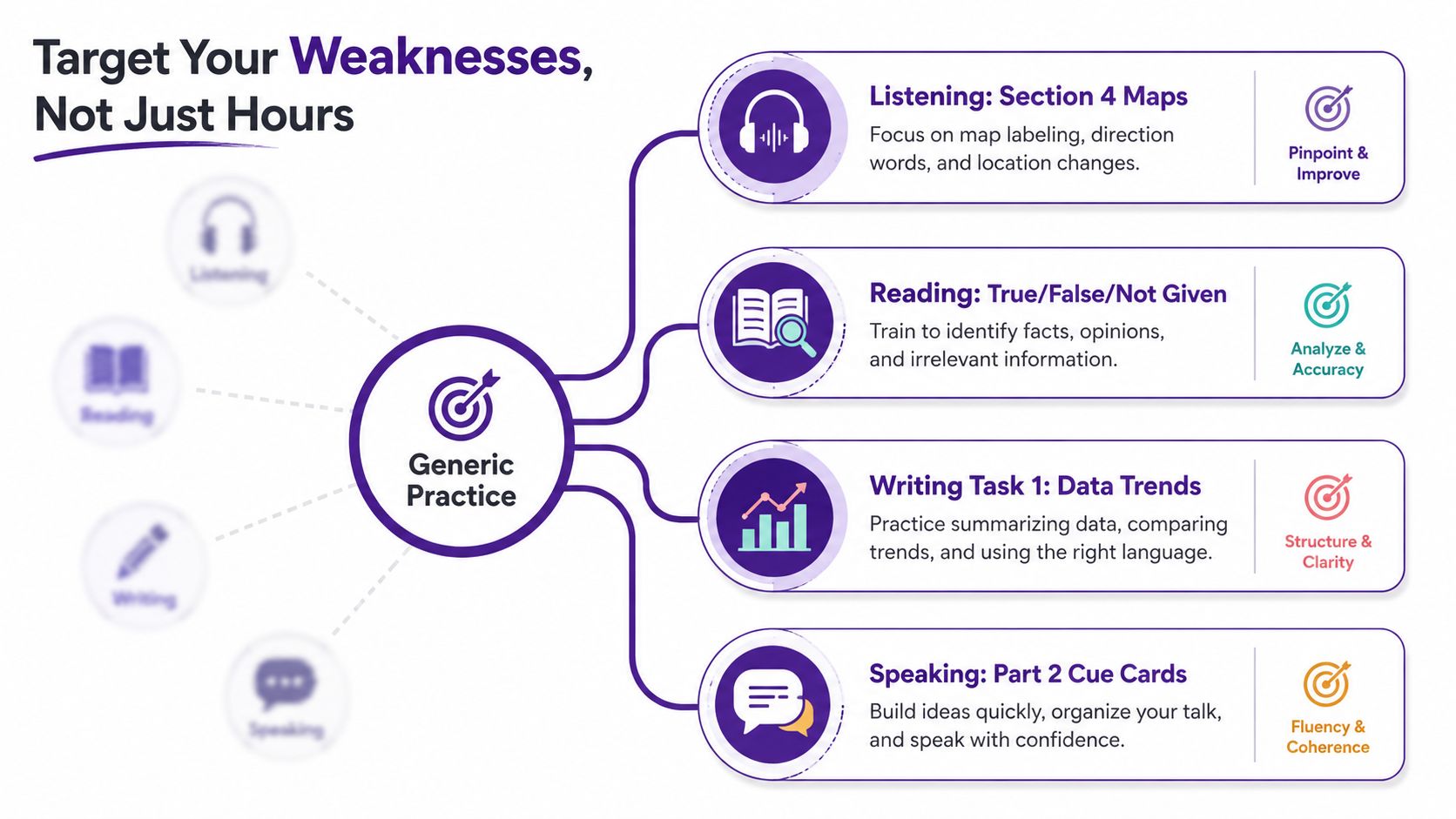
Use a 48-hour diagnostic
On the first day, complete one timed task in each skill. Use official-format materials where possible, follow the stated timing, and avoid pausing recordings or checking answers during the task. For Writing, produce both tasks within the one-hour limit. For Speaking, record responses that include an extended turn and follow-up discussion.
On the second day, review the results in a table with four columns:
Skill or criterion
Observed error
Likely cause
Next drill
For example, “Writing, Coherence and Cohesion, body paragraph contains two unrelated claims, outline one controlling idea before drafting.” Or, “Reading, True, False, Not Given, treats absent information as false, mark explicit contradiction and missing evidence separately.”
The diagnostic doesn't need to produce a perfect band estimate. It needs to reveal where your next study hour can produce the clearest improvement.
An 8-Week Study Plan You Can Adapt to Your Timeline
An eight-week plan works when each phase has a distinct purpose. The early weeks establish evidence, the middle weeks isolate weaknesses, and the final weeks test whether improvements survive realistic pressure. If you have less time, combine phases. If you have more, extend the review cycles rather than filling extra days with unfocused mock tests.
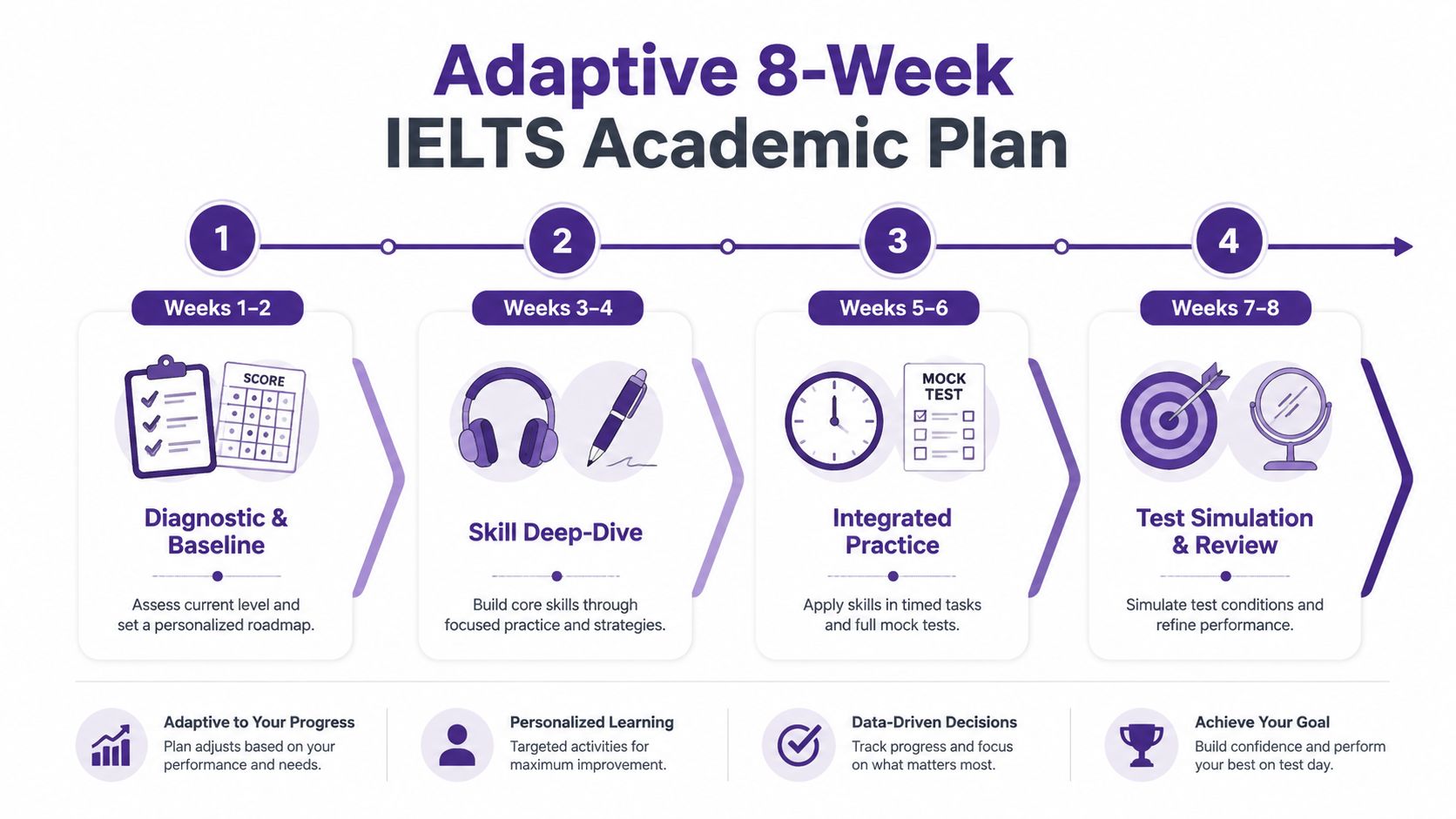
Weeks 1 and 2, establish the baseline
Complete a full diagnostic under exam-like conditions. Record your result by skill, then audit recurring vocabulary and grammar problems. Don't spend these weeks memorizing long lists. Note the words and structures that repeatedly prevent you from understanding a text or expressing a precise idea.
Use each weekday study session as a focused block:
First block: Complete a timed skill task.
Second block: Review every error and classify its cause.
Final review: Rewrite, replay, or re-answer only the items that exposed a weakness.
At the weekend, compare your error log with the original diagnostic. If the same issue appears repeatedly, promote it to a priority target.
Weeks 3 and 4, train the criteria
Write Task 2 essays with special attention to Task Response and Lexical Resource, then review whether your position answers every part of the prompt and whether your word choices are precise. Practice Reading by question type, especially True, False, Not Given and matching headings. For Listening, work section by section and identify whether errors come from prediction, concentration, spelling, or question navigation.
Complete at least one timed practice task in each skill during each week. The purpose isn't to chase a new score every day. It's to test whether the targeted behavior appears under a clock.
This IELTS exam coaching resource can help you think about preparation as guided practice rather than repeated exposure.
Weeks 5 to 8, integrate and simulate
In Weeks 5 and 6, complete full timed tests and add regular Speaking Part 2 long-turn practice. Review the recordings for pauses, repetition, incomplete answers, and weak development. In Weeks 7 and 8, schedule mock tests every few days, then spend the following study block reviewing the error log instead of immediately taking another test.
Use adjustment triggers:
Scores remain flat: reduce broad practice and return to the weakest criterion.
One skill falls: protect it with short, frequent practice while maintaining the others.
Timing fails: rehearse the exact section with a visible clock.
Accuracy improves but output remains weak: add rewriting or recorded response work.
Daily study doesn't need to be complicated. A consistent 90-minute block can include timed production, error analysis, and one targeted correction. The schedule should change when the evidence changes.
Mock Tests, Feedback Loops, and What to Do With the Results
The following case is hypothetical, but it reflects a common uneven profile: Reading 7.5, Listening 6.5, Writing 6.0, and Speaking 5.5. The preparation problem is not necessarily a lack of effort. Many candidates practice all four skills but cannot explain why some tasks go wrong or which habit deserves attention first.
Week 1 and Week 2
This hypothetical candidate begins with a complete Academic mock under timed conditions: Listening for about 30 minutes, Reading for 60 minutes, Writing for 60 minutes, and a recorded Speaking session lasting 11 to 14 minutes. The candidate does not pause recordings, extend section times, or rewrite answers during the test.
During Week 2, the candidate builds an error log. Instead of writing “careless mistake,” the log records the question type, the answer given, the correct answer, and the reason for the failure. Writing notes are organized under Task Response, Coherence and Cohesion, Lexical Resource, and Grammatical Range and Accuracy.
Feedback only helps when it changes the next task.
Week 3 and Week 4
The log shows a specific pattern. Listening errors come from answer spelling in Section 2. Writing Task 2 loses control when ideas move between paragraphs, which points to Coherence and Cohesion. Speaking includes long fluency pauses, especially when the candidate has to extend an answer without preparation.
The candidate then replaces general practice with three targeted routines. The routine includes spelling-focused Listening drills, outlining one controlling idea per Writing paragraph before drafting, and recording short Speaking responses followed by a second attempt with fewer pauses. The candidate waits 48 hours before attempting the same Writing prompt again, which helps the writer respond to the idea rather than memorize previous wording.
A second mock in Week 4 produces Writing 6.5 and Speaking 6.0. That shift is used here to illustrate the workflow, not to prove effectiveness or guarantee the same outcome for other candidates. The next step is to keep the improved behaviors under pressure, not abandon them for new techniques.
Use the same rules in your own cycle:
Simulate conditions: Keep timing and task order realistic.
Log by criterion: Name the specific source of the lost mark.
Delay repeated prompts: Review before rewriting the same task.
Record Speaking: Listen for development, clarity, and pauses.
Choose one correction: Make the next practice task test that correction.
You can use an IELTS full mock test online as one structured way to create this cycle.
How AI Tools Can Speed Up Every Stage of Preparation
AI is most useful when it shortens the distance between performance and feedback. A diagnostic system can estimate a starting level quickly, while a planning system can turn that result, your target, exam date, and available study time into a practical weekly schedule. The benefit isn't that software removes the need to think. It helps you spend more of your thinking time on the right problem.
One feedback loop across four skills
For Writing, criterion-level evaluation can organize feedback around Task Response, Coherence and Cohesion, Lexical Resource, and Grammatical Range and Accuracy. That structure is more useful than a general comment such as “use better vocabulary,” because it tells you whether the next task should focus on answering the prompt, developing paragraphs, choosing precise language, or controlling sentence form.
For Reading and Listening, an AI tutor can explain the relationship between the question and the passage or recording. If a True, False, Not Given response is wrong, the explanation should identify whether the text contradicts the statement, fails to mention it, or uses a syntactic structure that changed the meaning. Similar analysis can group Listening errors by section and question type.
Cathoven states that its AI scoring can estimate performance within 0.5 bands of human examiners (pricing). Treat that estimate as a planning signal, not an official result. Human judgment still matters, especially when you need to understand why a response sits at a particular level.
Make progress visible
A useful dashboard should show movement by skill and criterion, not only one overall number. If Writing improves while Speaking regresses, a single total can hide the trade-off. A progress view can prompt you to rebalance the schedule before test day.
Cathoven offers diagnostic tests, IELTS-format practice, criterion-level Writing and Speaking feedback, personalized planning, an AI tutor, and progress tracking across the four skills. Its Score Guarantee is a separate policy with stated terms, so read those conditions carefully before treating it as part of your preparation decision.
Common Traps, Current Topics, and Your First 48 Hours
Memorized essay templates often produce rigid writing that misses the exact question. Reading rewards controlled timing, not perfection on the first passage. In Speaking Part 2, use the preparation minute to choose and order ideas. In Listening, practise question types and section demands instead of trying to imitate native-speed conversation.
Possible practice themes include artificial intelligence in schools, remote work, and environmental policy, so build flexible outlines around these themes rather than memorized essays. You might prepare ideas for questions such as:
Should schools teach students to use artificial intelligence responsibly?
Does remote work benefit employees and communities equally?
Should governments prioritize environmental protection over economic growth?
How can public health systems prepare for future disruption?
Does cultural integration require changes from newcomers, host communities, or both?
Time pressure, misreading instructions, incomplete task response, and neglecting a skill are recurring risks. Your first 48 hours should create evidence and a schedule, not only motivation.
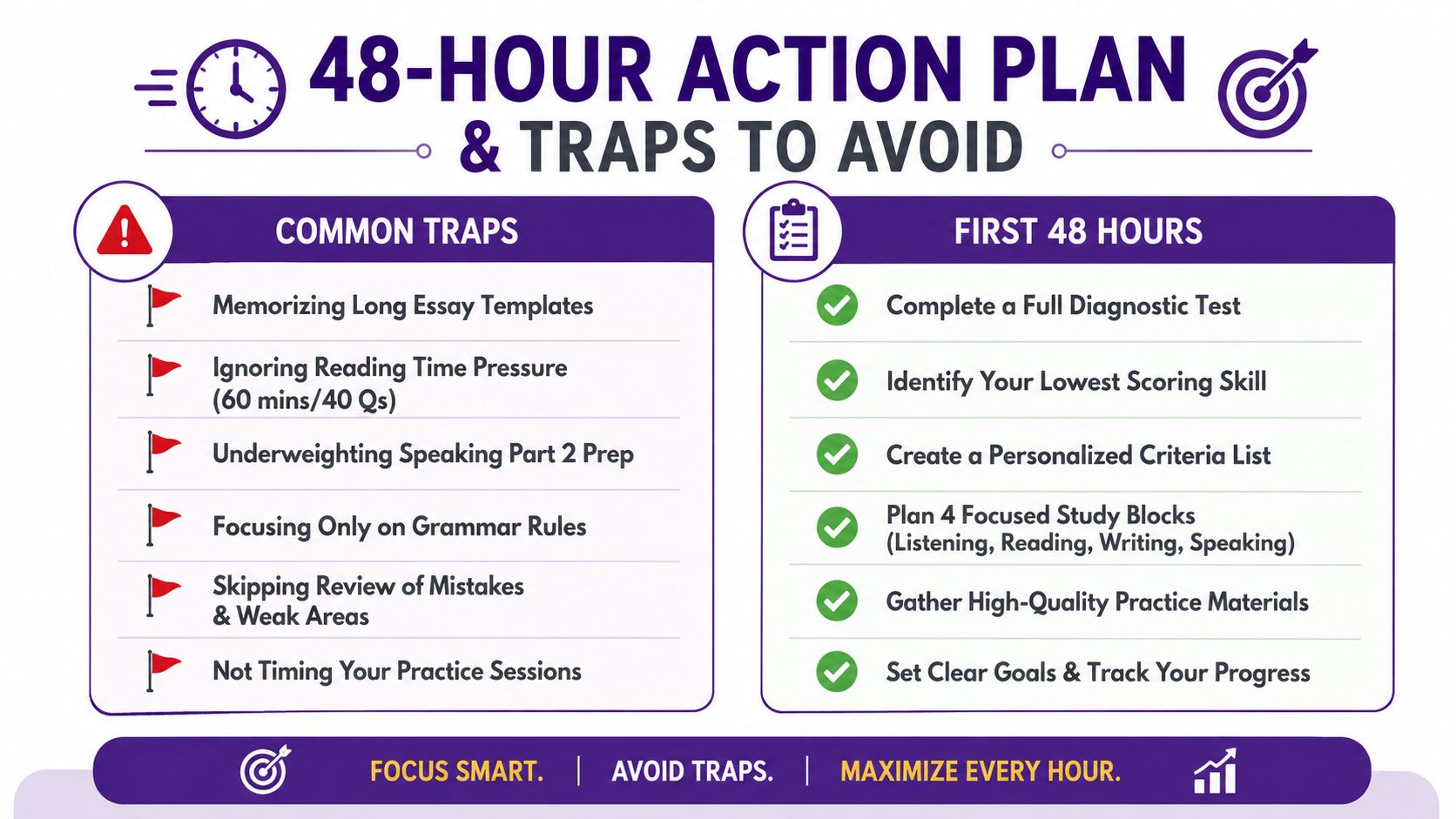
Complete a full diagnostic under realistic conditions.
Score the work against the official band descriptors.
Identify your two weakest criteria or question types.
Block six study slots and give each a specific purpose.
Schedule one Speaking practice with a partner.
Check result validity policies and application deadlines together. IELTS results are often accepted for up to two years, but receiving organizations set the final rule.
Do not wait for a perfect plan. Take the diagnostic, record each error, and let the evidence determine your next practice. Confirming result requirements early also prevents an administrative problem from undermining your preparation.
Cathoven can organize that evidence into an IELTS Academic routine with diagnostic testing, exam-format practice, criterion-level Writing and Speaking feedback, and progress tracking. Visit the Cathoven IELTS hub to build a study plan around your current performance and target band.