
IELTS Listening Practice Test: A Complete 2026 Guide
A stronger IELTS Listening practice test routine is usually shorter, stricter, and more analytical than most learners want. In 2026, that routine should also be computer-first. IELTS announced that paper-based testing would begin to be withdrawn from mid-2026, with the exact end date varying by market, so your practice should now mirror IELTS on computer by default official test delivery update British Council Japan market notice. If you keep doing random tests without reviewing why you missed each answer, you're just rehearsing the same mistakes under prettier timing.
Answer-first routine: before every test, scan the instructions, predict the answer form for each gap or option set, and get ready to type answers directly as you listen.
Table of Contents
- What the IELTS Listening Test Actually Tests
- Best Sources for Authentic IELTS Listening Practice Tests
- Understanding Question Types and Where Marks Are Lost
- Building a Four-Week Practice Test Routine
- Matching Practice Tests to Your Current Band Level
- Smart Ways to Use Practice Tests Every Day
- Tracking Progress and Reaching Your Target Band
What the IELTS Listening Test Actually Tests
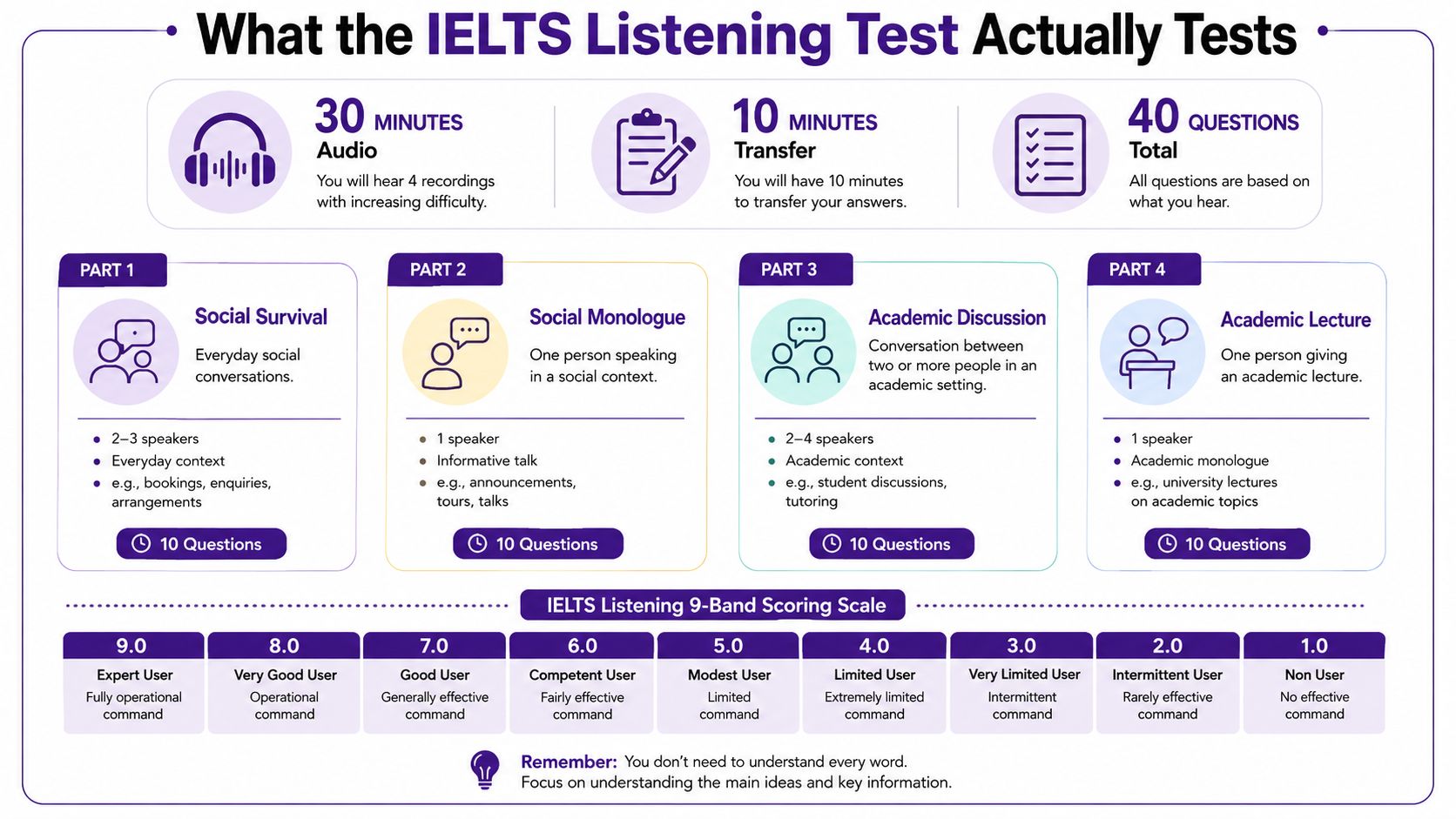
A higher IELTS Listening practice test score comes from accurate processing, not memorized tricks. The Listening test contains 40 questions across four parts, with 10 questions each, and every correct answer earns 1 mark official listening format. Listening is the same for Academic and General Training. On IELTS on computer, you enter answers directly on screen while listening, so there is no 10-minute paper transfer stage. In markets that still temporarily offer paper during the transition, the older paper workflow may still appear for a limited period, but the direction of travel is clearly computer-first official test delivery update British Council Japan market notice. Wrong answers carry no penalty, so answer every question and focus your practice on increasing correct responses official listening scoring.
The test changes context and difficulty in a planned sequence. Part 1 presents an everyday social conversation, Part 2 an everyday social monologue, Part 3 an educational or training conversation, and Part 4 an academic monologue official listening format. Candidates who practise only easy conversations often lose control when Part 3 introduces several speakers or Part 4 delivers dense lecture-style information.
Your target band should determine how you review each test. Official score conversion places 30 to 31 correct answers typically at Band 7.0, 35 to 36 at Band 8.0, and 39 to 40 at Band 9.0 official listening scoring. That makes raw-score tracking more useful than relying on an estimated band. A learner targeting Band 7 should identify the errors preventing roughly three-quarters accuracy, while a Band 8 target requires much tighter control of detail.
Practical rule: a useful practice test should reproduce the part sequence, the one-play audio format, and the answer-entry method you will use on test day. Audio practice without error analysis will not show which mistakes are holding back your band.
For a structured starting point, Cathoven's IELTS Listening page offers IELTS-format listening practice with instant scoring, detailed explanations, transcript highlights, and coverage of all four sections. Use that structure differently at each level: build control of Parts 1 and 2 at a lower band, then give more review time to Parts 3 and 4 as you approach a higher target.
Best Sources for Authentic IELTS Listening Practice Tests
Authentic material beats a large pile of weak practice tests. If the audio, question design, and timing differ from the exam, repeated practice can reinforce poor habits, especially in Parts 3 and 4. Build your resource mix in a clear order: official material for calibration, broader practice banks for repetition, and fast feedback tools for daily correction.
Start with official sources. The official listening test format sets the standard for sections, timing, and task design. Judge every other resource against that baseline. Use official samples for an exam-faithful warm-up and a full practice platform with realistic design when you need a score check.
| Resource | Type | Cost | Timing | Scoring details | Best use case |
|---|---|---|---|---|---|
| IELTS.org Listening format and sample tasks | Official format guide | Free | Mirrors the standard 4-part, 40-question listening structure | Explains official format and raw-score basis, not a full auto-scored mock | Format calibration and first-pass familiarity |
| British Council free Listening practice tests | Official practice set | Free | Individual tasks can be practised in a timed way, but the full computer practice experience is not the same as a fully timed live test delivery simulation | Answers provided for self-checking, not a guaranteed live-test score simulation | Official-style practice and question-type review |
| IDP free Listening practice questions | Official practice set | Free | Based on the official listening format, useful for short targeted practice | Answer checking provided, useful for raw-score review by question set | Targeted drilling by task type |
| IELTS Ready by the British Council | Official prep platform | Varies by region and booking status | Designed for test preparation across skills, with computer-based familiarity support | Includes guided score feedback depending on access level and package | Structured official prep if you want one platform |
| Cathoven IELTS Listening | Exam-format practice platform | See Cathoven pricing | Built for IELTS-format listening practice across all four sections | Instant practice scoring, detailed explanations, transcript highlights, and section coverage for targeted review | Daily practice, fast feedback, and error diagnosis |
Choose the resource based on your current band and target. At a lower band, use guided sets and shorter drills to build control before spending full tests. Near Band 7, use timed mocks to expose recurring errors. For a higher target, reserve your best official materials for score checks and use larger practice banks for repetition. Review every wrong answer instead of rushing into another test.
For a broader resource map, use this guide to IELTS preparation websites to assemble a focused practice stack. Select resources that match the mistakes found in your latest test, then measure progress through raw scores and error patterns rather than hours completed.
Understanding Question Types and Where Marks Are Lost
Question type predicts your mistakes better than accent or speed. The IELTS Listening test assesses whether you can hold the task in mind while a speaker changes direction, corrects an earlier point, or gives the answer through paraphrase. Build your diagnosis around the question format, then match practice to the errors blocking your current band and target score.
The six formats that cause the most pain
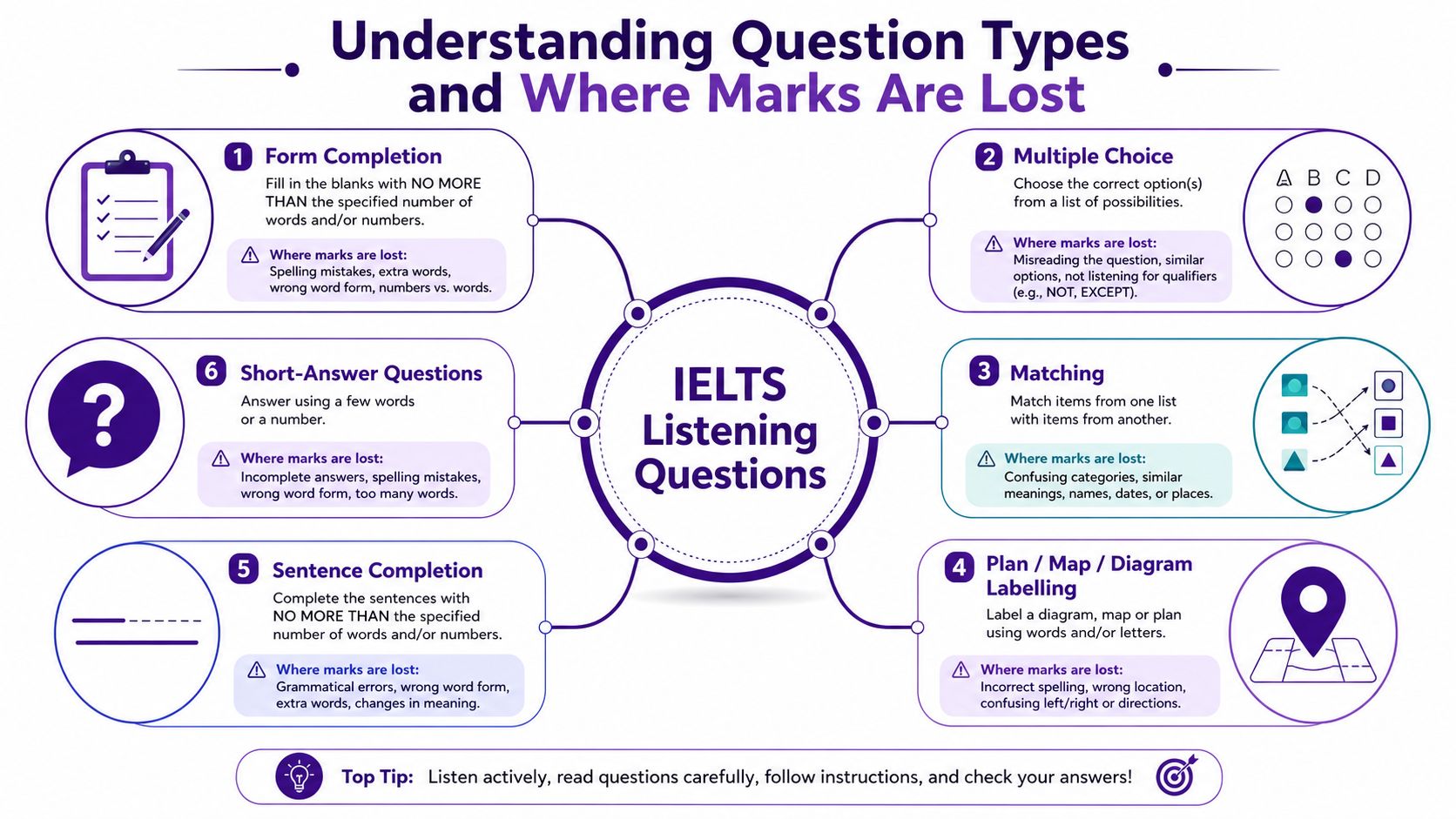
The main formats are form completion, multiple choice, matching, plan, map, or diagram labelling, sentence completion, and short-answer questions. Each creates a distinct route to lost marks.
Form completion: spelling and word-limit errors are common.
Multiple choice: distractors mislead you when the speaker revises an idea mid-sentence.
Matching: paraphrase separates the audio from the options, so word-for-word listening fails.
Plan or map labelling: changing directions and position language make sequence tracking difficult.
Sentence completion: the answer must fit the grammar, including singular, plural, and part of speech.
Short-answer questions: writing too much can make you miss the precise word required.
Follow the official instructions closely. Check the exact word limits, use surrounding grammar to predict singular or plural forms, and keep moving because questions follow a sequence official guidance on listening practice. Marks disappear through these small execution errors, not through an undefined lack of listening ability.
The score loss usually happens before the answer is entered. The learner hears the right information, then types or writes the wrong form of it.
Log every wrong answer by question type and error cause. A missed multiple-choice item requires a different correction from a missed sentence-completion item, even if both appeared in the same part. Record whether the problem was a distractor, paraphrase, spelling, grammar, or sequencing. Then choose drills that target the pattern before attempting another full test.
This approach turns practice hours into measurable progress. Track raw scores against your target, but also demand fewer repeated errors. A higher result without better control may reflect familiar material.
Building a Four-Week Practice Test Routine
A good IELTS Listening practice test routine produces evidence, not just completed tests. Build it around a baseline, targeted correction, stamina work, and a final readiness check. Match each week's workload to the mistakes blocking your current score, so practice hours lead to measurable band gains.
Week one establishes your baseline
Begin with one full timed test using an official-format source. Treat the result as a diagnostic, not a verdict. Record the raw score out of 40, then label each wrong answer by cause, such as spelling, distractor, paraphrase miss, or timing lapse. Identify the section with the greatest effect on your total and make it the first priority.
Review the format before starting, including the progression from Part 1 to Part 4, so your practice conditions reflect the actual computer test. The full mock test guide can help you organise timing, scoring, and review without turning preparation into random repetition.
Week two targets weak performance
Complete two tests in the week, with deliberate review between them. Use the first test to select drills and the second to check whether those corrections hold. Give particular attention to Part 2 and Part 3, where signposting and distractors can demand closer control.
Track two outcomes: the raw score and the recurring error pattern. A score increase matters more when the same mistake has stopped appearing across later attempts.
Week three builds exam control
Run one full test under strict timing, then add focused section practice. Concentrate on answer entry, because recognising the information is only part of the task. If plural forms, word limits, or rushed typing continue to cost marks, practise entering accurate answers under pressure rather than completing more tests without review.
Keep the drills short and specific. Correct one error pattern, test it again, and record the result.
Week four confirms readiness
Take two full mock tests in exam conditions and compare both with your baseline. Then review your error log as a coach would. Look for decisions you repeat, not isolated slips.
Useful checkpoint: if you can't explain why an answer was wrong, you don't know how to fix it yet.
A four-week cycle turns practice into measurable evidence. Use the test as a measurement tool, then adjust the next cycle according to your score and the errors that still remain.
Matching Practice Tests to Your Current Band Level
Your practice material should match both your current band and the mistake keeping you from your target. A Band 5 learner needs controlled accuracy work, while a Band 7 candidate needs pressure, speed, and sustained concentration. Using the same IELTS Listening practice test for everyone wastes study time because a correct score does not explain which skill needs attention.
Band 5 learners need shorter, cleaner wins
Start with short Part 1 and Part 2 drills, particularly form completion and sentence completion. Use each exercise to correct plural endings, word limits, and spelling. If the answer is “books” and you write “book,” the missed mark reflects answer precision, not only listening ability.
Choose material that lets you hear the key information, enter it accurately, and identify the exact point of failure. Raise the difficulty after these errors become less frequent, not just because the shorter drills feel familiar.
Band 6 learners need full-format exposure
Move to full-format practice tests once the basic accuracy is steadier. Completing the entire test reveals whether you can maintain concentration and apply the same control across all four parts. Band 6 learners often understand the general meaning but lose marks through paraphrase recognition problems and distractors in matching or multiple-choice questions.
Review every missed answer by comparing the wording in the recording with the wording in the question. Record the changed idea, synonym, or misleading option that caused the error. That log should determine your next practice set.
Band 7 and above need pressure, not comfort
Higher-level candidates should increase difficulty and time pressure rather than complete more comfortable tests. Prioritise Part 3 and Part 4 stamina work, alongside lecture-style listening that requires you to hold connected ideas across longer stretches. Inference speed matters because hesitation can make you miss the next item and its sequence.
| Current Band | Recommended Resources | Focus Skill |
|---|---|---|
| Band 5 | Short section drills and controlled practice | Spelling, plurals, and word limits |
| Band 6 | Full-format mock tests | Paraphrase recognition and distractor control |
| Band 7 and above | Harder timed listening and lecture-style audio | Inference speed and stamina |
Increase difficulty when your current errors are stable, not when boredom appears.
Match the resource to the mistake pattern and target band. That approach turns practice hours into measurable progress instead of repeated errors.
Smart Ways to Use Practice Tests Every Day
Daily practice should follow a fixed structure. An IELTS Listening practice test produces useful progress only when each session connects to your current band level, target score, and recurring mistakes. Repeating full tests without that match trains repetition, not improvement.
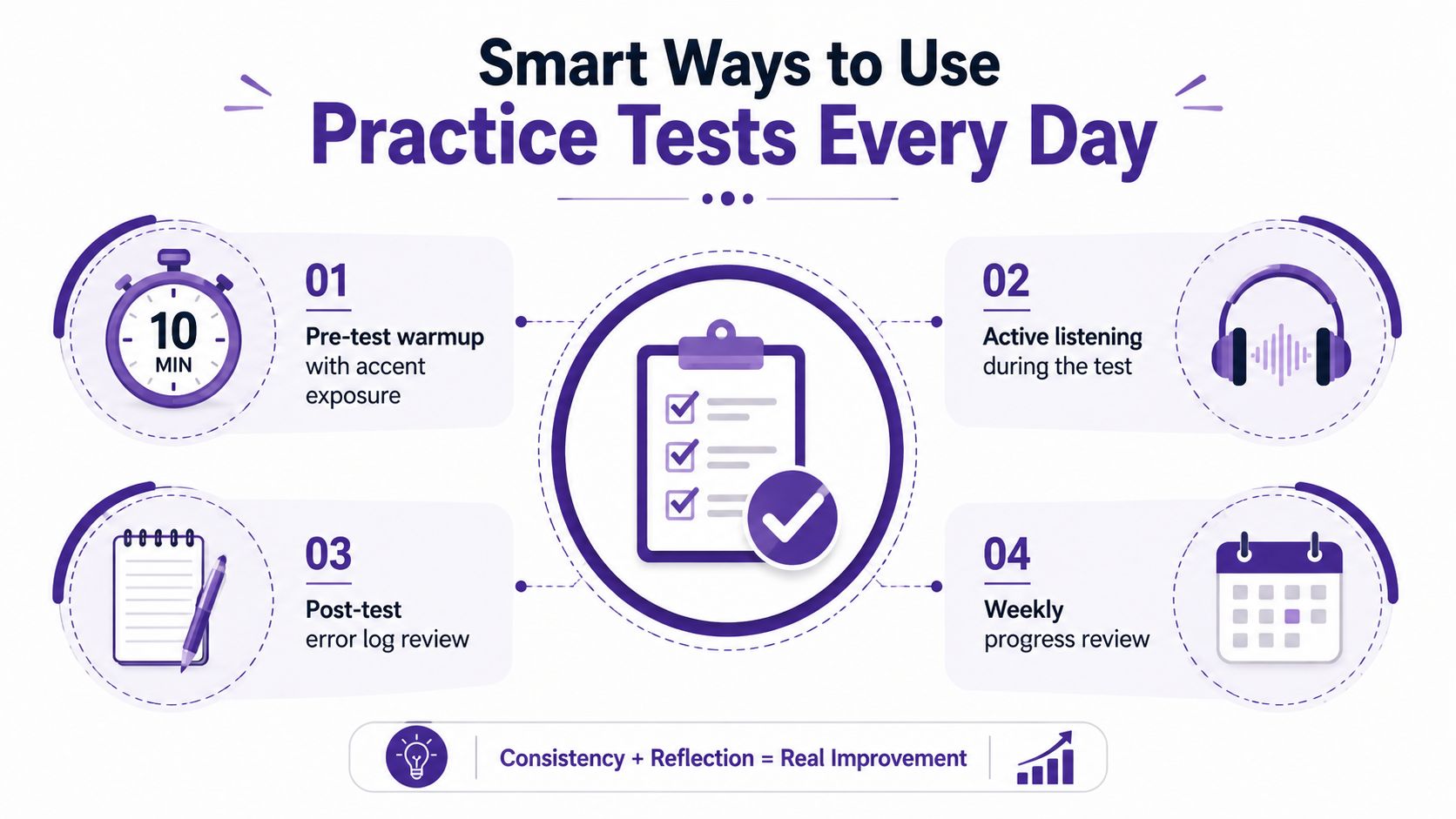
Start with a consistent warm-up
Use a short ear-tuning block before each test. Rotate general accent exposure and keep the volume moderate, so the recording's pace does not catch you unprepared. Band 5 learners should use this time to notice spelling, plural endings, and word limits. Stronger candidates should focus on following connected ideas and predicting the next answer.
Protect easy marks while answering on screen
On IELTS on computer, avoid easy losses by checking spelling, singular and plural forms, and whether each response fits the required form before moving on. Because you are typing answers directly during the test, accuracy under time pressure matters more than any end-of-test transfer habit. If your market still briefly offers paper during the transition, follow the local test-day rules, but train primarily for the computer workflow official test delivery update.
Review by error type
First, replay missed items with the transcript visible. Mark the exact point where the recording differs from the question. Then listen again without the script. If the answer remains unclear, label the problem as prediction, paraphrase recognition, distractor control, or attention rather than blaming the audio.
Choose the next practice set from that label. A Band 5 learner who repeatedly loses spelling marks needs controlled section drills, while a Band 6 learner losing marks to paraphrases needs full-format tests and focused review. Candidates targeting Band 7 or above should select harder timed listening and lecture-style audio, especially for Parts 3 and 4.
Cathoven is one option for practice with IELTS-format listening, instant practice scoring, detailed explanations, transcript highlights, and all four sections Cathoven listening page.
My rule: complete no more than two full tests in one day. Fatigue disguises careless errors as useful patterns.
End every session with one action for tomorrow. Write the mistake you will prevent, then stop. This routine turns practice hours into measurable band progress instead of another collection of repeated errors.
Tracking Progress and Reaching Your Target Band
A Listening score becomes useful only when you track the evidence behind it. Record each result instead of relying on how confident you felt after the session. A log shows whether your mistakes are changing or whether an easier practice test created false confidence.
What to record after every test
Use a five-column table: date, source, raw score out of 40, converted band, and error category. Make the final column precise. Use labels such as spelling, paraphrase miss, distractor loss, or timing failure. After four tests, calculate a rolling 4-test average. Use that figure as a study heuristic, not as a formal prediction of your official result.
A single strong score can flatter your progress, especially if the material felt familiar or the error types happened to suit you. Repeated tests give you a steadier view of whether your performance is moving toward the target band.
Know when to change the plan
A rolling 4-test average that stalls for two consecutive weeks is a useful sign that your plan may need to change. Stop adding random full tests. Match the next resource to the error pattern and target score: use section-specific drills for a Band 5 learner with recurring spelling or timing losses, then return to full-format tests after those weaknesses improve. A Band 6 learner who misses paraphrases needs targeted review and timed practice. Candidates aiming for Band 7.0+ should include demanding Parts 3 and 4 work, where concentration and interpretation matter most.
The number of completed tests is not the goal. A useful evaluation system measures skill movement and changing error patterns. Apply the same standard to IELTS practice: completion counts only when the mistake pattern changes.
Reaching Band 7.0+ requires accurate diagnosis and consistent review. Schedule the next practice test, record the result, compare it with your rolling average, and choose the next exercise from the errors you made.
Cathoven provides structured, exam-format listening practice with instant scoring, detailed explanations, transcript highlights, and coverage of all four sections Cathoven listening page. Use it to turn raw attempts into a focused study plan, then review each result before taking another test.