IELTS Band Score Calculator: How Scores Are Calculated
You finish a practice test, count your correct answers, and open an IELTS band score calculator. Then the confusion starts. Should you enter raw marks for every skill? Why does one calculator say 6.5 and another say 7.0? Why can two small decimal points change the final result?
Most candidates don't need more motivation. They need clean scoring math. If you understand the input for each skill and the rounding rule at the end, you can check your own numbers with confidence instead of guessing.
Overall band formula: (Listening + Reading + Writing + Speaking) ÷ 4, then round to the nearest whole or half band using official IELTS rules (official IELTS scoring in detail).
Table of Contents
- Academic Reading examples published by IELTS
- Worked conversion
- Where candidates go wrong
What the IELTS Band Score Calculator Tells You
An IELTS band score calculator helps you answer three practical questions after a test. First, what band do your Listening and Reading raw marks convert to? Second, what band might your Writing and Speaking performance earn once the criteria are averaged? Third, what overall band do those four skill scores produce once the final rounding rule is applied?
That sounds simple, but the calculator only works if you enter the right kind of score for each skill. Listening and Reading usually begin as raw correct answers. Writing and Speaking don't. Those start as examiner-rated criterion scores.
What a useful calculator does
A reliable calculator should help you do these jobs:
Convert raw marks correctly: It should treat Listening and Reading as answer counts first, then convert those counts into band scores.
Handle criterion scoring: It should let you estimate Writing and Speaking from the assessment criteria rather than from raw correct answers.
Apply the final rounding rule: It should average the four skill bands and then round to the official overall result.
Practical rule: The calculator is only as accurate as the input model you use. Raw marks belong to Listening and Reading. Band estimates belong to Writing and Speaking.
The 0–9 Band Scale and What Each Band Means
IELTS uses a 0 to 9 band scale in half-band steps, which creates 19 possible outcomes for both component scores and the overall score, from 0.0 to 9.0 (official scoring calculator guidance). That scale feels abstract until you attach behavior to each band.
IELTS 0–9 Band Scale at a Glance
| Band | Plain-Language Descriptor | Example Phrase |
|---|---|---|
| 9 | Expert command with accurate, fluent use in almost all situations | "I can discuss complex ideas clearly and naturally." |
| 8 | Very strong command with only occasional slips | "I speak fluently, with rare mistakes." |
| 7 | Operational command with some inaccuracies or misunderstandings | "I handle most tasks well, but not perfectly." |
| 6 | Effective command with noticeable errors, especially under pressure | "I communicate clearly, though mistakes are still visible." |
| 5 | Partial command of English in familiar situations | "I can manage everyday meaning, but control is uneven." |
| 4 | Basic competence limited to familiar topics | "I understand simple points, but complex language breaks down." |
| 3 | Extremely limited use, with communication only in very basic fragments | "I can say a little, but not sustain meaning." |
| 2 | Intermittent user with isolated words or short formulaic responses | "I know some words, but communication is very restricted." |
| 1 | Non-user apart from a few memorized items | "I can only produce learned phrases." |
| 0 | No attempt to answer | "No language produced." |
How to use the scale
The band isn't just a label. It tells you the level of control you showed in that skill. A 6 in Writing doesn't mean failure. It means the writing is effective, but errors still affect precision or consistency. A 7 in Speaking means the speaker can function well, though small inaccuracies still appear.
That matters when you set a target. If you need a higher band, you're not chasing a vague number. You're trying to show more stable control.
How the Overall Band Is Calculated
The overall IELTS band is calculated in one fixed way. You take the arithmetic average of the four skill scores, Listening, Reading, Writing, and Speaking, then round the result to the nearest whole or half band (official IELTS scoring in detail).
Each skill contributes equally, so each one effectively counts for 25% of the final result (official calculator explanation).
Example one
Use these scores:
Listening: 7.5
Reading: 6.5
Writing: 6.0
Speaking: 7.0
Now do the arithmetic step by step:
Add the four scores
7.5 + 6.5 + 6.0 + 7.0 = 27.0Divide by 4
27.0 ÷ 4 = 6.75Apply the rounding rule
An average ending in .75 rounds up to the next whole band, so 6.75 becomes 7.0.
Example two
Use a second score profile:
Listening: 7.0
Reading: 6.5
Writing: 6.0
Speaking: 7.0
Now calculate:
Add the scores
7.0 + 6.5 + 6.0 + 7.0 = 26.5Divide by 4
26.5 ÷ 4 = 6.625Round to the nearest half band
6.625 becomes 6.5
A lot of confusion comes from treating IELTS like ordinary decimal rounding. IELTS doesn't report results like 6.6 or 6.8. It reports only whole bands and half bands.
Why .25 and .75 matter
The official rule is precise. An average ending in .25 rounds up to the next 0.5 band, and an average ending in .75 rounds up to the next whole band (official IELTS scoring rule).
That means:
6.24 rounds down to 6.0
6.25 rounds up to 6.5
6.74 rounds down to 6.5
6.75 rounds up to 7.0
Institutions read the rounded overall band, not the unrounded mean.
Listening and Reading vs Writing and Speaking Inputs
Most calculator mistakes begin at the input stage. Candidates assume every skill starts with the same kind of score. It doesn't.
Listening and Reading usually begin with a raw count of correct answers. Writing and Speaking begin with criterion-level band judgments.
Input models for each IELTS skill
| Feature | Listening and Reading | Writing and Speaking |
|---|---|---|
| Input | Raw correct answers | Criterion band scores |
| Source | Objective answer key | Examiner judgment |
| Output | One band from a conversion table | One band from averaging criteria |
| Common entry style | 30 out of 40 | Bands such as 7, 6, 6, 5.5 |
The practical difference
If you answer 30 out of 40 questions correctly in a Reading paper, that number is not yet your final IELTS band. It must first be converted through the appropriate table.
If a Writing response receives criterion bands such as Task Achievement 7 and Coherence 6, those are already on the IELTS band scale. They don't need a raw-mark table. They need averaging.
Here is the simplest contrast:
Listening and Reading: count answers, then convert
Writing and Speaking: score criteria, then average
A calculator that mixes those models will give a wrong result even if the math itself is correct.
Listening and Reading Raw Score Conversion Worked Examples
Listening and Reading are the only two skills where many candidates begin with a raw score. That's why calculators often provide separate input boxes for these sections before converting to a band.
Official IELTS guidance explains the overall rounding rule, but raw-score conversion tables shown online should be treated as estimates for practice use, not as permanent one-to-one promises for every test version. They are useful for planning, but exact raw-to-band interpretation can vary by module and source (official scoring calculator guidance).
Academic Reading examples published by IELTS
Instead of relying on broad unofficial ranges, use the limited examples IELTS publishes directly. IELTS states that in Academic Reading, a score of 30 correct answers out of 40 is typically about Band 7, and in Listening, 30 out of 40 is also typically about Band 7 (official IELTS scoring in detail).
That example is useful for orientation, but it is still not a full official conversion table for every possible raw score.
Worked conversion
Suppose your Academic Reading raw score is 30 out of 40.
Using the example published by IELTS:
- 30 correct answers out of 40 in Academic Reading = typically Band 7
So your Reading estimate is about Band 7, based on the official example.
Now take a Listening example. IELTS gives the same published example here:
- 30 correct answers out of 40 in Listening = typically Band 7 (official IELTS scoring in detail)
For raw scores beyond those published examples, treat third-party conversion tables as planning aids rather than official guarantees.
Where candidates go wrong
The biggest trap is assuming one Reading table fits every version of the exam. It doesn't. General Training Reading uses a different conversion pattern from Academic Reading, so the calculator should let you choose the correct module.
Check this first: If your Reading raw mark looks reasonable but the band looks strange, confirm that you selected Academic or General Training correctly before doing anything else.
Writing and Speaking Criterion Scoring Explained
Writing and Speaking don't start with raw correct answers. They are judged through criteria, but Writing is assessed as two separate tasks. Task 2 counts twice as much as Task 1, so your final Writing band is not a simple average of two task scores. Official IELTS guidance states that Writing Task 2 is worth double Writing Task 1 (official IELTS scoring in detail).
For each Writing task, examiners assess four criteria:
Task Achievement or Task Response
Coherence and Cohesion
Lexical Resource
Grammatical Range and Accuracy
For Speaking, examiners assess four equally weighted criteria:
Fluency and Coherence
Lexical Resource
Grammatical Range and Accuracy
Pronunciation
Writing and Speaking assessment criteria at a glance
| Criterion | Writing focus | Speaking focus |
|---|---|---|
| Task achievement or response | How fully the task is answered in Task 1 or Task 2 | Not used in Speaking |
| Coherence and cohesion | Organization, linking, clarity | Fluency and coherence in spoken delivery |
| Lexical resource | Vocabulary range and appropriateness | Vocabulary range and appropriateness |
| Grammatical range and accuracy | Sentence control and accuracy | Grammar control and accuracy |
| Pronunciation | Not used in Writing | Clarity and naturalness of speech sounds |
If you want a closer look at how these ideas show up in real task performance, this guide to IELTS Writing Task 1 is a useful companion.
Worked Writing example
Suppose you estimate the two Writing tasks separately.
Task 1 criterion bands:
Task Achievement = 6
Coherence and Cohesion = 6
Lexical Resource = 5.5
Grammatical Range and Accuracy = 5.5
Task 1 mean:
Add the scores
6 + 6 + 5.5 + 5.5 = 23.0Divide by 4
23.0 ÷ 4 = 5.75
Task 2 criterion bands:
Task Response = 7
Coherence and Cohesion = 6.5
Lexical Resource = 6.5
Grammatical Range and Accuracy = 6
Task 2 mean:
Add the scores
7 + 6.5 + 6.5 + 6 = 26.0Divide by 4
26.0 ÷ 4 = 6.5
Now weight Task 2 twice as heavily, using the task means:
Apply the weighting
(Task 1 5.75 + Task 2 6.5 + Task 2 6.5) = 18.75Divide by 3
18.75 ÷ 3 = 6.25Round the weighted mean to the nearest half band for this practice estimate.
Estimated Writing band = 6.5
This example is a planning model, not a statement that IELTS officially rounds each task score before combining them. The key official point is that Task 2 carries double weight in the final Writing band (official IELTS scoring in detail).
What to watch for
A calculator that treats Writing as one single equally weighted block, or that ignores the extra weight of Task 2, will misstate the result. That's especially important near threshold points.
Writing and Speaking are easy to misjudge because the starting scores already look like final bands, but they still need the correct averaging and rounding steps.
Why Module-Specific Conversions Matter for Planning
Many candidates treat a calculator as a final-answer machine. It's more useful as a diagnostic tool.
Official IELTS guidance is strongest on final band calculation and rounding. For raw-score conversions in Listening and Reading, use practice tables as planning estimates rather than as fixed promises across every paper (official scoring calculator guidance).
The planning lesson is straightforward. If you score 28 out of 40 on Listening, don't write only the band estimate in your notebook. Record the raw count, the test date, and the form or source if available.
Why that changes study decisions
That habit helps you see more than one headline number:
Weak item types: You may lose marks mostly on matching or multiple choice.
Timing pressure: Your score may fall late in the paper, not evenly across the section.
Careless errors: Short-answer or fill-in mistakes can hide inside an otherwise solid attempt.
A form-aware calculator helps you analyze where marks are lost. A simple overall score can't do that on its own.
Worked Calculator Examples Across Three Score Profiles
The fastest way to understand an IELTS band score calculator is to run several profiles through the same arithmetic template. Once you see how the rounding threshold behaves, the pattern becomes much easier to trust.
Three Score Profiles Run Through the Calculator
| Profile | Listening | Reading | Writing | Speaking | Mean | Rounded Overall |
|---|---|---|---|---|---|---|
| A | 7.5 | 7.0 | 6.5 | 7.0 | 7.0 | 7.0 |
| B | 7.0 | 6.5 | 6.5 | 7.0 | 6.75 | 7.0 |
| C | 6.5 | 6.5 | 6.0 | 6.5 | 6.375 | 6.5 |
Profile A
Input scores:
Listening = 7.5
Reading = 7.0
Writing = 6.5
Speaking = 7.0
Arithmetic:
7.5 + 7.0 + 6.5 + 7.0 = 28.0
28.0 ÷ 4 = 7.0
Rounded overall = 7.0
Nothing special happens here because the mean is already a final reportable band.
Profile B
Input scores:
Listening = 7.0
Reading = 6.5
Writing = 6.5
Speaking = 7.0
Arithmetic:
7.0 + 6.5 + 6.5 + 7.0 = 27.0
27.0 ÷ 4 = 6.75
Rounded overall = 7.0
This is the threshold profile many candidates miss. The mean sits exactly at .75, so it rises to the next whole band.
Profile C
Input scores:
Listening = 6.5
Reading = 6.5
Writing = 6.0
Speaking = 6.5
Arithmetic:
6.5 + 6.5 + 6.0 + 6.5 = 25.5
25.5 ÷ 4 = 6.375
Rounded overall = 6.5
This profile does not reach 7.0 because the mean doesn't touch the .75 threshold.
If you want to test these combinations under realistic conditions, a full IELTS full mock test online can give you score inputs that feel closer to exam day performance.
One half-band shift in a single skill can change the overall result only if it moves the average across a rounding threshold. That's the number to watch.
Common Miscalculations and How to Avoid Them
Most score errors aren't advanced math problems. They're input mistakes.
Four Common Miscalculations Compared
| Mistake | Wrong Calculation | Correct Calculation | Band Impact |
|---|---|---|---|
| Using invalid score steps | Entering values not used as valid IELTS band steps | Use whole or half-band values only | Can produce an impossible result |
| Dropping one skill | Add 3 skills and divide by 3 | Add all 4 skills and divide by 4 | Usually inflates the average |
| Using normal decimal rounding | 6.75 becomes 6.8 | 6.75 becomes 7.0 | Changes the reported overall band |
| Mixing Reading tables | Using the wrong Reading module table | Match Academic or General Training correctly | Can shift the band outcome |
Quick audit before you trust the output
Check the input type: Raw marks for Listening and Reading. Band scores for Writing and Speaking.
Count all four skills: Never divide by three.
Check the rounding model: IELTS reports whole bands and half bands only.
Check the Reading module: Academic and General Training don't use the same raw-score table.
A one-minute audit can prevent a false target and a lot of unnecessary stress.
Reading an IELTS Band Score Report
When you receive a Test Report Form, read it from top to bottom. The top area contains the candidate identification block, including the personal details used to verify the record. Below that, the four skill scores appear separately: Listening, Reading, Writing, and Speaking.
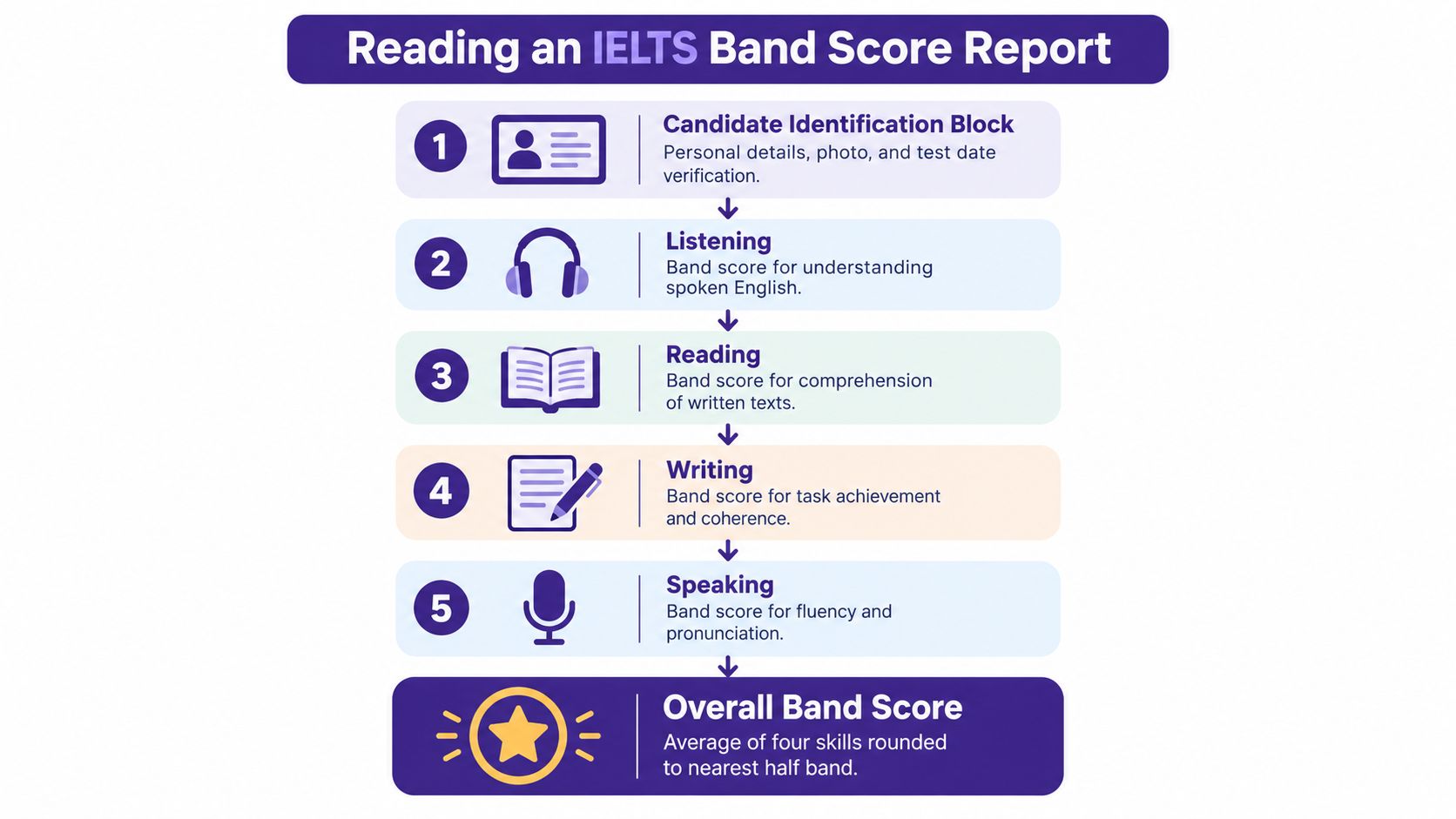
Each skill has its own band score. Then, in a separate box, you see the Overall Band. That overall number summarizes the four component bands into one admissions-friendly result.
Institutions don't only look at the overall band. They often read the component bands first. A profile with a stronger spread across all four skills may be interpreted differently from one with the same overall band but a weaker Writing or Speaking score.
Later on the form, you'll also find details such as the TRF number, test date, and centre code, which help confirm authenticity. The CEFR mapping and centre validation marks appear in their own places, so it's worth learning where your eye should go first.
A short walkthrough helps if you've never studied the form carefully:
Working Backwards From a Target Overall Score
A good calculator doesn't only tell you what you got. It also helps you test what you need.
Start with the target overall score, then work backward into possible four-skill combinations. If your target is 7.0, the simplest equal-skill profile is easy:
7.0 + 7.0 + 7.0 + 7.0 = 28.0
28.0 ÷ 4 = 7.0
Target Overall Band and Required Skill Combinations
| Target Overall | Example Mixed Profile | Equal-Skill Profile | Notes |
|---|---|---|---|
| 7.0 | 6.5, 6.5, 6.5, 8.0 | 7.0, 7.0, 7.0, 7.0 | This mixed profile works because the mean rounds up |
| 6.5 | 6.0, 6.5, 6.5, 7.0 | 6.5, 6.5, 6.5, 6.5 | This mixed profile reaches 6.5 without every skill being 6.5 |
Now test the mixed profile for 7.0:
6.5 + 6.5 + 6.5 + 8.0 = 27.5
27.5 ÷ 4 = 6.875
Rounded overall = 7.0
That works.
Now test the mixed profile for 6.5:
6.0 + 6.5 + 6.5 + 7.0 = 26.0
26.0 ÷ 4 = 6.5
Rounded overall = 6.5
This is exactly why backward planning matters. A profile that looks "close enough" can still land below the result you hoped for if one skill slips.
For candidates also comparing broader level labels with IELTS goals, this guide on how to convert your CEFR level to IELTS can help frame the target more realistically.
How to use backward planning well
Set the floor first: Decide the lowest score you can afford in your weakest skill.
Protect the spread: Don't let one section fall far below the others.
Use safer targets: If you need 7.0, aim for inputs that produce more than a borderline mean.
IELTS Band Score Calculator Questions Answered
Does the calculator differ between Academic and General Training
Yes, but only in Reading raw-score conversion. Listening, Writing, and Speaking use the same scoring structure across the two modules.
Can a calculator predict Writing or Speaking from raw correct answers
No. Writing and Speaking don't use raw answer counts. They depend on criterion-based examiner judgment.
Can you reuse one raw score from one practice paper as a fixed future target
Not safely. Raw counts are tied to the specific test form or practice version, so they aren't fully transferable across every paper.
Can two calculators disagree
Yes. The most common reason is different rounding logic. One may apply the official whole-and-half-band rule correctly, while another may treat decimals too loosely. Cathoven is one option that supports IELTS preparation with calculator-style score estimates, criterion-based feedback, and structured practice across the four skills.
If you want to turn score math into a study plan, Cathoven offers IELTS-format practice, band estimates, and criterion-level feedback for Writing and Speaking. It's useful when you don't just want a number, but also want to see which skill is holding that number down.