IELTS Exam Coaching Formats Compared
You've booked the test, set a target band, and downloaded enough practice material to fill your schedule. Yet your Writing score still sits below the requirement, your Speaking practice feels unstructured, and every coaching provider promises a different path to improvement. The sensible question isn't "Which course has the most features?" It's which feedback and accountability system will correct your specific weaknesses before test day.
Quick answer, which coaching format fits best?
If you want the shortest answer, choose the format that matches the kind of help you actually need:
In-person coaching is usually best for candidates who need external structure, real-time Speaking pressure, and a fixed study routine.
Live online coaching is usually best for candidates who want human feedback on Writing and Speaking without travel or location limits.
AI-assisted coaching is usually best for candidates who need frequent practice, fast responses, and lower-cost repetition, ideally with human review added for higher-stakes weaknesses.
Many candidates benefit from a blended approach: automation for practice volume, plus human review for judgment, explanation, and accountability.
Table of Contents
- Quick answer, which coaching format fits best?
- What the Right Coaching Decision Looks Like
- What Effective IELTS Exam Coaching Includes
- In-Person, Online, and AI-Assisted Coaching Compared
- How to Evaluate Coaching Price and Value
- Matching Coaching to Your Goal, Baseline, and Deadline
- Situational Recommendations for IELTS Candidates
What the Right Coaching Decision Looks Like
A working professional wants Band 7.0 and has eight weeks before the test. Her Listening and Reading practice is close to target, but she loses marks in Writing because her arguments drift and her examples lack development. She doesn't need a long general English course. She needs a diagnostic, regular Task 2 review, occasional Speaking checks, and a study routine that fits around work.
An undergraduate applicant has two months left and keeps scoring Band 5.5 in Writing. His problem is broader. He misunderstands parts of the task, uses paragraphs inconsistently, and makes grammar errors that affect clarity. Paying for the same package as the professional could produce a very different result because he needs foundational correction, repeated guided practice, and close monitoring rather than occasional polishing.
The budget might be identical, but the useful purchase isn't. The professional should spend more of it on high-quality feedback per submission, while the undergraduate should spend more on structured instruction and accountability. A large video library won't solve either problem if nobody identifies the error pattern and checks whether the candidate stopped repeating it.
Compare the decision before the course
| Candidate | Main gap | Sensible use of coaching budget | Poor purchase |
|---|---|---|---|
| Working professional targeting Band 7.0 | Writing precision and limited study time | Focused reviews, flexible practice, scheduled accountability | A fixed full-time class with extensive material she already knows |
| Undergraduate at Band 5.5 in Writing | Task response, coherence, grammar, and confidence | Human-led correction, guided rewrites, regular progress checks | Unlimited practice without explanations or correction |
IELTS coaching works best as a feedback loop. You attempt a task, receive criterion-level feedback, revise it, and complete a related task to test whether the correction transferred. Speaking follows the same logic: record a response, identify problems with fluency, organization, vocabulary, or grammar, then repeat under a similar prompt.
A peer-reviewed study published in 2021 examined 89 Chinese speakers of English in Shanghai who were tested twice, four weeks apart. 45 received intensive IELTS coaching and 44 served as an uncoached comparison group. The coached group improved by an average of about 0.6 band, with larger gains among lower baseline scorers, but the improvement did not generalize clearly to broader English measures beyond IELTS performance (peer-reviewed study of IELTS coaching). The useful limitation is just as important as the result: this was a short, four-week intervention at one large Shanghai test-preparation centre, so you should treat it as evidence that targeted prep can improve test performance, not as proof that any course will reliably raise long-term language proficiency.
Practical rule: Buy the feedback you're currently missing, not the course catalogue that looks most impressive.
What Effective IELTS Exam Coaching Includes
Good IELTS exam coaching starts with a diagnostic, not a sales pitch. You need separate estimates for Listening, Reading, Writing, and Speaking, followed by an explanation of the tasks causing lost marks. A single overall score hides the difference between a candidate who needs language development and one who needs better timing or task control.
The four skills have different demands. IELTS includes Listening, Reading, Writing, and Speaking, and the total test time is 2 hours and 45 minutes. Listening, Reading, and Writing happen on the same day without breaks, while Speaking is a separate 11 to 14 minute interview. Depending on test delivery and location, that interaction may be conducted face to face with an examiner or by live video call with an examiner (official IELTS test format). Coaching should therefore include stamina practice and section-specific timing, not just general conversation or vocabulary work.
Feedback must match the scoring system
Writing feedback should refer to the public rubric. IELTS assesses Writing through four criteria that are equally weighted within each task: Task Achievement or Task Response, Coherence and Cohesion, Lexical Resource, and Grammatical Range and Accuracy. However, Task 2 counts twice as much as Task 1 when the final Writing band is calculated (IELTS Writing band descriptors, official IELTS scoring in detail).
That structure changes what useful correction looks like. "Add more vocabulary" is weak advice. "Your position is clear in the introduction but becomes uncertain in the second body paragraph, so Task Response and Coherence and Cohesion are affected" gives the learner an action. The tutor or system should then provide a rewrite task and check whether the same issue appears again.
Speaking practice should use the official three-part progression. Candidates answer introductory questions, deliver a solo long turn on a set topic, and then discuss broader ideas with the examiner. Useful preparation includes recorded responses, review of turn length, planning habits, pronunciation, and natural delivery under exam conditions (official IELTS Speaking format).
Practice volume needs structure
Reading and Listening drills should identify question-type errors, timing problems, distractors, spelling mistakes, and missed paraphrases. Vocabulary and grammar work should target weaknesses revealed by those tasks, rather than becoming a disconnected list of exercises.
A full mock test can help you rehearse timing and concentration, and an IELTS full mock test online can be useful when you need a realistic practice sequence. For learners who prefer structured digital exam practice, the value comes from immediate feedback and repeatable practice, but candidates still need to check whether the feedback addresses their actual target criteria.
Accountability closes the loop. It can come from scheduled classes, tutor check-ins, homework deadlines, or a progress dashboard. Without it, learners often repeat familiar exercises because repetition feels productive, even when it avoids the weakness holding back the score.
In-Person, Online, and AI-Assisted Coaching Compared
The three formats solve different problems. In-person coaching gives you immediate human interaction and a physical routine. Live online coaching preserves tutor contact while removing travel and location barriers. AI-assisted coaching increases practice volume and response speed, but it needs careful use when a task depends on nuanced argumentation or spoken interaction.
| Format | Feedback Quality | Flexibility | Consistency | Typical Cost Pattern | Accountability |
|---|---|---|---|---|---|
| In-person classes | Often strong for live Speaking drills and immediate clarification, but quality depends heavily on the tutor and class size | Lowest, because attendance follows fixed locations and times | Can vary between tutors and groups | Often higher once venue, schedule rigidity, and live teaching time are included, though local pricing varies widely | Strong when attendance is monitored |
| Live online coaching | Often strong for Writing conferences, Speaking interviews, and follow-up questions | High, with remote access and possible timezone flexibility | More consistent when sessions are recorded and plans are documented | Sometimes lower than comparable in-person instruction, but not always | Strong if sessions and homework are scheduled |
| AI-assisted practice | Fast, repeatable feedback across routine tasks, though human review remains valuable for complex reasoning and coherence | Highest, with on-demand practice | High for standardized workflows and repeated drills | Usually lower for high-volume practice than repeated one-to-one tutoring | Depends on progress tracking and the learner's discipline |
| Blended coaching | Combines automated volume with human judgment at selected points | High if the live component is limited and scheduled | Strong when the plan assigns clear roles to each format | Can be cost-efficient when human review is reserved for high-impact weaknesses | Strong when both practice and review are tracked |
In-person support
A classroom can be the right choice for a candidate who avoids independent study or needs real-time Speaking pressure. Peer responses also expose you to different accents and communication styles. The drawbacks are practical: fixed slots, travel, group pacing, and the possibility that a tutor spends time on weaknesses you don't share.
Ask how much individual Writing gets marked. A class can feel active while providing little personal correction if students mostly listen to explanations and complete exercises together.
Live online support
Live online tutoring is more adaptable. A tutor can review a paragraph on screen, conduct a Speaking mock, share a recording, and assign a precise revision task. It's particularly useful for candidates who need human explanations but can't attend a local centre.
The weakness is inconsistency if the provider changes tutors, skips written feedback, or treats each session as a separate lesson. Require a shared record of errors and a plan that carries from one meeting to the next.
AI-assisted and blended support
AI-assisted practice is strongest when you need frequency, instant response, and adaptive repetition. It can help you complete more Listening, Reading, Writing, and Speaking tasks without waiting for a tutor. However, an automated estimate shouldn't be treated as the final authority on a complex argument, subtle coherence problem, or strategic decision about your target.
A practical blended plan might pair daily digital drills with a weekly human Writing or Speaking review. Cathoven's AI tutor for IELTS practice is an example of a software-based option that combines guided practice, feedback, and progress-oriented preparation. The principle matters more than the label: use automation for volume, and reserve human time for judgment, explanation, and accountability.
How to Evaluate Coaching Price and Value
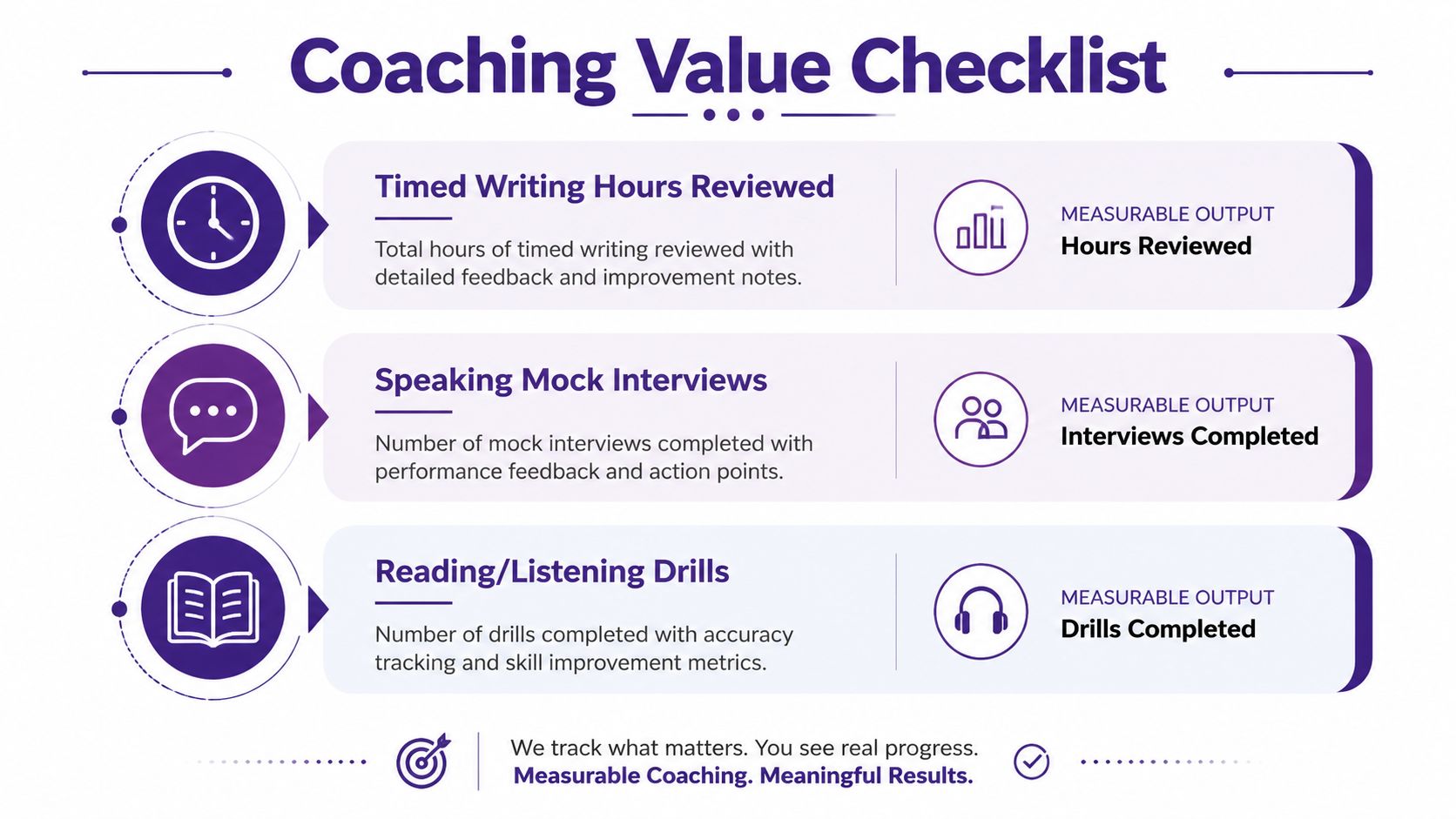
A course price tells you almost nothing until you translate it into usable output. Count the work that will be completed, reviewed, and repeated. A package with many lessons may deliver less value than a smaller plan that marks every Writing task and conducts targeted Speaking assessments.
Measure feedback, not access
Ask providers to specify:
Writing review: How many Task 1 and Task 2 responses will receive criterion-level comments, and can you submit a revision?
Speaking assessment: How many mock interviews are included, and will feedback cover the three-part format rather than general fluency?
Reading and Listening analysis: Will incorrect answers be grouped by question type, timing, paraphrase recognition, or careless error?
Turnaround: How quickly will you receive feedback, and can you use it before your next practice attempt?
Tutor standards: What training and IELTS-specific experience does the reviewer have?
Scoring alignment: Does the feedback explicitly use the official band descriptors?
Build a simple cost-per-feedback-hour calculation. Add the cost of tutor access, written marking, live review, and any required subscription, then divide the total by the amount of feedback you'll receive. Don't count passive video hours as equivalent to individualized correction.
Look for evidence of progress
A credible provider should establish a baseline before recommending intensity. The plan should track recurring errors, completed tasks, revised work, and skill-level movement. If you can't see what changed from one review to the next, you're buying activity rather than progress.
Red flags are easy to identify:
Guaranteed scores: No serious plan can promise a specific result without controlling your baseline, effort, attendance, and test conditions.
No diagnostic: A provider that enrols everyone into the same path can't match support to the actual gap.
Generic marking: Comments such as "improve grammar" don't tell you what to practise or how to verify improvement.
Duplicated materials: Bundled resources have little value if they reproduce information available through official channels.
No revision cycle: Feedback that never leads to a corrected second attempt won't reliably change your habits.
Budget test: If you can't describe the exact task you'll complete, the feedback you'll receive, and the next correction you'll make, don't pay for the package yet.
Value also depends on accountability. A structured study plan, scheduled progress check, homework review, and clear escalation when you miss targets can justify paying for support. A cheaper plan without follow-through may cost more in wasted time and another test attempt.
Matching Coaching to Your Goal, Baseline, and Deadline
The right format changes with the purpose of the exam. IELTS is used for university admission, migration, work, and professional registration across many countries, and the official British Council booking network lists availability through 800+ test centres worldwide (British Council IELTS booking information). That scale creates many coaching choices, so your decision should stay tied to the score you need, the skills that are weak, and the amount of support you can realistically use.
A university applicant targeting a competitive programme should choose detailed Writing and Speaking review. Academic Task 1 requires accurate selection and organization of information, while Task 2 requires a clear position, logical development, and controlled language. A tutor who marks against the four criteria is more useful than a broad English class that spends little time on actual submissions.
A General Training candidate preparing for migration or work needs practice with practical writing tasks, letter formats, and reading content connected to everyday or workplace contexts. Speaking preparation should still follow the official test progression, but the candidate may want extra practice explaining work history, plans, and familiar situations clearly.
For a working professional, flexible online or AI-assisted preparation is usually more defensible than a rigid class timetable. The plan should support short study blocks, evening sessions, modular tasks, and feedback that arrives while the test date remains relevant.
Remote learners should prioritize scheduled live contact, not just a large resource library. A local centre offers little value if the tutor can't explain your errors, while a structured online plan can provide continuity across time zones and locations.
Candidates retaking after a low band need volume, but volume alone won't fix a recurring weakness. Choose repeatable mocks and question banks for stamina, then direct human review toward the skill that keeps missing the target.
Use the gap to choose intensity
Start with a timed diagnostic mock. Record a separate estimate for each skill, identify your target band, and calculate the size of the gap. IELTS uses a 0 to 9 band scale, gives each skill its own band, and calculates the overall band from the average of the four section scores. There is no pass or fail, so your decision should be based on the section thresholds required by your university, employer, or immigration pathway (official IELTS scoring in detail).
A candidate below 5.5 usually needs more than test tricks. Grammar control, coherence, task response, vocabulary, and comprehension habits may all need sustained attention. A structured human-led plan over several weeks can be appropriate for this kind of foundational gap, but only if the candidate completes regular work between sessions.
Candidates between 6.0 and 7.0 often benefit from a blended structure. Use digital practice for volume and immediate responses, then use regular tutor sessions to resolve the weaknesses that automated repetition can't fully explain. The tutor should review actual work, not spend every meeting describing strategies the candidate could read independently.
A candidate already at 7.0 or above who wants a half-band increase quickly needs concentrated feedback, not broad content review. Prioritize rapid Writing review, Speaking mocks, and precise correction of the few issues costing marks. The shorter the deadline, the less room there is for unfocused coursework.
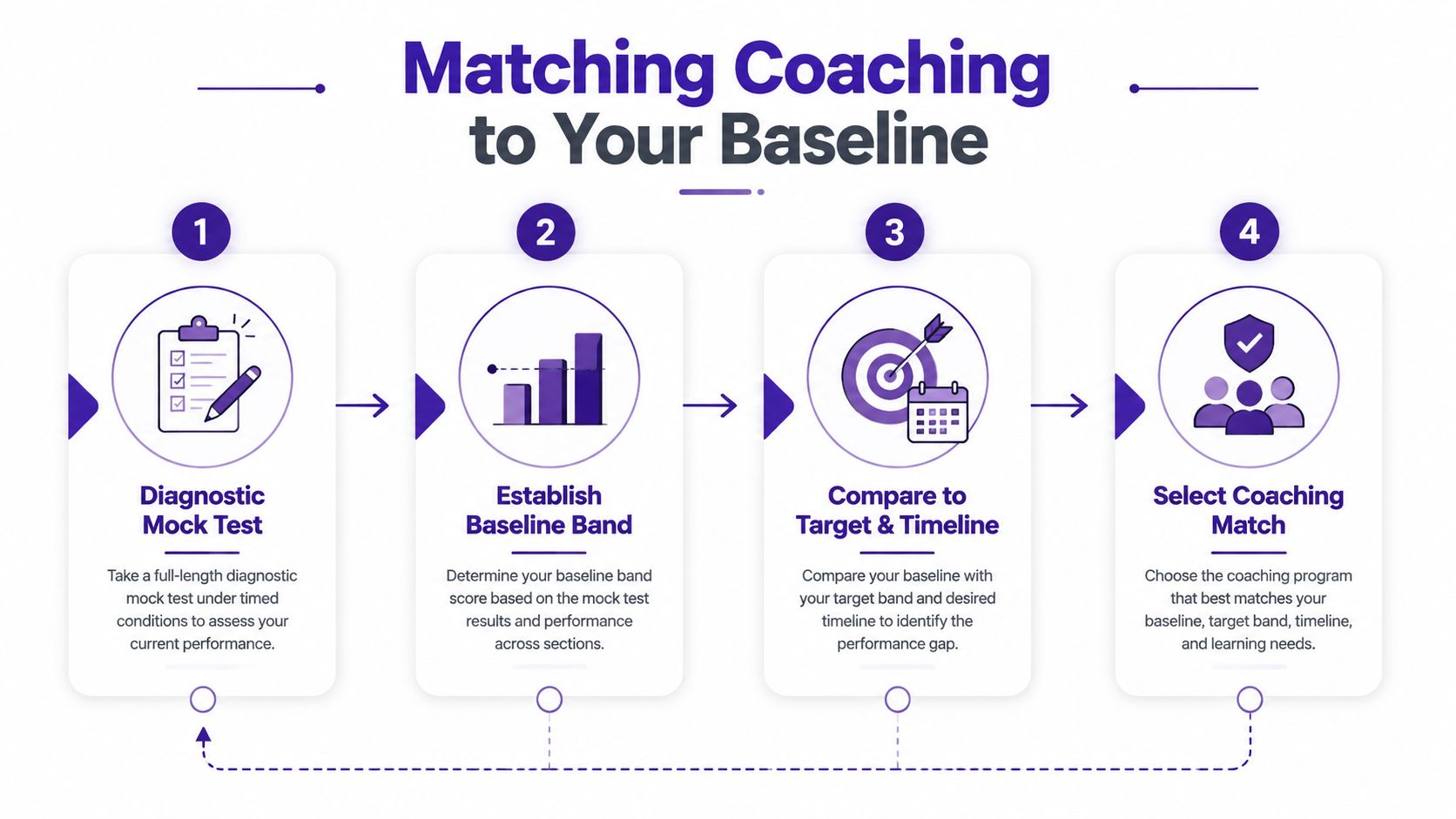
Make the schedule realistic
Check the test date, registration deadline, work shifts, travel, family responsibilities, and likely study windows before buying. A format that requires fixed attendance will fail if your routine changes every week. A fully flexible plan will also fail if you need external pressure to complete tasks.
A guide to converting your CEFR level to IELTS can help you understand how general language-level information relates to IELTS planning, but a timed IELTS diagnostic remains more useful for choosing coaching. Your provider should show you what to practise next, how often to submit work, and what evidence will indicate that the plan is working.
Situational Recommendations for IELTS Candidates
The strongest choice depends on the combination of goal, weakest skill, deadline, schedule, and feedback preference. Don't choose a format because it sounds modern or because a classroom feels more serious. Choose the smallest support system that can reliably correct the problem you have.
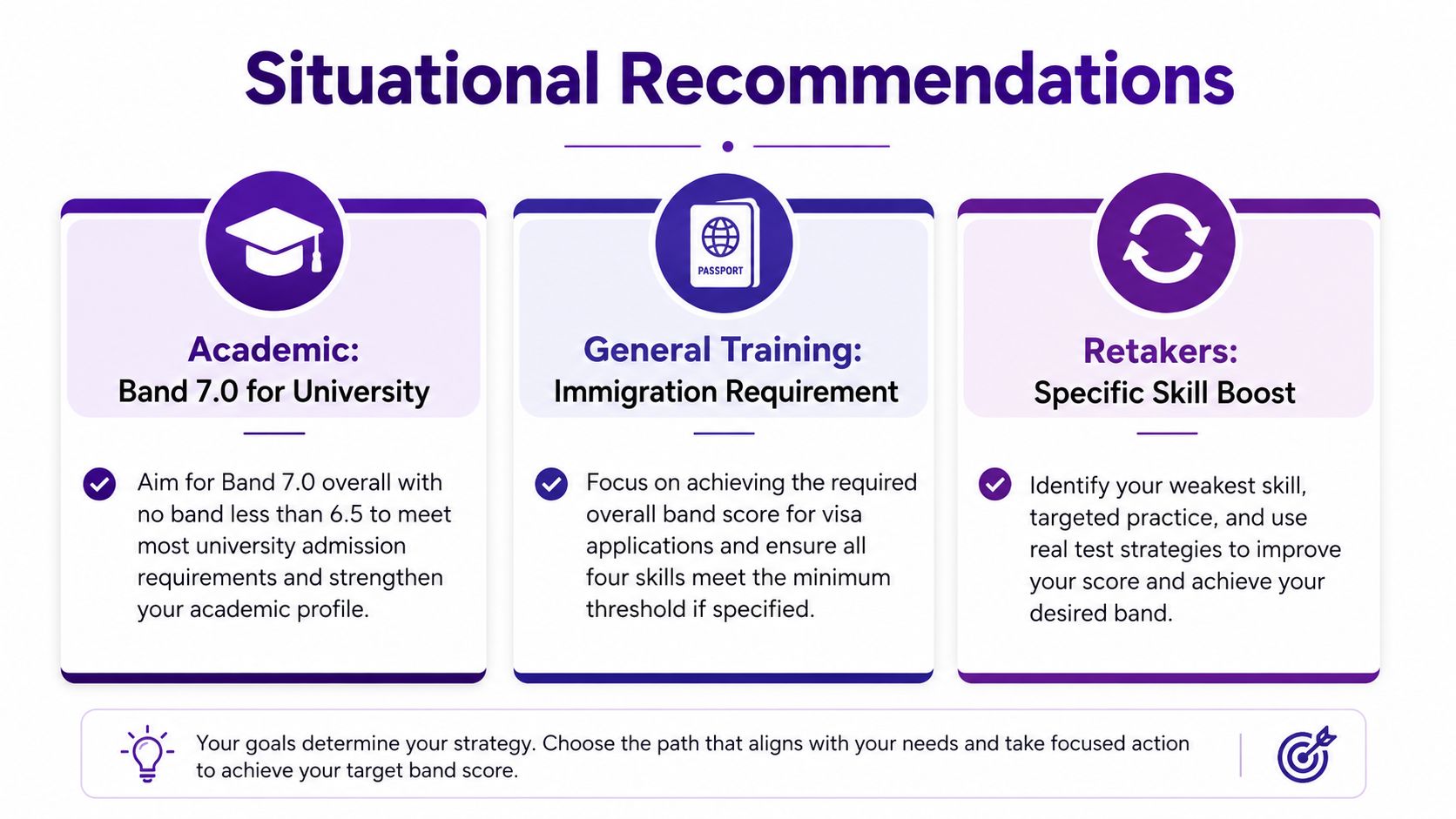
Academic applicants targeting Band 7.0
Choose human Writing and Speaking review as the core. Look for criterion-level marking, Academic Task 1 and Task 2 analysis, recorded Speaking assessments, and a clear turnaround for corrections. Add AI-assisted daily practice when you need more Reading, Listening, vocabulary, or timed Writing volume.
Your second choice is live online tutoring with a documented error log. Avoid a general English course that doesn't show how each assignment connects to the required band descriptors.
General Training candidates preparing for migration or work
Prioritize General Training letter tasks, practical reading, and clear responses under time pressure. Online tutoring is the most defensible primary format when you need someone to explain why a letter fails its purpose or why a response lacks the required tone.
Self-directed digital practice can work as a second choice if you already understand the task types and can obtain human review for Writing and Speaking. Ask whether the offer covers General Training rather than assuming Academic materials transfer directly.
Working professionals with limited evening hours
Choose an AI-assisted plan for short, repeatable study blocks, then add scheduled online reviews for your weakest skill. This arrangement avoids paying for classroom time you can't attend and keeps practice available when your workday changes.
Check whether feedback is available when you need it, whether sessions can be recorded, and whether missed work triggers a realistic catch-up plan.
Remote learners without qualified local centres
Choose structured online tutoring with fixed review appointments. A library of lessons is only a second choice unless it includes progress tracking, actual task marking, and a way to ask focused questions.
Retakers stuck at a plateau
Use digital practice for repeatable mocks and extensive drills, but spend human-review time on Speaking and Writing. A plateau often means the candidate has learned the familiar practice routine without correcting the specific errors that keep returning.
Official IELTS providers also now reference options such as One Skill Retake in eligible locations, which can make modular coaching more useful for some candidates. Check four points before you plan around it: whether your original test was on computer, whether your test centre offers it, whether you are still within the 60-day window, and whether your university, employer, or migration authority accepts it. But the core rule stays the same: if you retake one skill, your preparation should become narrower and more feedback-rich, not another full course.
Cathoven combines structured IELTS practice with automated scoring, criterion-level estimated feedback for Writing and Speaking, IELTS-format Reading and Listening questions with instant scoring and explanations, an adaptive AI tutor, and progress tracking across Listening, Reading, Writing, and Speaking. Explore the Cathoven IELTS AI tutor to compare your baseline with your target and build a more focused preparation routine before paying for coaching.