UK University English Requirements Explained
You open your offer letter, scan for the course name, and then hit the line that causes the pause: “conditional upon meeting English language requirements.” If you already have a test score, that sentence can feel strangely unhelpful. You passed an English test. The university says you still have a condition. So what, exactly, is missing?
This confusion is common because UK universities rarely use a single yes-or-no rule. They look at which test you took, which version you took, when you took it, your overall score, and your score in each skill. For some applicants, there is also a separate visa layer that doesn't always match the academic one.
A student might have an overall IELTS Academic score that looks strong enough at first glance, then discover that one lower Writing or Speaking band blocks direct entry. Another student may have the right level for academic admission but the wrong test version for a particular route. Someone else may be perfectly suitable for the degree, yet still need a pre-sessional English course because their current score profile doesn't match the exact offer condition.
That's why it helps to treat UK university English requirements as a system, not a single score. Once you understand that system, the offer letter becomes much easier to read. You can tell whether you already meet the condition, whether you need a different test version, or whether a staged route would get you onto the same degree.
Table of Contents
- Introduction to UK University English Requirements
- How UK University English Requirements Actually Work
- Accepted English Tests and Score Equivalents You Can Use
- Typical Score Thresholds by Study Level and Subject
- Pre-sessional Courses and Conditional Offer Routes Explained
- Evidence Documents Timelines Exemptions and Waivers
- Practical Steps to Meet Your Target Score and Prove Readiness
Introduction to UK University English Requirements
A typical applicant reaches this stage after months of work. You've shortlisted universities, written your personal statement, sent documents, and maybe even celebrated getting an offer. Then the English condition arrives and turns that excitement into a checklist problem.
The university isn't trying to make things difficult. English requirements exist for two practical reasons. First, universities need to know you can handle lectures, seminars, reading lists, lab instructions, essays, and exams in English. Second, they have to follow immigration rules where those apply. Those two purposes overlap, but they aren't identical.
Why the requirement can look more complicated than expected
Many readers expect one simple answer: “What IELTS score do I need?” In reality, most UK universities set English entry requirements around IELTS Academic 6.0 to 7.5, with many undergraduate courses using 6.0 to 6.5 overall and postgraduate courses often requiring 6.5 to 7.0 overall. At the more selective end, Oxford is listed at 7.5 overall with 7.0 in each element, while another highly selective university is listed at 7.0 overall with 7.0 in each element, accessed 20 Sep 2026). The same source also notes that UCAS frames degree-level study as equivalent to CEFR B2, which helps explain why 6.0 to 6.5 is such a common baseline for admission.
That sounds straightforward until you notice the hidden detail. Universities often care as much about the shape of your score as the average. A student with balanced skills may qualify more easily than a student with the same overall result but one weak band.
Practical rule: Don't read an English condition as “overall score only.” Read it as a bundle of rules.
What usually confuses applicants most
These are the points that tend to cause delays:
The wrong test type: You took an accepted English test, but not the version your route needs.
A weak sub-score: Your overall score looks right, but one skill falls below the minimum.
A timing issue: Your test result may be valid academically, but the intake or route has date-specific rules.
A route mismatch: You may need a pre-sessional course, not another full retake.
By the time you finish reading, you should be able to interpret your English condition with much more confidence and choose the quickest realistic route to satisfy it.
How UK University English Requirements Actually Work
Think of UK university English requirements as two locks on one door. One lock is academic. The other is immigration-related. Your test result has to fit the right lock, and sometimes it has to fit both.
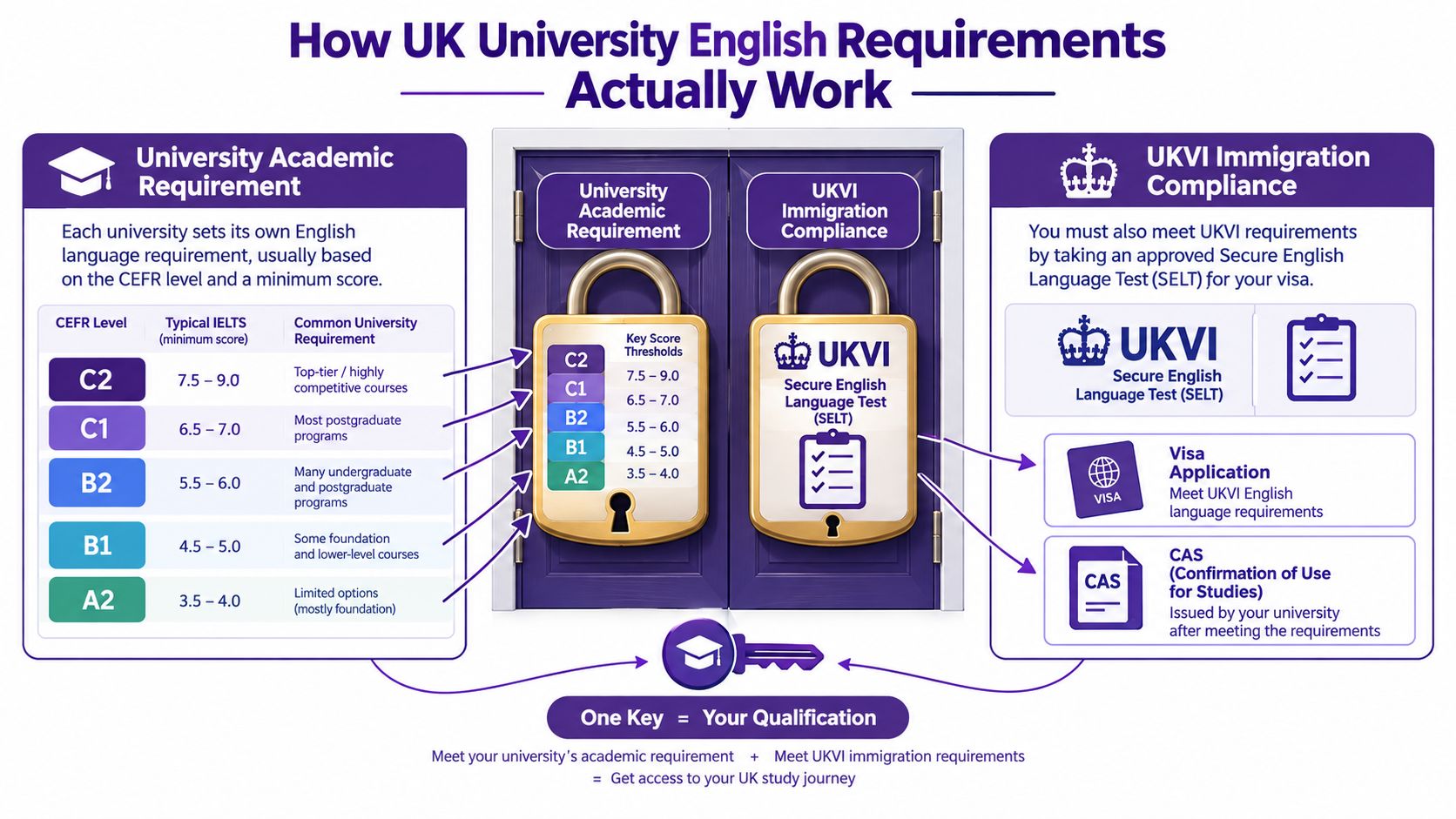
The academic lock
The first lock is the university's own admissions standard. This is the part that answers questions like these:
Can you follow lectures and discussion?
Can you write assignments at degree level?
Can you read academic material at the pace the course demands?
Do you have balanced ability across listening, reading, writing, and speaking?
That's why universities don't stop at one overall score. They often specify an overall band plus a minimum in each component. A course may say 6.5 overall, but still reject a profile with one skill below the stated floor.
The immigration lock
The second lock is visa compliance. UK immigration rules set the Student visa English threshold at CEFR B2 for courses at UK bachelor's level or above and B1 below bachelor's level (UK government English requirement levels). That threshold is not the same thing as a university's own academic target. It's a separate compliance baseline.
Many applicants get tripped up here. Meeting a visa minimum doesn't automatically mean you meet the course requirement. A university can still ask for a higher standard because the course itself is more demanding.
If the visa rule is the legal minimum, the course requirement is the academic working standard.
Why test version matters
After rule changes in the period after 2010, universities increasingly separated standard academic admission from visa-linked secure testing requirements. That distinction is still visible in current policies. For example, the University of Manchester says it accepts IELTS Academic and IELTS UKVI for degree study, but not IELTS General, IELTS Home, IELTS Indicator, IELTS Life Skills, or IELTS Online, and it requires a UKVI-approved SELT for courses below degree level (University of Manchester language requirements).
That's a strong example of the two-lock system in practice. One applicant may be fine with IELTS Academic for degree entry. Another applicant on a below-degree route may need the secure UKVI-approved version.
How to read any requirement correctly
When you check a course page or offer letter, break it into three parts:
Overall score required
Minimum score in each skill
Exact test and version accepted
If one of those three doesn't match, the condition usually isn't met yet. That's why two applicants with the same headline score can end up with different outcomes.
Accepted English Tests and Score Equivalents You Can Use
Once you understand the two-lock system, the next question is practical: which test can you use? For many applicants, IELTS Academic is the clearest reference point because universities often publish their requirements in IELTS bands even when they accept other tests.
Start with the test named on your course page
In UK admissions, the safest habit is to treat accepted tests as course-specific, not universal. A university may accept several English tests across the institution, but your department or entry route may still narrow that list.
The main point isn't just the test name. It's the exact version. That matters because accepted formats can differ between direct degree entry, pathway study, and visa-related routes. For example, the University of Manchester says it accepts IELTS Academic and IELTS UKVI for degree study, but not IELTS General, IELTS Home, IELTS Indicator, IELTS Life Skills, or IELTS Online (University of Manchester language requirements). That is a useful reminder that equivalence tables are only indicative unless you confirm the current rule for your intake date.
A simple comparison table
The table below is best used as a planning tool, not as a promise of acceptance. Universities publish their own equivalencies, and those can vary by course and year. If you need help translating CEFR into an IELTS target before you compare tests, this guide to converting CEFR level to IELTS gives a useful starting point.
| IELTS Academic Overall | TOEFL iBT Indicative | PTE Academic Indicative | Typical UK Use |
|---|---|---|---|
| 5.0 | University-specific | University-specific | Often seen for some foundation or pre-sessional entry points |
| 5.5 | University-specific | University-specific | Common for some pathway entry routes |
| 6.0 | University-specific | University-specific | Common baseline for many undergraduate offers |
| 6.5 | University-specific | University-specific | Common for many postgraduate taught courses |
| 7.0 | University-specific | University-specific | Often used for more demanding postgraduate or selective courses |
| 7.5 | University-specific | University-specific | Seen in highly selective academic contexts |
Common mistakes when comparing tests
Applicants often lose time by assuming that “equivalent” means “automatically accepted.” It doesn't. Equivalence only helps if the university currently accepts that test, in that version, for that route.
Watch for these problems:
General instead of Academic: Some applicants sit General Training and only later learn their course asked for an academic test.
Online or home editions: Even when a score looks strong, the delivery format may not be accepted for degree admission or visa purposes.
Old comparison assumptions: A score conversion you saw last year may not match the current entry cycle.
Ignoring component rules: A converted overall result still has to satisfy section-level requirements if the university applies them.
A useful habit is to save the exact course-page wording as a screenshot or PDF. That gives you one fixed version to work from while you plan your next step.
Typical Score Thresholds by Study Level and Subject
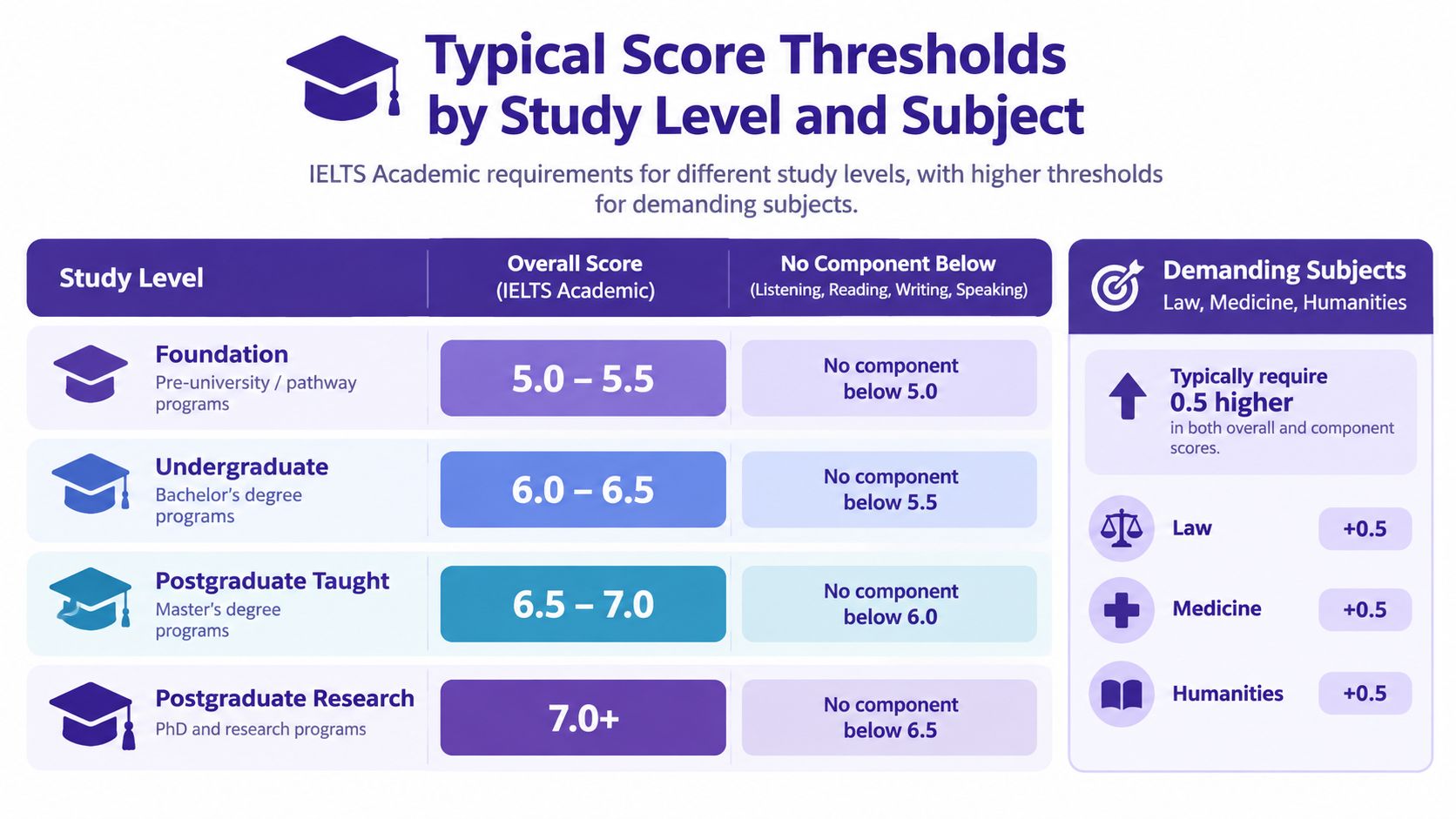
By the time most applicants start comparing universities, they notice a pattern. Requirements usually rise as the academic and linguistic demands of the course rise. What surprises people is that the skill-by-skill floor can matter just as much as the headline band.
What most applicants will encounter
Across the sector, undergraduate degrees often cluster around IELTS 6.0 to 6.5, while postgraduate study often clusters around 6.5 to 7.0. That pattern is widespread enough to be useful for planning, but it still doesn't replace checking your exact course.
example of overall plus sub-score thresholds
For a concrete example of how score profiles work, the University of Brighton lists a standard postgraduate requirement of IELTS 6.5 overall, with a minimum of 5.5 in all components, and a higher requirement of 7.0 overall, with a minimum of 6.5 in all components for some courses. That shows why one weak skill can block admission even when the overall result looks acceptable (University of Brighton English language requirements, accessed 20 Sep 2026).
A practical way to think about level and subject
Different study routes tend to ask different things from your English:
| Study route | What the university is often checking |
|---|---|
| Foundation or pathway | Can you begin academic preparation with support? |
| Undergraduate | Can you handle lectures, reading, seminars, and essays at degree level? |
| Postgraduate taught | Can you manage faster reading, sustained writing, and more independent discussion? |
| Postgraduate research | Can you communicate complex ideas clearly and consistently over a long project? |
Courses with heavier reading, argumentation, or professional communication demands often push requirements upward. Law, medicine, humanities, education, and linguistics-related study can be especially strict about Writing and Speaking because those skills affect assessment, discussion, and professional standards.
Why selective universities often ask for stronger balance
At the more selective end, universities may ask not only for a higher overall score but also for stronger performance in every skill, not just one or two. That matters because academic success isn't built on averages. A student who reads well but writes weakly may still struggle in coursework-heavy degrees. A student who writes strongly but can't follow fast seminar discussion may have trouble participating fully.
Admissions reality: Universities often treat an uneven profile as a readiness issue, not just a testing issue.
This is why “I already hit the overall score” doesn't always resolve the condition. If your course requires a balanced profile, the lower band is the result you need to fix.
Pre-sessional Courses and Conditional Offer Routes Explained
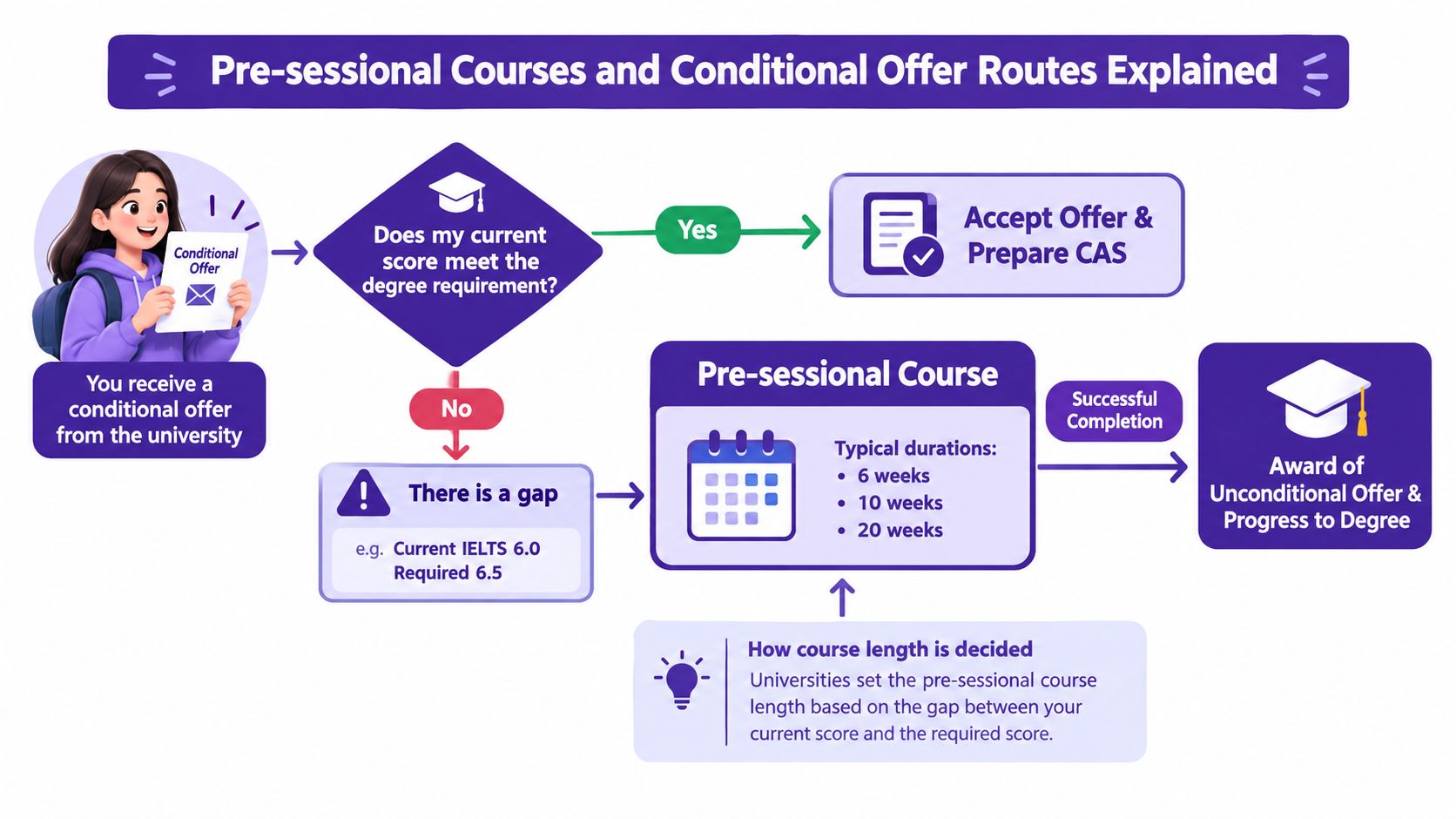
A conditional English offer isn't always a dead end. In many cases, it's a sign that the university believes you're academically suitable and is giving you a structured path to close the language gap.
How the staged route works
A pre-sessional course is a short academic English program linked to your future degree. Instead of retaking a test immediately, you join a pathway that targets the skills your main course will require: academic writing, seminar communication, reading strategies, note-taking, referencing, and listening in lecture-style settings.
Universities often set different entry points into these pre-sessional routes based on both your overall score and your sub-scores. That's why two students with the same overall band may be offered different lengths or different options.
The University of West London gives a clear example of this staged approach. Its pre-sessional pathway includes routes where one undergraduate entry point requires IELTS 4.5 overall and another requires IELTS 5.5 overall, while direct entry can still require 6.0 or 6.5 overall depending on the programme (University of West London pre-sessional pathways).
A second example comes from the University of Sussex, which publishes multiple pre-sessional thresholds tied to the degree offer level. For conditional offers at IELTS 6.0 or 6.5, one route requires IELTS 5.0 overall with at least 5.0 in Writing and 4.5 elsewhere, while another for the same offer band requires IELTS 5.0 overall with 5.0 in every section. For conditional offers at IELTS 7.0, Sussex lists IELTS 5.5 overall with different section floors depending on the route (University of Sussex pre-sessional entry bands).
Here's a short visual overview of how that route usually feels from the student side:
When a pre-sessional may be smarter than a retake
A retake makes sense when your gap is narrow and your score profile is already balanced. A pre-sessional often makes more sense when one or two skills remain stubbornly low, or when the intake deadline is close and the university offers a clear progression route.
A useful decision check is this:
Choose a retake if your target is close and you mainly need a better exam performance.
Choose a pre-sessional if you need structured academic English development linked to your actual degree.
Pause and verify dates if your offer, CAS timing, or route has strict document deadlines.
If you're working on the retake route, focused IELTS exam coaching guidance can help you decide whether you need broad practice or a narrow repair plan.
Evidence Documents Timelines Exemptions and Waivers
Once you know which route applies to you, the job becomes administrative. Strong applicants still get delayed here, not because their English is too weak, but because a document is missing, outdated, or attached to the wrong rule.
What you usually need to prepare
Start by collecting the evidence that proves both the result and the test format. Universities commonly ask for the official test report details and then verify them through their own systems or through secure reporting methods accepted for that test.
Use this working checklist:
Exact test result: Keep the official certificate or reporting details exactly as issued.
Correct version: Match the version in your offer or course conditions, especially if your route involves secure testing rules.
Date awareness: Check whether the result still falls within the university's accepted validity window for your intake.
Name match: Make sure your name matches across passport, application, and test registration.
Submission timing: Upload or send the result before the university's CAS or enrolment deadline.
The single biggest timing mistake is waiting until the rest of the application is complete before checking the English rule. English evidence often affects when a university can finalise the next stage of your admission.
Exemptions and waivers
Some applicants won't need the standard test route at all. Universities may consider waivers or exemptions if you already hold an eligible qualification taught in English or if you fit a recognised exemption category under their policy.
Policies vary, but a waiver request often involves one of these arguments:
| Possible route | What the university may ask for |
|---|---|
| Previous degree taught in English | Official transcript and proof of language of instruction |
| Recent UK study | Award documents and confirmation from the institution |
| Recognised nationality or qualification route | Passport or qualification evidence matching the published policy |
| Internal pathway progression | Completion evidence from the approved pathway |
Ask for the waiver decision in writing. Verbal reassurance from an agent, school contact, or informal adviser won't protect you if the admissions team applies the published rule later.
Why timing matters more than applicants think
Even where a waiver is possible, it can take time to assess. The university may need to confirm the awarding institution, teaching language, date of study, or whether the qualification fits the current admissions cycle. If your route also involves visa processing, that timing pressure becomes sharper.
A calm way to manage this is to work backward from your intended start date. Put your English evidence task near the front of your plan, not at the end. That gives you room to retake a test, switch routes, or request a waiver without rushing the rest of the application.
Practical Steps to Meet Your Target Score and Prove Readiness
Once you know your required profile, your preparation should become narrower and smarter. Don't study as if all four skills are equally weak if your real problem is one floor score in Writing or Speaking.
Build preparation around the condition you actually have
Start with the exact wording of your offer. Then mark three things: your required overall score, your required minimum by skill, and your accepted test version. Your study plan should aim at the missing piece, not at vague “English improvement.”
A focused preparation loop usually works better than random practice:
Diagnose the weak skill. If your overall band is already close, the lower component is the main obstacle.
Practice in IELTS-format tasks. General English improvement helps, but admissions conditions are usually cleared through exam-format performance.
Get criterion-level feedback. You need to know why a response is falling short, not just that it is.
Track readiness before booking again. Retake only when your performance is stable at or above the needed floor.
If you want a structured place to do that kind of prep, IELTS Academic preparation resources can help you organise practice around university entry goals. In the same space, Cathoven can be used for diagnostic estimates, writing and speaking feedback, and skill-by-skill tracking, which is useful when your obstacle is a component floor rather than the overall score.
What “ready” really means
Being ready doesn't just mean hitting a good score once in practice. It means you can reproduce the target profile consistently. If your course requires balanced skills, treat one-off high performances with caution.
Readiness is not “I reached the score once.” Readiness is “I can reach the right profile reliably, under test conditions, in the accepted format.”
That's the point where you can submit with confidence, choose a retake with good timing, or decide that a pre-sessional route is the better use of time.
If you're trying to decode an offer condition or close a specific band gap, Cathoven offers IELTS-format practice, diagnostic level checks, and detailed feedback for writing and speaking in one place. It can help you identify whether your real issue is the overall target, a sub-score floor, or simple readiness for the next accepted test attempt.