IELTS Full Mock Test Online: How to Simulate the Real Exam
The most popular advice about an IELTS full mock test online is also the least useful. People are told to take as many full mocks as possible, then trust the number that pops out at the end. That sounds disciplined, but it can reward familiarity with a website instead of readiness for the exam.
A proper mock should do something harder, it should expose what breaks under pressure. IELTS has a fixed four-section sequence, a 2 hour 45 minute written test, and a separate 11 to 14 minute Speaking test, so a mock that lets you pause, reorder sections, or skim past fatigue is training a different skill set entirely (official IELTS test structure).
Table of Contents
- Why Most Online Mock Tests Miss the Mark
- The Exact Format a Realistic Mock Must Replicate
- Evaluating Platforms on Scoring Quality and Feedback
- How Often to Take Full Mocks Without Inflating Scores
- Turning Mock Results Into a Targeted Study Plan
- What to Look for Before You Commit to a Platform
Why Most Online Mock Tests Miss the Mark
A common mistake is judging a mock test by how quickly it delivers a score. That's the wrong metric. A quick band estimate can feel reassuring even when the platform has skipped the parts of the exam that decide performance, like time pressure, section transitions, and the strain of moving from Listening into Reading and then Writing without a reset.
Score comfort is not score validity
The biggest problem with many online mocks is inflated confidence. If the questions are too easy, the scoring is too loose, or the Writing and Speaking feedback is vague, the result looks polished without being predictive. That matters because IELTS is still a standardized, high-stakes test used for study, migration, and professional registration, and the official guide says it is taken by over 3.5 million people every year and accepted by more than 12,500 organizations worldwide (IELTS guide for test takers).
The issue isn't just the band number. It's whether the platform can tell the difference between a lucky run and a stable skill level. A mock that doesn't reflect the official sequence can also hide cognitive fatigue, which is one of the most practical reasons candidates underperform on test day.
Practical rule: if a mock feels easy enough to do while half-distracted, it's probably not teaching you how the real test feels.
Fast feedback can still be shallow
Many systems tell you what you scored, but not why. That's a major flaw because the core value of a mock test is diagnostic, not decorative. If you don't know whether your weakness sits in question interpretation, pacing, grammar control, or task response, the next study session turns into guesswork.
A realistic IELTS full mock test online should therefore behave like rehearsal, not entertainment. It should make the pressure visible, not hide it behind a glossy dashboard.
The Exact Format a Realistic Mock Must Replicate
A credible mock has to mirror the exam with awkward precision. Anything less is only partial preparation. The official IELTS structure is built around Listening, Reading, Writing, and Speaking, with the written modules taking 2 hours and 45 minutes in total and the Speaking test running separately for 11 to 14 minutes (official IELTS test structure).
Timing and sequence matter more than most users think
Listening has 40 questions and lasts about 30 minutes. Reading has 40 questions in 60 minutes, and Writing has 2 tasks in 60 minutes. That sequence is not cosmetic. Candidates have to carry attention across three consecutive written modules before they ever reach Speaking.
The paper-based Listening section includes transfer time, while computer-delivered delivery uses the same core section structure in a different interface. A good mock should match the format you plan to take, especially if you are preparing on screen. If the platform lets you pause between sections or jump around, it is not training endurance.
Task types should be realistic, not generic
Writing has its own structure. In Academic Writing Task 1, you describe a visual such as a graph, table, chart, or diagram in your own words, and Task 2 counts twice as much as Task 1 toward the Writing score (IELTS Academic Writing format). That weighting changes how a mock should be built, because a generic essay drill will not prepare you for the official score balance.
Listening and Reading are also scored differently from Writing and Speaking. They are one question, one mark sections, so a real mock should preserve the 40-question structure and score them as discrete point-based parts rather than through a rubric-style impression (IELTS Listening format).
| Exam Component | Official Format | Common Platform Deviation |
|---|---|---|
| Listening | 40 questions, about 30 minutes | Too much pause control, weak timing pressure |
| Reading | 40 questions, 60 minutes | Reordered sections or untimed browsing |
| Writing | 2 tasks, 60 minutes, Task 2 weighted more | Generic essay prompts without task balance |
| Speaking | Separate 11 to 14 minute live or simulated interview | Overly scripted prompts with no follow-up pressure |
Evaluating Platforms on Scoring Quality and Feedback
A band score only matters if the scoring method is trustworthy. Flashy design does not help here. The official IELTS scoring framework uses a 9-band scale, with overall results reported in whole or half bands, and section scores tied to raw-score thresholds rather than free-form estimates (IELTS scoring in detail).
Human judgment and AI both have trade-offs
Human-graded mocks usually handle nuance better. They are often stronger at checking whether a Writing response answers the task, and whether a Speaking answer sounds controlled rather than memorized. The trade-off is speed and cost, because detailed feedback often takes longer.
AI-graded options return results quickly, sometimes in moments rather than hours. The risk is overconfident scoring on coherence, task response, or speaking fluency when the performance is uneven. That is why criterion-level detail matters more than the headline band.
A practical question cuts through the noise. Does the platform explain how it reached the score, or only show the score itself?
Look for criterion-level breakdowns, not just totals
Writing and Speaking need the closest inspection. If a mock only gives an overall band with no breakdown for task response, cohesion, vocabulary, grammar, or pronunciation, the result is hard to use. Listening and Reading are simpler, but the error pattern still matters more than the final total.
Cathoven is one option that combines mock tests with automated scoring, criterion-level feedback, and band estimates aligned to IELTS criteria. Its free IELTS band score calculator also makes the scoring logic more visible before you commit to a full test. The test is not the brand name, it is whether the feedback changes what you do next.
| Platform | Scoring Transparency | Feedback Depth | Format Fidelity | Best For |
|---|---|---|---|---|
| Official practice materials | High for format, limited for scoring depth | Basic | High | Familiarizing yourself with test style |
| Human-graded mock systems | Variable, usually clearer | Strong on writing and speaking nuance | Moderate to high | Candidates who need detailed diagnosis |
| AI-graded mock systems | Fast, but quality depends on calibration | Often criterion-based, sometimes uneven | Often strong on interface | Fast iteration and frequent check-ins |
| Hybrid feedback systems | Better balance of speed and depth | Usually more usable for revision | Depends on build quality | Learners who want speed plus correction |
For a broader view of how practice resources are organized, the IELTS practice website guide is useful as a directory-style reference.
A score that arrives quickly is not automatically a score you can trust.
How Often to Take Full Mocks Without Inflating Scores
Taking a full mock every day feels productive. It usually isn't. Repeating the same kind of test too often makes familiar question patterns feel easier than they really are, and that can inflate scores without improving the underlying skill.
Use mocks as checkpoints, not your daily study method
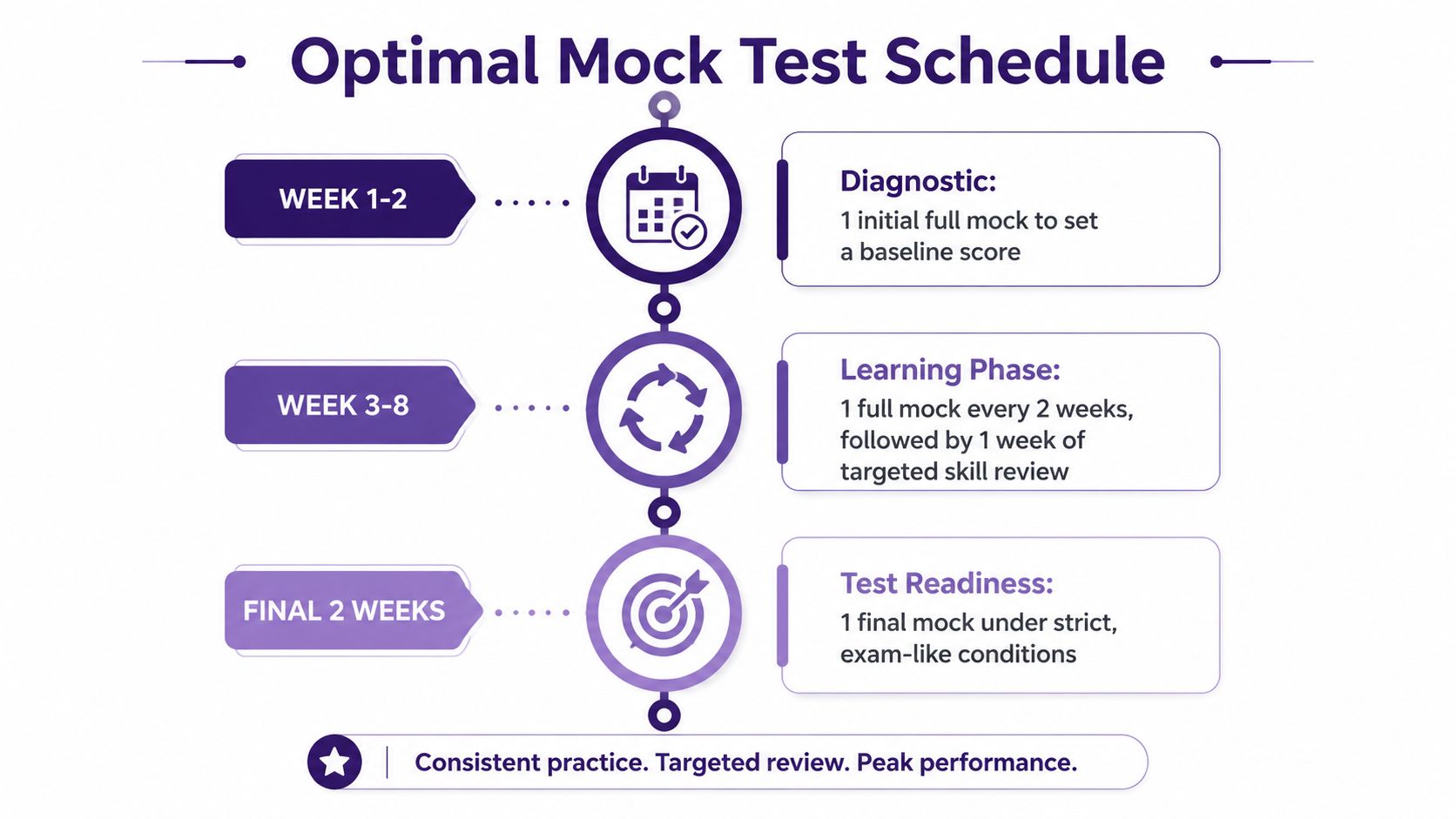
The cleanest approach is to separate diagnosis from development. Start with one baseline mock to find the weak spots, then leave enough space between full tests so that your revision can change something. If you keep testing too often, you measure familiarity with the format instead of real improvement.
A strong schedule usually has three stages. First, a diagnostic mock sets the baseline. Next, full mocks return at spaced intervals while you drill the weak skills between them. Finally, one or two strict rehearsals in the last stretch help you check timing, stamina, and nerves.
Watch for the warning signs
If your scores stop moving but your confidence keeps rising, that's a red flag. So is a sudden rise in Reading speed that doesn't hold when the question types change. These patterns often mean the test itself has become familiar, not that the skill has become stronger.
The practical fix is to alternate. Use full mocks for measurement, then use shorter section drills for repair. That protects stamina and keeps the feedback clean.
If the same score appears too often for the wrong reason, stop calling it progress.
Turning Mock Results Into a Targeted Study Plan
A mock score only matters when it changes what you do next. Overall bands are too blunt on their own, because the actual work happens inside the skill breakdown. A learner who misses matching headings in Reading needs a different plan from someone who struggles with timing or paraphrasing.
Start with the error pattern, not the band number
In Listening and Reading, sort mistakes by question type. That tells you whether the problem is attention, vocabulary, distractor traps, or pace. If one question type keeps collapsing, that's where your next practice block should go.
In Writing, compare your performance against the official criteria, especially Task Achievement, Coherence and Cohesion, Lexical Resource, and Grammatical Range and Accuracy. Task 1 and Task 2 are not interchangeable, and because Task 2 carries more weight, weak performance there deserves more study time (IELTS Academic Writing format).
Convert the gap into weekly work
Speaking needs the same kind of breakdown. Don't just ask whether the answer sounded fluent. Ask where the breakdown happened, vocabulary, grammar, pronunciation, or the ability to extend an answer naturally.
| Skill | Mock Band | Target Band | Gap | Weekly Hours Allocated | Priority Focus Area |
|---|---|---|---|---|---|
| Listening | Question-type accuracy | ||||
| Reading | Speed plus trap recognition | ||||
| Writing | Task response and coherence | ||||
| Speaking | Fluency, grammar, pronunciation |
A useful weekly plan gives the largest share of time to the biggest gap, but not blindly. A small Reading gap with a large timing problem can be more urgent than a larger gap in a skill that's already stable. That's why a good IELTS full mock test online doesn't end at the band score, it ends when the next week's work is obvious.
What to Look for Before You Commit to a Platform
Before you pay, test the platform against a short checklist. If it fails on format fidelity, the rest of the features matter less. The whole point is to rehearse the actual exam, not a simplified imitation.
Three things you should verify immediately
First, check whether the mock reproduces the exact section timing, question count, and interface behavior of the format you'll sit. Second, make sure the platform explains how Writing and Speaking are scored, and whether a human, AI, or hybrid model is doing the grading. Third, look for feedback that breaks performance into meaningful parts instead of giving you one polished number.
Authenticity matters too. Recycled content dressed up as fresh practice can only take you so far once you've already seen the material. Results also need to arrive soon enough that you can act on them while the mistakes are still fresh.
A platform should help you act, not just observe
Good practice systems track trends across skills and make the next session more specific. Weak systems leave you with a band and a vague sense that you should “study more.” That's not a preparation plan.
If a platform can't show you what happened in the test, it can't help you change what happens next.
If you want a structured way to turn mock tests into measurable IELTS progress, Cathoven gives you full-length practice, criterion-level feedback, and band estimates tied to the skills that matter most. Visit Cathoven to use mock results as a real study plan, not just another score screen.