10 IELTS General Writing Letter Purposes and Essay Question Types
What do you do first when an IELTS General Training writing prompt appears, start writing, or identify the relationship, purpose, and essay logic behind it? Recognizing the task type is the first strategic decision. It determines your register, paragraph purpose, vocabulary, and the kind of evidence or detail you need.
IELTS General Training Writing contains two tasks in a fixed 60-minute period. Task 1 is a letter of at least 150 words, while Task 2 is an essay of at least 250 words. General Training Task 1 uses practical situations, such as requests or explanations, whereas Task 2 requires an essay responding to a point of view, argument, or problem. The official IELTS General Training Writing format also confirms that computer-delivered questions follow the same format as paper questions.
The 10 IELTS General Writing categories below are organized by letter purpose and essay question type, not as a list of answers to memorize. You'll see illustrative practice prompts, short model excerpts, useful language, likely focus areas, and a practical task for each category. Task 1 should usually receive 20 minutes, and Task 2 40 minutes, because Task 2 contributes twice as much as Task 1 to the Writing score, as explained in the official General Training practice guidance.
Use this feedback loop: plan, write under time pressure, review with a checklist, use Cathoven for criterion-level feedback, and revise one recurring weakness. In that checklist, review Task Achievement (Task 1) / Task Response (Task 2) along with the other writing criteria. That process builds flexible writing skills instead of dependence on memorized templates.
Table of Contents
- 1. Formal Complaint Letter to a Service Provider
- 2. Request for Information Letter
- 3. Thank You or Apology Letter
- 4. Application Letter for a Job or Course
- 5. Letter Requesting a Favor or Permission
- 6. Opinion Essay on a General Training Topic
- 7. Advantages and Disadvantages Essay
- 8. Problem and Solution Essay
- 9. Discussion Essay on Two Opposing Views
- 10. Letter Describing an Experience or Event
- 10-Category Comparison: IELTS General Writing
- Turn Topic Recognition Into a Repeatable Routine
1. Formal Complaint Letter to a Service Provider
A complaint letter has one central purpose: explain a failure and request a reasonable remedy without sounding aggressive. The recipient might be a hotel manager, airline representative, internet provider, school director, or customer-service department. Although the situation may be frustrating, your language should remain controlled and professional.
An illustrative three-point practice prompt could be:
You recently stayed at the Riverton Hotel and were dissatisfied with your room. Write a letter to the hotel manager.
In your letter:
describe the problems you experienced
explain how these issues affected your stay
say what action you would like the manager to take
A strong opening makes the purpose immediately clear:
I am writing to complain about the condition of room 214 during my stay at the Riverton Hotel from 12 to 14 May.
The next paragraphs should separate the problems from the requested solution. You might describe unclean bedding, late-night noise, and the effect on your sleep. Specific details make the complaint credible, but they should support the task rather than become a long story.
Language and focus
Use polite modal verbs to make a firm request:
General Training Writing practice materials
Explain the failure: “The room had not been cleaned properly, and construction noise continued until late at night.”
Describe the effect: “As a result, I was unable to rest before an important business meeting.”
Request action: “I would appreciate a partial refund, or an explanation of how this matter will be addressed.”
Avoid dramatic accusations such as “Your hotel is completely unacceptable.” A formal complaint should show dissatisfaction through precise description. Check subject-verb agreement, articles, verb tense, and whether each paragraph has a clear purpose. The British Council's General Training Writing practice page reflects the standardized nature of these practical letter situations.
For practice, write an airline complaint about lost luggage. Include the flight details, describe the inconvenience, and request a specific response. Then review whether you stated the purpose, explained the problem clearly, and asked for appropriate action. You can also use Cathoven's IELTS General Training Writing guide to support targeted practice with formal and informal letters.
2. Request for Information Letter
How can you ask for several details without making your letter feel like a questionnaire? Treat the letter as a clear route from your situation to your decision. The recipient should quickly understand why you are writing, what you need to know, and how to reply. Common recipients include training centers, employers, universities, local authorities, and public services.
Consider this illustrative three-point practice prompt:
You want to join an evening language course at a local training center. Write a letter to the course administrator.
In your letter:
explain why you want to take the course
ask about the schedule, fees, and entry requirements
say how the center can contact you with the information
A useful opening combines context with purpose:
I am planning to improve my English before starting a new job, and I would like to ask for information about your evening courses.
Now arrange the questions by decision order. Begin with timetable and course length, then ask about fees and payment arrangements. Finish with class size, placement requirements, or enrollment procedures. This grouping works like labeled folders: each paragraph gives the reader one related set of details to answer.
Useful language includes:
Ask for details: “Could you please tell me which evenings the course is held?”
Request clarification: “I would also like to know whether students must complete a placement test.”
Ask about possibility: “Would it be possible to pay the fee in monthly installments?”
Close politely: “Thank you in advance for your assistance. I would be grateful if you could reply by email.”
Keep each question focused. “Could you tell me about the course?” is too broad, while “Could you tell me whether the course includes speaking assessments?” gives the recipient a precise task. Mention your preferred contact method in the closing, especially if you are ready to enroll after receiving the information.
For practice, write to an employer requesting information about a role's responsibilities, working hours, relocation support, and interview process. Underline each question, then label it with its purpose, such as duties, schedule, support, or selection. Check that no request is hidden inside a long sentence and that your tone suits a professional recipient. Use Cathoven's IELTS General Training Writing guide to review formal letter language and build a repeatable practice routine.
3. Thank You or Apology Letter
Thank-you and apology letters share a personal purpose, but their emotional direction differs. A thank-you letter explains the value of someone's help. An apology letter accepts responsibility, explains what happened, and shows how you'll prevent a repeat problem.
An illustrative three-point thank-you practice prompt might ask you to write to a former employer who provided a reference:
A former employer wrote a reference letter for you, and you have now been offered the job. Write a letter to your former employer.
In your letter:
thank them for supporting your application
explain how their reference helped you
tell them about the job you have received
A suitable opening could be:
I'm writing to thank you sincerely for the reference letter and for the career advice you gave me before my interview.
An illustrative three-point apology practice prompt could involve a neighbor disturbed by renovation noise:
Your home renovation work caused noise that disturbed your neighbor last weekend. Write a letter to your neighbor.
In your letter:
apologize for the disturbance
explain what caused the noise
say what you will do to avoid this problem in future
A suitable opening could be:
I sincerely apologize for the noise from my apartment last weekend. I realize that it disrupted your family's routine.
In both cases, the first sentence should identify the purpose. Don't make the reader infer whether you're expressing gratitude or regret.
Develop the personal meaning
A short model excerpt for a thank-you letter might read:
Your reference highlighted my project-management experience, which helped the employer understand how my previous work matched the position. I also appreciated your advice to prepare examples of challenging situations, because one of the interview questions focused on that exact skill.
For an apology, explain the context without using it as an excuse:
The renovation took longer than expected because the electrician found a problem with the wiring. However, I should have warned you in advance and arranged for the loudest work to finish earlier.
Useful expressions include “I greatly appreciate your help,” “I sincerely apologize,” “I realize that my actions caused inconvenience,” and “I'll make sure this doesn't happen again.” End with a forward-looking statement, such as offering help, inviting the person to meet, or assuring corrected behavior.
For practice, write an apology to a colleague for missing a deadline that affected a team project. Include the reason, the impact, the responsibility you accept, and a practical commitment. Then rewrite the opening in a more informal style for a close friend, noticing how the greeting, contractions, and vocabulary change.
4. Application Letter for a Job or Course
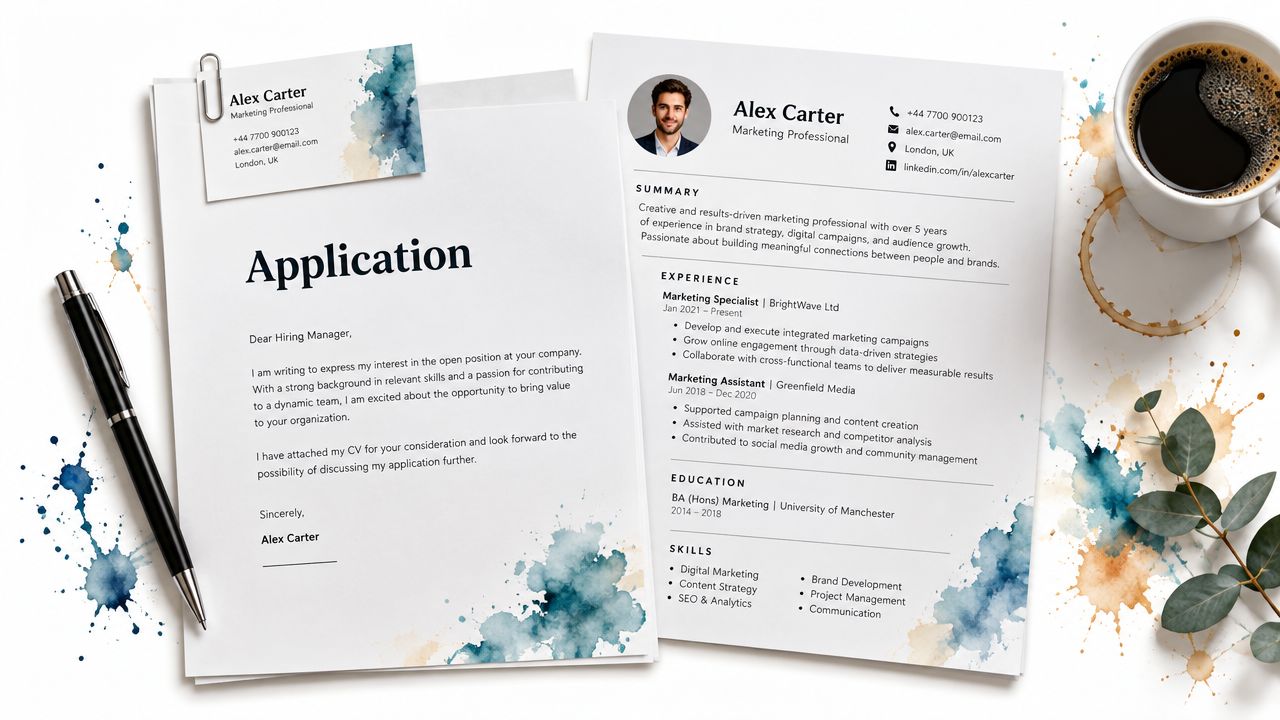
An application letter is a formal letter with a persuasive purpose. You're not merely giving information. You're selecting relevant qualifications and showing why they match a particular job or course.
Try this illustrative three-point practice prompt:
You have seen an advertisement for a temporary sales representative position during the holiday season. Write a letter to the hiring manager.
In your letter:
introduce yourself and say where you saw the advertisement
describe your relevant experience and skills
explain why you are interested in the position
A focused opening could be:
I am writing to apply for the temporary Sales Representative position advertised in the local newspaper. I have three years of retail experience and am available throughout the holiday period.
The body should connect your experience to the opportunity. Don't list every responsibility you've ever had. Select two or three qualifications that the role needs, such as customer service, handling payments, product knowledge, teamwork, or bilingual communication.
Turn claims into evidence
Compare these two sentences:
I am hardworking and good with customers.
In my previous retail role, I helped customers choose suitable products, handled difficult returns calmly, and regularly supported new staff during busy periods.
The second version is stronger because it demonstrates skills through actions. You can then connect motivation to the opportunity:
This position interests me because it would allow me to use my customer-service experience in a fast-paced environment while developing my knowledge of retail operations.
Close by requesting an interview or information about the next step:
I would welcome the opportunity to discuss my application and am available for an interview at your convenience.
Application letters are especially sensitive to grammar and word choice because errors can damage your credibility.
For practice, apply for an office manager role and include organizational experience, bilingual skills, and one concrete example of solving a workplace problem. Check whether every qualification relates directly to the advertised role.
5. Letter Requesting a Favor or Permission
How can you ask for an exception while showing that it will be managed responsibly? A favor or permission letter usually goes to someone with authority, such as a landlord, manager, course provider, or school administrator. Its logic is simple: state what you want, explain why, reduce the recipient's concerns, and offer a workable arrangement.
Illustrative three-point practice prompt:
You want to sublet your room for a few months while you complete a course in another city. Write a letter to your landlord.
In your letter:
explain why you need to leave temporarily
ask for permission to sublet the room
describe how you would manage the arrangement responsibly
Open with the purpose:
I am writing to ask for permission to sublet my room from September to December while I attend an intensive course in another city.
This direct first sentence acts like a signpost. The reader immediately knows the decision required. Follow it with two or three focused reasons, such as avoiding payment for two homes and continuing to pay rent on time. Keep the explanation relevant to the request rather than describing your entire situation.
Make the arrangement easy to approve
A strong paragraph anticipates practical questions:
I understand that subletting may require additional checks. I would be happy to provide the proposed tenant's references, arrange a meeting, and remain fully responsible for the rent and condition of the room.
The wording respects the recipient's authority while showing that you have considered possible risks. Replace demands with language that leaves room for discussion:
Offer flexibility: “I would be willing to discuss a shorter arrangement if that is more suitable.”
Reduce concern: “I can provide proof of the tenant's employment and contact details.”
Show appreciation: “I would be grateful if you could consider this request.”
The same structure works for flexible working hours, a course extension because of illness, or leave to attend a family event. The details change, but the communication purpose remains consistent: explain the need, demonstrate responsibility, propose safeguards, and request a decision politely.
For practice, write to a manager requesting flexible hours to complete an evening course. Include your required schedule, the reason for the request, and one compromise that protects your team's workload. In Cathoven, review the letter for clear purpose, appropriate formality, specific support, and language that recognizes the recipient's concerns. Then rewrite any sentence that sounds entitled or leaves the proposed arrangement unclear.
6. Opinion Essay on a General Training Topic
An opinion essay asks you to take a position and support it. The topic may concern remote work, public transportation, social media, online shopping, or foreign-language education. The subject itself matters less than your ability to answer the exact question with a consistent position.
Sample prompt:
Some people believe that remote work should become permanent for office employees. To what extent do you agree or disagree?
A direct introduction might read:
Remote work should remain available for many office employees, although it shouldn't replace every form of office-based collaboration. Flexible arrangements can reduce commuting demands and support concentration, while regular in-person contact remains valuable for team development.
This position is clear and qualified. The body paragraphs should explain why you hold it, not repeat the same opinion in different words.
Build one argument completely
A model body excerpt could be:
The strongest argument for permanent remote-work options is that employees can organize their working environment around tasks that require sustained concentration. For example, a software developer who spends much of the day writing code may complete complex work more efficiently without constant interruptions. This benefit is greatest when employers set clear communication routines and measure results rather than physical presence.
The example is realistic, and the final sentence limits the claim. You can acknowledge a counterargument in a separate paragraph:
However, office attendance can support informal learning and cooperation, particularly for new employees. A hybrid arrangement may therefore be more practical than requiring every worker to choose the same location.
Use signposting naturally, with phrases such as “The strongest argument,” “However,” “In contrast,” and “For this reason.” Don't force a formula into every essay. Cathoven's guide to common mistakes in IELTS Writing Task 2 can help you review position clarity, paragraph development, and common language problems.
For practice, write an opinion essay about whether public transportation should be free or subsidized. Plan your position first, then write one paragraph supporting it, one paragraph addressing a limitation, and a conclusion that introduces no new idea.
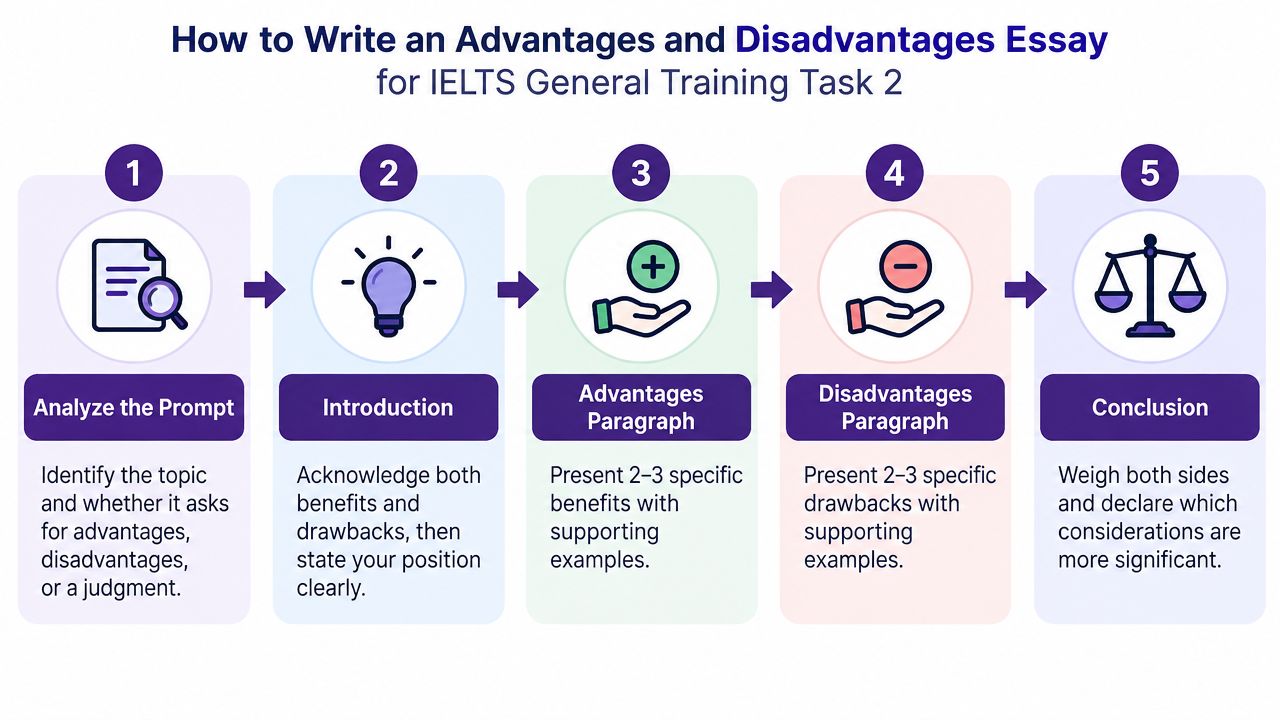
7. Advantages and Disadvantages Essay
What changes when a question asks you to weigh both sides rather than defend one position? An advantages and disadvantages essay examines the benefits and drawbacks of a development, situation, or proposal. It differs from an opinion essay because balance comes first. Give a final judgment only if the prompt asks you to decide which side is stronger.
Sample prompt:
More people are choosing to work from home full-time. What are the advantages and disadvantages of this trend?
A focused introduction could be:
Working from home gives employees greater control over their daily routines, but it can reduce direct social contact and informal collaboration. The overall value of this arrangement depends on the type of work and the support available to employees.
The language signals two purposes. “Gives” introduces a benefit, while “can reduce” introduces a limitation. The final sentence prepares the reader for a qualified assessment rather than an extreme claim.
Build each body paragraph around one connected line of reasoning. For example:
A primary benefit is the removal of daily commuting. Employees can use that time for rest, family responsibilities, or preparation for work, and companies can recruit people who live far from a central office. This arrangement is particularly useful for tasks requiring independent concentration.
The example explains how the benefit affects both workers and employers. Practise by expanding “less commuting” into a cause, two effects, and a suitable condition.
The opposing paragraph needs equal development:
The main drawback is that remote employees may find it harder to ask quick questions or learn through observation. New staff members can miss informal explanations that experienced colleagues provide naturally in an office. Deliberate mentoring and regular meetings may reduce this gap.
Use language such as “A primary benefit is…”, “Another positive feature is…”, “The main drawback is…”, and “A further concern involves…”. For evaluation, “On balance,” and “This benefit is likely to outweigh the drawback when…” help you state a measured conclusion.
A repeatable Cathoven workflow can keep the comparison balanced: identify the two sides, draft one developed example for each, check whether each paragraph explains consequences, then review linking language and conclusion strength. For practice, compare online education with classroom learning. Write about flexibility and interaction, then decide which matters more for adult learners. Ensure the conclusion weighs the points instead of merely repeating them.
8. Problem and Solution Essay
A problem and solution essay asks you to diagnose an issue and recommend practical responses. The strongest answers explain why the problem exists, who it affects, how each solution would work, and what limitations might remain.
Sample prompt:
Many cities are experiencing serious traffic congestion. What problems does this cause, and what solutions can you suggest?
Begin by defining the issue:
Traffic congestion creates longer journeys, unreliable arrival times, and greater pressure on urban roads. Although the problem is linked to private-car use and limited alternatives, cities can address it through coordinated transport policies.
The first body paragraph should explain causes or effects, depending on the wording. For example, unreliable buses may encourage more residents to drive, which then slows public transport further. That cause-and-effect relationship is more useful than a vague claim that traffic is “bad for society.”
Make each solution operational
A solution needs an actor, an action, and a reason:
Local authorities could improve bus reliability by introducing dedicated lanes on the busiest routes. If buses avoid the worst traffic, commuters may see public transport as a practical alternative to driving. This measure would require road-space changes, so officials should test it on congested corridors and monitor the effect on nearby traffic.
A second solution might involve employers adjusting start times or supporting flexible schedules. Don't present policies as magic answers. Acknowledge feasibility, cost, public resistance, or the need for gradual implementation when relevant.
Useful language includes “One practical response would be…,” “This could work because…,” “A further measure is…,” “The limitation is that…,” and “For this approach to succeed…”
For practice, write about poor English proficiency among adult workers. Explain one cause, propose workplace training and community classes, and state why each could help. Before writing, label your plan problem, solution one, solution two, limitation, conclusion.
9. Discussion Essay on Two Opposing Views
A discussion essay presents two perspectives and asks for your own position. The main risk is giving one view much more attention than the other, or stating your opinion without clearly separating it from the summary of each side.
Sample prompt:
Some people believe that immigration strengthens host countries, while others think it creates social tension. Discuss both views and give your opinion.
Your introduction should present the disagreement neutrally:
Some people regard immigration as a source of economic and cultural strength, whereas others are concerned about pressure on public services and social cohesion. Both perspectives have merit, but I believe immigration is most beneficial when governments plan integration and public provision effectively.
The first body paragraph can explain one perspective:
Supporters argue that newcomers expand the workforce and contribute skills that employers need. They may also introduce cultural practices that enrich local communities. From this viewpoint, immigration is not only a demographic change but also a way to support economic activity and cultural exchange.
The next paragraph should represent the opposing view fairly:
Critics, however, worry that rapid population growth can place pressure on housing, schools, and healthcare. These concerns may become stronger when local authorities lack the resources to support both existing residents and newcomers. In their view, the problem is not necessarily immigration itself, but inadequate planning.
Separate summary from judgment
Use attribution phrases such as “One perspective is…,” “Supporters argue…,” “Others are concerned that…,” and “Critics, however…”. After both views, signal your own judgment clearly:
Personally, I believe the benefits are greater when migration is matched by investment in housing, language education, and employment support.
Your conclusion can acknowledge the opposing concern while maintaining your position. Cathoven's discuss-both-views essay guidance provides a useful reference point for practicing balanced organization and clear opinion placement.
For practice, write about whether companies should prioritize profit or environmental responsibility. Give each view one developed paragraph, then add your judgment in a distinct sentence and conclusion. Review whether a reader could identify both positions without guessing your preference too early.
10. Letter Describing an Experience or Event
A descriptive experience letter uses narrative language, but it still needs a clear purpose and controlled organization. The recipient might be a friend, relative, former colleague, or another person with whom you share a relationship. Your register should change according to that relationship.
An illustrative three-point practice prompt could ask:
You have recently started a new job in an English-speaking country. Write a letter to a relative.
In your letter:
describe your new workplace
explain what your daily responsibilities are
say how you feel about the change so far
An informal opening might be:
It's been ages since we spoke, so I wanted to tell you about my first month in my new job.
For a former colleague, a semi-formal version would be more suitable:
I hope you've been well. I wanted to tell you about my new role and the changes I've experienced since moving to the city.
The main body should follow a chronological or thematic plan. You might first describe the workplace, then explain your responsibilities, and finally discuss an event that changed your impression of the job.
Make the experience vivid and easy to follow
A model excerpt could read:
On my first morning, I expected the office to feel unfamiliar, but one of my teammates introduced me to everyone before the meeting began. After that, I joined a training session on the company's customer system. I was nervous at first, yet by the afternoon I had already handled a simple request independently.
Use sequencing connectors such as “First,” “Next,” “After that,” and “Finally.” Add selective sensory or emotional detail, but don't turn the letter into an unrelated story. Each paragraph should cover one phase or aspect of the experience.
Close by re-engaging the recipient:
I'm enjoying the role more than I expected, and I'd love to tell you more when we speak. How is your new project going?
For practice, write to a friend about a recent holiday, then rewrite the same event for a former colleague. Keep the facts similar but adjust the greeting, contractions, emotional detail, and closing. That comparison makes register control visible.
10-Category Comparison: IELTS General Writing
| Category | Task type | Main purpose or question focus | Tone and structure focus | Typical content requirements | Why it matters in practice |
|---|---|---|---|---|---|
| Formal Complaint Letter to a Service Provider | Task 1 letter | Explain a problem and request a remedy | Formal tone, clear problem-solution paragraphing | What happened, its effect, requested action | Tests polite but firm complaint language |
| Request for Information Letter | Task 1 letter | Ask for specific details before making a decision | Formal or semi-formal tone, grouped questions | Context, information needed, preferred reply method | Tests clarity, question control, and purpose |
| Thank You or Apology Letter | Task 1 letter | Express gratitude or apologize appropriately | Tone matched to relationship, clear emotional purpose | Reason for thanks or apology, detail, forward-looking close | Tests register control and interpersonal language |
| Application Letter for a Job or Course | Task 1 letter | Present qualifications and motivation persuasively | Formal tone, selective evidence, strong closing | Background, relevant skills, reason for applying | Tests relevance, persuasion, and formal accuracy |
| Letter Requesting a Favor or Permission | Task 1 letter | Ask for approval or an exception politely | Respectful tone, clear request, reassurance | Request, reason, safeguards or compromise | Tests explanation, tact, and negotiation language |
| Opinion Essay on a General Training Topic | Task 2 essay | State and support your position | Clear thesis, developed arguments, possible qualification | Opinion, explanation, examples, conclusion | Tests position clarity and argument development |
| Advantages and Disadvantages Essay | Task 2 essay | Examine benefits and drawbacks of a development | Balanced structure, fair treatment of both sides | Advantages, disadvantages, possible overall judgment | Tests comparison and measured evaluation |
| Problem and Solution Essay | Task 2 essay | Explain a problem and propose workable solutions | Logical cause-effect structure, practical recommendations | Problem, effects or causes, solutions, limitations if relevant | Tests analysis and practical reasoning |
| Discussion Essay on Two Opposing Views | Task 2 essay | Discuss both views and give your opinion | Balanced summary followed by a clear stance | View 1, view 2, personal judgment, conclusion | Tests fairness, organization, and opinion placement |
| Letter Describing an Experience or Event | Task 1 letter | Describe an experience and communicate its meaning clearly | Informal or semi-formal tone, clear sequencing | What happened, key details, feelings or reactions | Tests narrative control and audience awareness |
Turn Topic Recognition Into a Repeatable Routine
The most useful IELTS General Writing topics aren't isolated predictions. They're practice vehicles for learning how to identify purpose, control tone, and develop ideas under time pressure. Task 1 letters may involve hotels, airlines, landlords, employers, schools, councils, or service providers, but the underlying decisions remain consistent. Ask who will read the letter, why you're writing, what each bullet point requires, and how formal your language should be.
Task 2 themes may involve education, technology, health, environment, work, transport, urban life, culture, government, or social issues. You don't need specialized academic knowledge. You need a clear response to the exact question, relevant explanations, and realistic examples that show why your argument makes sense. A prompt about technology can become an opinion essay, an advantages and disadvantages essay, or a discussion essay, so topic familiarity alone won't determine your structure.
Use this compact routine before every practice task:
Identify the task: Decide whether you're writing a General Training Task 1 letter or a Task 2 essay.
Determine the audience: Mark whether the recipient is a friend, colleague, manager, institution, or public official.
Choose the register: Select informal, semi-formal, or formal language before drafting.
Underline every bullet point: Treat each instruction as a required content decision.
Name the logic: Choose complaint, request, thanks, apology, application, permission, opinion, comparison, problem and solution, or discussion.
Plan paragraph purposes: Give each paragraph one job instead of collecting disconnected ideas.
Develop specific support: Use a realistic detail, consequence, example, or explanation.
Reserve editing time: Check grammar, articles, verb forms, spelling, punctuation, cohesion, and word choice.
For Task 1, practice moving between letter purposes rather than writing the same complaint repeatedly. Write a formal complaint about poor accommodation, a request for information about a course, an apology to a colleague, an application for a job, and a permission request to a landlord. Then compare your openings and closings. If they all sound identical, your register control needs more attention.
For Task 2, rotate essay logic deliberately. Take one broad theme, such as online education, and write an opinion response, an advantages and disadvantages response, and a discussion response. The topic can remain familiar while the paragraph purpose changes. This teaches you to respond to wording rather than memorize a prepared essay.
A useful review system records recurring errors by criterion. For Task 1 letters, under Task Achievement, note missed bullet points, unclear purpose, or underdeveloped support. For Task 2 essays, under Task Response, note unclear positions, missed parts of the question, or underdeveloped examples. Under Coherence and Cohesion, record weak paragraph order, abrupt transitions, or repeated linking words. Under Lexical Resource, identify inaccurate collocations, vague vocabulary, and unnecessary repetition. Under Grammatical Range and Accuracy, track article errors, agreement, tense control, sentence boundaries, and complex structures that you use inaccurately.
Cathoven's IELTS Writing evaluation can support this process by giving criterion-level feedback on General Training Task 1 and Task 2 writing. Use the feedback as a revision guide, not as a replacement for judgment. Choose one recurring weakness, rewrite the affected paragraph, and compare the revised version with the original. That narrow revision cycle is more useful than collecting a long list of corrections you never apply.
A simple weekly sequence keeps practice varied:
Letter variety: Write one formal complaint and one request, then revise their tone and organization.
Essay variety: Write one opinion, advantages and disadvantages, problem and solution, or discussion essay under timed conditions.
Feedback: Review the writing against the four criteria and use Cathoven to identify patterns that you may overlook.
Rewrite practice: Rewrite one paragraph, focusing on the most frequent weakness rather than changing every sentence.
The goal is not to predict the exact IELTS General Writing topic. It's to recognize the communicative task quickly, choose an appropriate structure, and produce precise writing even when the wording changes.
Cathoven provides IELTS General Training Task 1 and Task 2 writing evaluation with criterion-level feedback, alongside structured practice for other IELTS skills. Use it to review letters and essays from these 10 categories, identify recurring weaknesses, and guide targeted rewrites. Visit https://www.cathoven.com/ielts/writing/ to start practicing with feedback connected to your writing goals.