IELTS Academic Writing Task 1 Guide to Band 7 and Beyond
You sit down, open the Writing paper, and the first task is a chart, table, map, or process diagram. In that moment, IELTS Academic Writing Task 1 is not a creativity test. It is a test of how well you can identify the main features, organize them clearly, and report them accurately.
This guide focuses only on IELTS Academic Writing Task 1. It explains the task format, the four scoring criteria, what Band 7 and higher look like under the current public descriptors, and how to turn visual information into a clear response. It also includes one original sample answer with annotations so you can see how the scoring logic works in practice.
According to the official format, the whole Writing test lasts 60 minutes. Task 2 carries more weight than Task 1, so test takers are commonly advised to spend about 20 minutes on Task 1 and about 40 minutes on Task 2, while still managing their own time across the full hour (IELTS Academic Writing format). Task 1 requires at least 150 words and asks you to summarize visual information such as graphs, charts, tables, maps, or diagrams.
A practical way to approach the task is simple: identify the overall picture first, then support it with the most important comparisons or stages. That matters more than trying to force every prompt into one memorized template.
Table of Contents
Answer-first summary: what Band 7 Academic Task 1 requires
If you want the short version first, a Band 7 Academic Task 1 response usually does the following:
Task Achievement: presents a clear overview and covers the key features of the visual with enough relevant detail
Coherence and Cohesion: organizes information logically, with clear grouping and progression
Lexical Resource: uses a sufficient range of vocabulary with enough precision for trends, comparisons, and stages
Grammatical Range and Accuracy: uses a mix of sentence forms with generally good control, even if some errors remain
For most writers, the fastest route to Band 7 is not more complex vocabulary. It is better selection. You need to identify the main trends or features, group related details, and avoid treating every number as equally important.
How IELTS Academic Writing Task 1 works and how it is scored
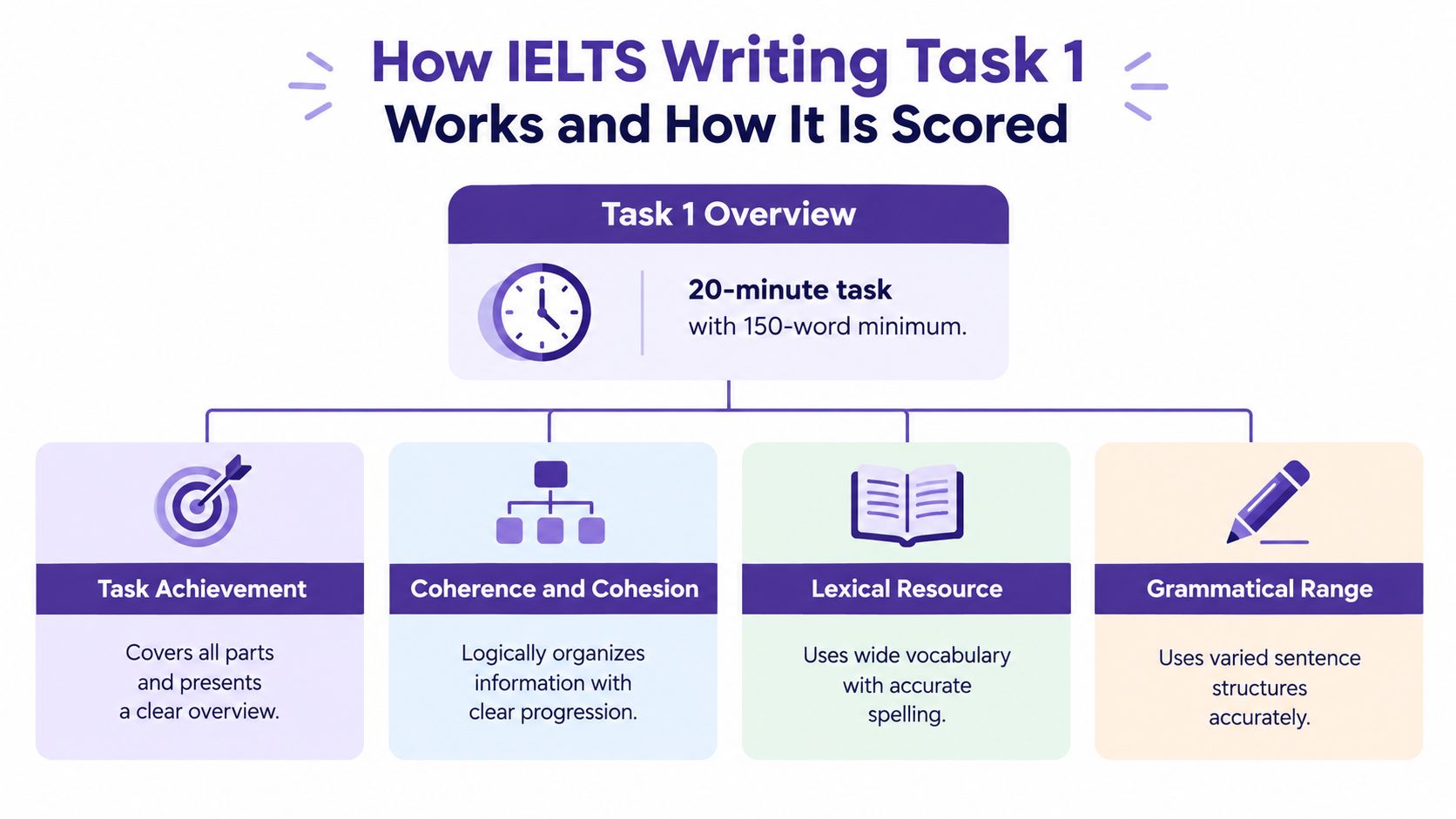
Academic Task 1 asks you to summarize visual information in at least 150 words. The task appears as part of the 60-minute Writing test, and because Task 2 contributes more to the final Writing score, many teachers and official preparation materials recommend using roughly one third of your writing time, about 20 minutes, for Task 1, while keeping enough time for Task 2 (IELTS Academic Writing format).
Your Writing score is based on four equally weighted criteria: Task Achievement, Coherence and Cohesion, Lexical Resource, and Grammatical Range and Accuracy (IELTS Writing band descriptors, May 2023).
The four criteria are equally weighted
No single criterion outranks the others in the published scoring system. A strong Task 1 response needs to perform well across all four areas.
Task Achievement asks whether you addressed the task appropriately, selected key features, and supported them with relevant detail.
Coherence and Cohesion looks at organization, sequencing, and how clearly ideas and comparisons are connected.
Lexical Resource covers range, accuracy, and appropriacy of word choice.
Grammatical Range and Accuracy covers sentence variety and control.
That balance matters. Strong vocabulary cannot compensate for a missing overview, and accurate grammar alone cannot fix poor feature selection.
A short, accurate overview usually contributes more than a long paragraph of loosely connected figures.
Task Achievement is not Task Response
These terms are easy to mix up because they belong to different IELTS Writing tasks.
In Academic Task 1, the criterion is Task Achievement. It focuses on whether you summarized the visual appropriately, highlighted key features, and supported those features with relevant data.
In Task 2, the criterion is Task Response. That criterion applies to essay questions and focuses on answering the prompt, presenting a position, and developing ideas.
If you are preparing for Academic Task 1, use the term Task Achievement and evaluate your writing against that standard.
What to decide before you write
Before writing your first sentence, decide three things:
What is the overall picture?
Which features are the most important?
How should the details be grouped?
That brief planning step often improves both Task Achievement and Coherence and Cohesion. It helps you write an overview early, avoid unnecessary detail, and build body paragraphs around real comparisons rather than a list of separate figures.
Academic Task 1 format explained
This article focuses only on the Academic version of Task 1. If you also need the other module, see this guide to General Training Writing. In this module, you are not writing an opinion essay or a letter. You are summarizing information presented visually.
What kinds of visuals appear
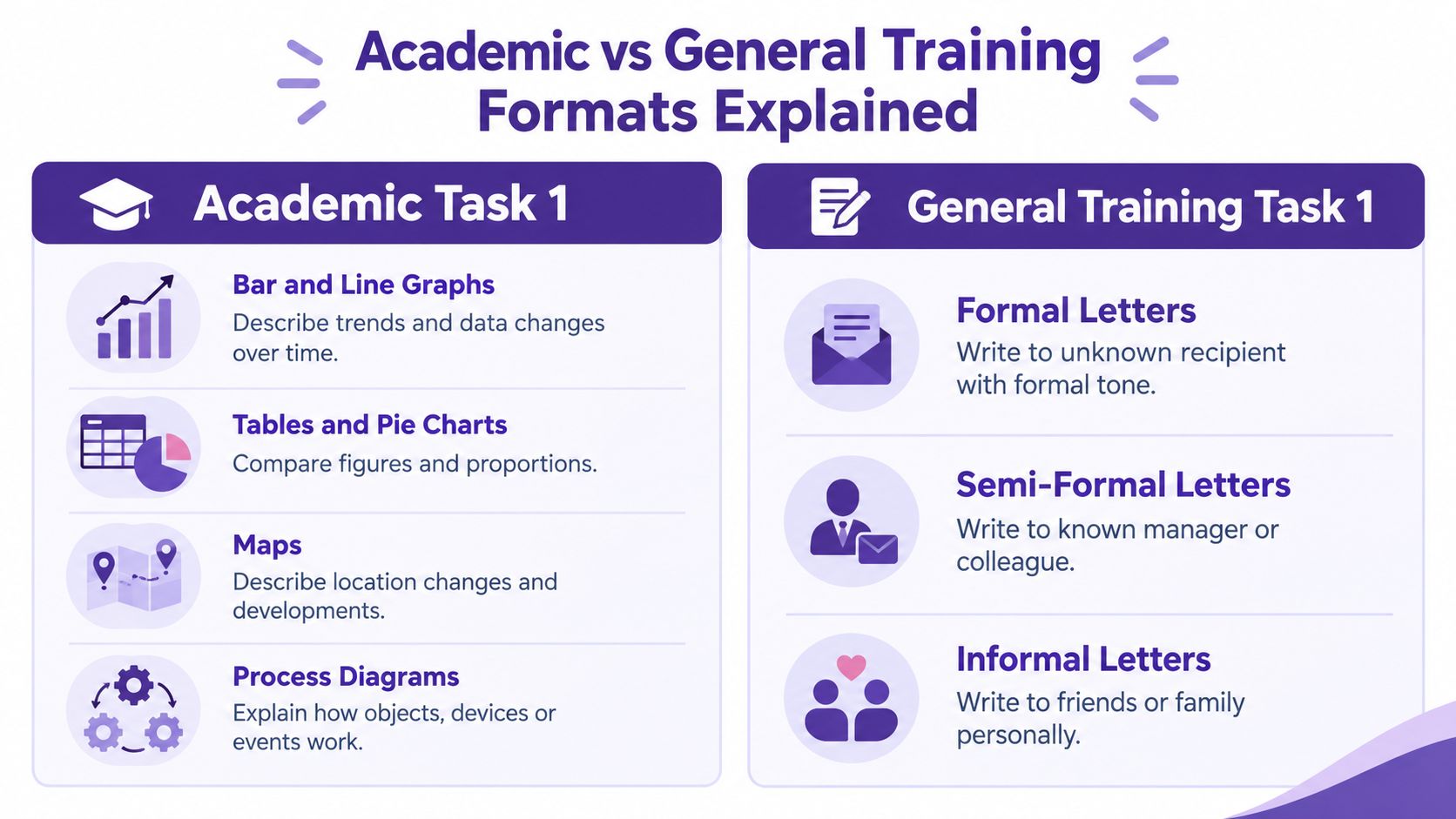
Academic Task 1 may ask you to describe bar charts, line graphs, tables, pie charts, maps, or process diagrams showing objects, devices, processes, or events, as described in the IELTS Academic Writing format.
Some tasks contain one visual. Others combine two related visuals, such as a chart and a table. In both cases, the goal stays the same: report the main features clearly and accurately.
What the task asks you to do
Academic Task 1 typically asks you to summarize the information by selecting and reporting the main features, and make comparisons where relevant. That wording is important because it tells you what the examiner is looking for:
selecting means not every detail deserves equal attention
reporting means accuracy matters
main features means you need an overview
comparisons where relevant means body paragraphs should show relationships, not just isolated numbers
For process diagrams and maps, the same principle applies. You still need to identify the main stages or main changes rather than describing every tiny element in the same level of detail.
Official IELTS preparation and research resources
If you want materials grounded in the official test, start with IELTS resources such as:
the official IELTS preparation area, including Writing support and sample tasks at IELTS Prepare
IELTS research publications and validation work available through the IELTS Research Reports
These are better reference points than unofficial trend claims because they show how the test is designed, scored, and prepared for.
Understanding Bands 5 to 9 across all four criteria
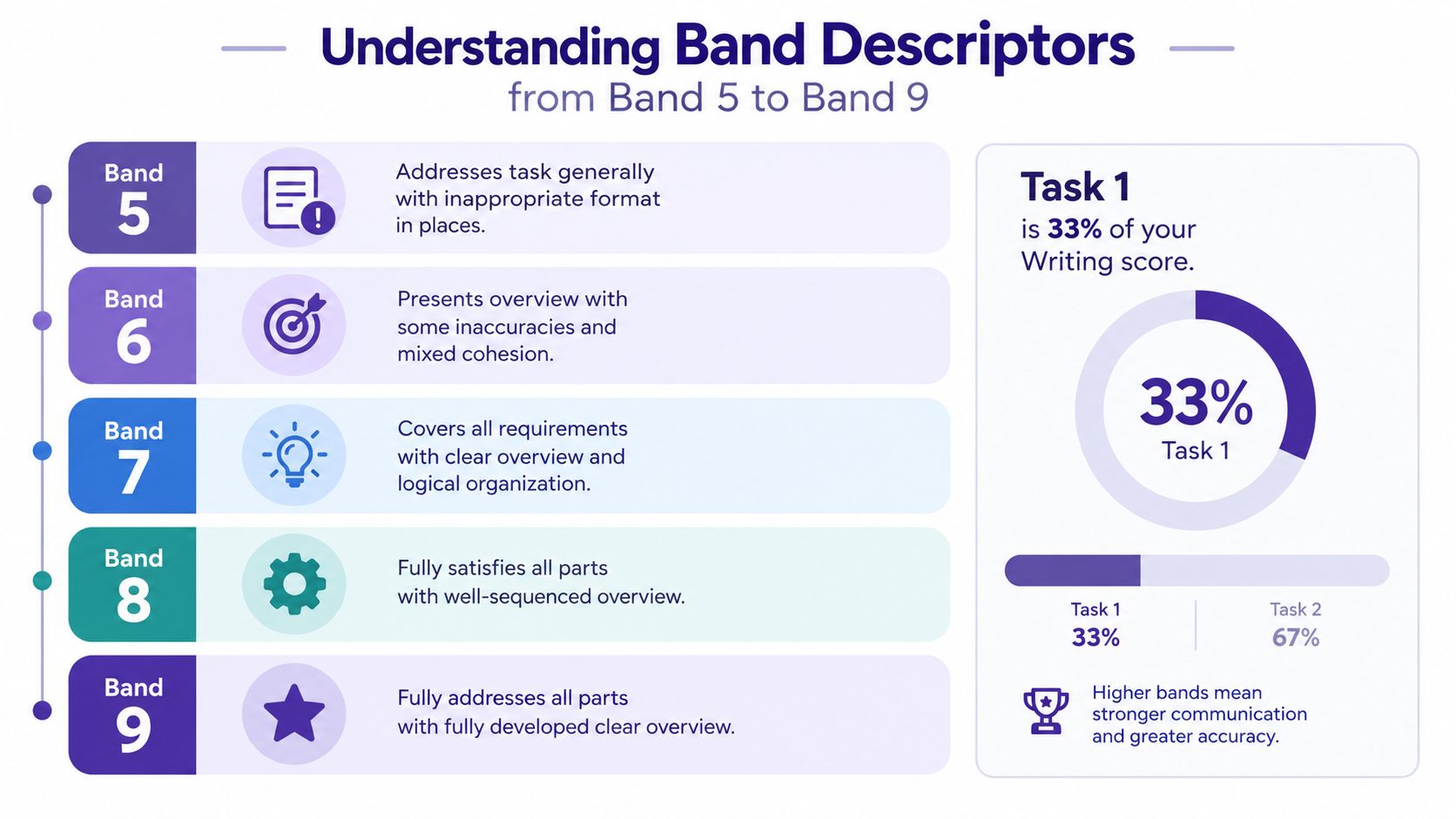
The public band descriptors were updated in May 2023, and they describe performance for each Writing criterion separately. For Academic Task 1, the safest way to interpret them is criterion by criterion, not as a single vague impression (IELTS Writing band descriptors, May 2023).
Band 5 profile
At Band 5, a response shows limited control across the four criteria.
Task Achievement: generally addresses the task, but key features may be inadequately covered, unclear, or insufficiently supported.
Coherence and Cohesion: shows some organization, but progression may be weak and relationships between ideas may not always be clear.
Lexical Resource: uses a limited range of vocabulary, with noticeable inaccuracies, repetition, or inappropriate word choice.
Grammatical Range and Accuracy: uses only a limited range of structures, and errors are frequent enough to reduce clarity at times.
A typical Band 5 script may mention some relevant data but fail to build a clear overview or logical grouping.
Band 6 profile
At Band 6, control is more consistent but still uneven.
Task Achievement: addresses the task requirements, attempts a relevant overview, and adequately highlights selected key features with supporting figures or data.
Coherence and Cohesion: arranges information and ideas coherently and there is a clear overall progression.
Lexical Resource: uses an adequate range of vocabulary for the task.
Grammatical Range and Accuracy: uses a mix of simple and complex sentence forms, and makes some errors in grammar and punctuation but they rarely reduce communication.
Band 6 is often where the writer starts to move from listing data to explaining patterns, but the overview or paragraphing may still lack full control.
Band 7 profile
At Band 7, the response becomes clearly purposeful and easier to follow.
Task Achievement: covers the requirements of the task. The content is relevant and accurate, and there is a clear overview of the main trends, differences, or stages.
Coherence and Cohesion: logically organizes information and ideas, and there is clear progression throughout.
Lexical Resource: uses a sufficient range of vocabulary to allow some flexibility and precision.
Grammatical Range and Accuracy: uses a variety of complex structures with some flexibility and accuracy.
This is the band many candidates aim for because it reflects clear selection, a visible overview, and language that is accurate enough to support meaning without constant strain on the reader.
Band 8 profile
At Band 8, the response shows strong control across the criteria.
Task Achievement: covers all requirements appropriately, relevantly, and sufficiently; key features are skillfully selected, clearly presented, highlighted, and illustrated.
Coherence and Cohesion: sequences information and ideas logically, and cohesion is well managed.
Lexical Resource: uses a wide range of vocabulary fluently and flexibly, with only occasional inaccuracies.
Grammatical Range and Accuracy: uses a wide range of structures with only occasional errors or inappropriacies.
A Band 8 script usually feels efficient. The main patterns are easy to identify, the comparisons are well chosen, and the language supports precision.
Band 9 profile
At Band 9, the response fully satisfies the task and shows highly natural control.
Task Achievement: fully satisfies all the requirements of the task.
Coherence and Cohesion: uses cohesion in such a way that it very rarely attracts attention.
Lexical Resource: uses a wide range of vocabulary with very natural and sophisticated control of lexical features.
Grammatical Range and Accuracy: uses a wide range of structures with full flexibility and accuracy.
Band 9 is not about sounding ornate. It is about complete, accurate, and effortless control.
Data description strategies for overviews and comparisons
A common difficulty in Academic Task 1 is deciding what to leave out. The visual often contains more information than you can usefully cover in a concise response, so selection is central to the task.
Scan, group, overview, compare
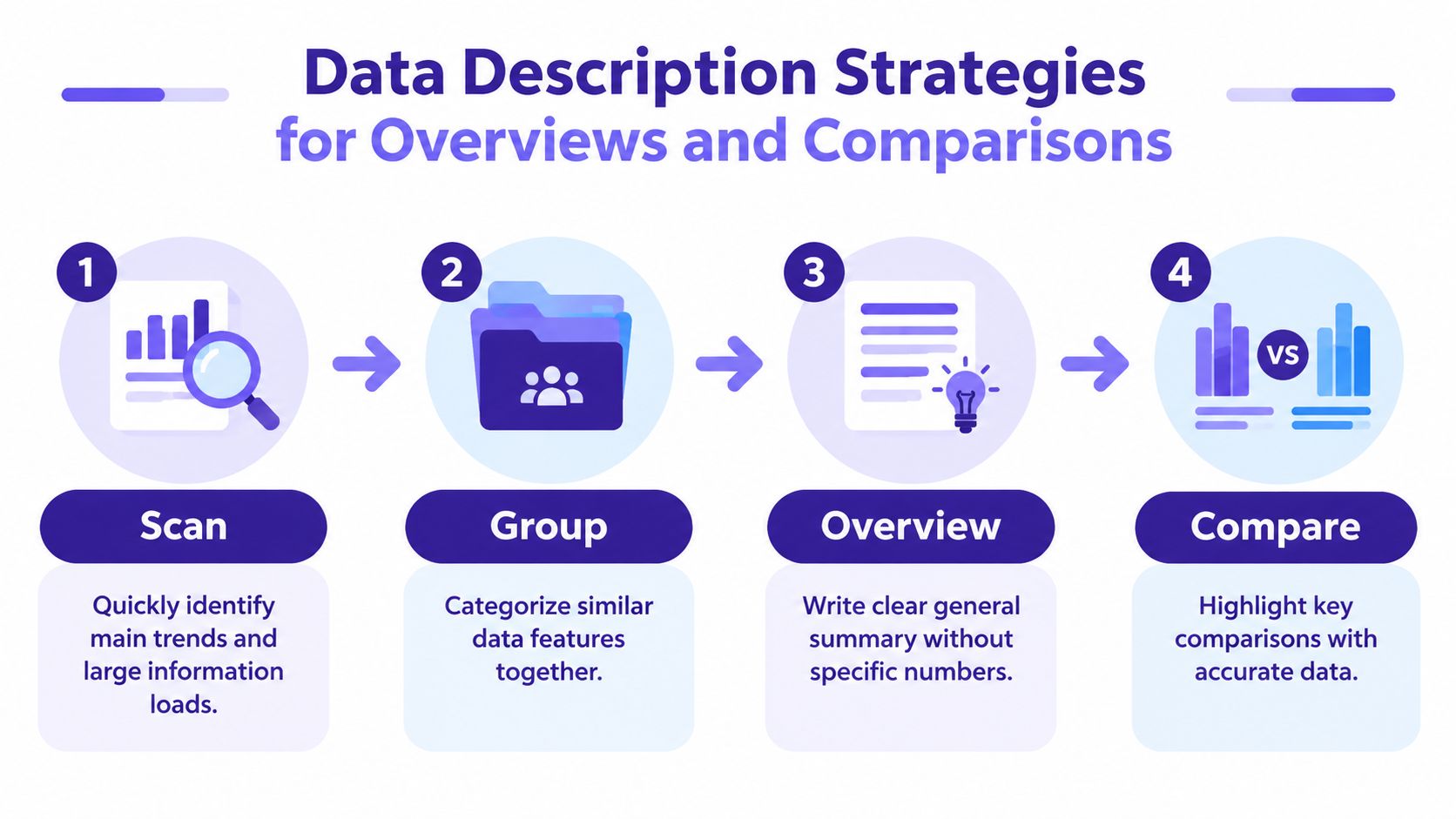
A practical sequence is:
Scan the visual for big patterns before reading every number.
Group related data, such as categories with similar levels or lines with similar movement.
Write the overview by summarizing the main trends, differences, or stages.
Compare the most important details in the body paragraphs.
This sequence helps you avoid a common mistake: starting with isolated figures before you know what the overall pattern is.
What to omit on purpose
In Task 1, omission can be a sign of good judgment. If a detail does not help explain a key feature, it may not need a full sentence.
For example:
if several categories stay close together, you can report them as a group
if one change is much more significant than the others, it usually deserves more attention
if a small fluctuation does not affect the overall trend, it may need little or no mention
The goal is not to compress every data point into the answer. The goal is to explain the visual clearly.
Pattern recognition matters more than topic prediction
Trying to predict exact topics is usually less useful than building fast pattern recognition. If you can quickly identify upward and downward trends, rank categories, notice clusters, and describe stages of change, you will be better prepared for a wide range of Academic Task 1 prompts.
One useful question is: What would I say if I had to summarize this visual in one sentence? The answer often becomes the basis of your overview.
Band 7 language toolkit and one annotated sample answer
Vocabulary matters in Task 1, but it helps only when it improves precision. The examiner does not reward difficult words on their own. The real aim is to describe the visual clearly enough that the main features are easy to follow.
Language choices that help scoring
Compare these two overview sentences:
Weak overview: The chart shows different changes in the figures over time.
Stronger overview: The chart shows steady growth in one category, a sharp decline in another, and little overall change in the remaining figures.
The stronger version gives the reader a usable summary of the whole visual.
The same applies to body sentences:
Weak comparison: The number was bigger and it changed a lot.
Stronger comparison: The figure was highest at the start, then fell sharply, before stabilizing in the final period.
Useful language in Academic Task 1 often does one of four jobs:
reports change: rose, fell, declined, climbed, remained stable
reports comparison: higher than, lower than, similar to, the largest, the smallest
reports degree: slightly, steadily, sharply, marginally, considerably
reports stage in maps or processes: initially, subsequently, finally, after that
Precision matters more than complexity. A simple, accurate phrase scores better than an ambitious phrase used incorrectly.
Original Academic Task 1 sample response
Sample prompt:
The data table below shows the percentage of households in five income groups that owned a car in one city in 2010. Summarize the information by selecting and reporting the main features, and make comparisons where relevant.
Data used for this model:
under $20,000: 35%
$20,000 to $39,999: 55%
$40,000 to $59,999: 72%
$60,000 to $79,999: 83%
$80,000 and above: 91%
Sample answer:
The data table compares the proportions of households in five income bands that owned a car in a particular city in 2010.
Overall, car ownership rose steadily with income. Households in the highest income group were far more likely to own a car than those earning under $20,000, while the three middle bands followed a clear upward pattern between these two extremes.
In the lowest income category, only 35% of households had a car. This figure increased to 55% among those earning between $20,000 and $39,999, a rise of 20 percentage points. Ownership then climbed further to 72% in the $40,000 to $59,999 group.
The upward trend continued in the two highest bands. Among households with incomes of $60,000 to $79,999, 83% owned a car, and the proportion peaked at 91% in the $80,000-and-over group. Overall, the gap between the lowest and highest income categories was substantial, at 56 percentage points.
Criterion-based annotations
Here is why this sample would likely sit around Band 7 if written accurately under exam conditions:
Task Achievement: The response gives a clear overview, identifies the main pattern, and supports it with selected data. It does not try to report every possible statistic beyond what is needed.
Coherence and Cohesion: The information is grouped logically. The first body paragraph covers the lower to middle income bands, and the second covers the upper bands. The progression is easy to follow.
Lexical Resource: Vocabulary is appropriate and reasonably varied, including terms such as income bands, rose steadily, climbed further, peaked, and gap.
Grammatical Range and Accuracy: The response uses a mix of sentence forms, including comparison and reporting structures, with generally good control.
It is also useful to note what this sample does not do. It does not speculate about why richer households owned more cars, and it does not insert opinions. Academic Task 1 rewards accurate reporting, not explanation beyond the data.
One place that offers IELTS Writing Task 1 sample reports and related examples is Cathoven's sample report page, which can help you study how task features are selected and described in exam-style responses.
How to use sample answers well
When you read a model answer, ask practical questions:
Overview check: Can I identify the main pattern in one or two sentences?
Selection check: Did the writer focus on the most important features?
Grouping check: Are similar items discussed together?
Language check: Does each sentence add a trend, comparison, or stage?
A sample answer is most useful when you study it as a set of decisions rather than a script to memorize.
Your next steps to improve your Academic Task 1 score
If your Task 1 responses often feel crowded or unfocused, start by checking your overview. Can a reader understand the main trend, difference, or stage sequence quickly? If not, improve that first.
Then review your body paragraphs:
Did you select the most important features?
Did you group related details logically?
Did you support the overview with accurate data?
Did you use vocabulary that made the comparisons clearer?
In terms of timing, remember that Task 1 sits inside the 60-minute Writing test. A practical plan is to spend a few minutes analyzing the visual, write an overview early, and leave most of the remaining time for Task 2, which has greater weighting in the final Writing score (IELTS Academic Writing format).
For more structured preparation, see Cathoven's IELTS academic preparation guide. It can help you build a study plan that covers writing as a whole, not just one isolated task.
Finally, review each practice response against the official descriptors, not just general impressions. Check whether you achieved the task, organized the answer clearly, used vocabulary precisely, and kept grammar accurate enough to support meaning. That makes improvement more measurable and much closer to the way IELTS Writing is actually scored.