IELTS General Training Writing: A Complete Guide
Candidates who perform well in IELTS General Training Writing do not depend on guesswork or memorized templates. They make controlled decisions under time pressure. In one hour, you must produce two distinct pieces of writing: a practical letter for a specific reader and a developed essay on a broader issue. Success depends on understanding purpose, selecting an appropriate register, organizing ideas logically, and maintaining accuracy while writing efficiently.
High band scores come from precision. You must address the task fully, present information in a sequence the examiner can follow easily, use vocabulary that fits the context, and demonstrate grammatical range without losing control. Memorized responses are a weak strategy. Examiners can identify formulaic writing quickly, and prepared language cannot reliably match the task purpose, the relationship with the reader, or the exact demands of the question.
IELTS General Training Writing at a Glance
The IELTS General Training Writing module has two tasks in 60 minutes.
Task 1 is a letter of at least 150 words and is best completed in about 20 minutes.
Task 2 is an essay of at least 250 words and is best completed in about 40 minutes.
The two tasks require 400 words minimum in total.
Task 2 contributes twice as much to the Writing score as Task 1, so it has a greater effect on your final Writing band.
Task 1 is judged using Task Achievement, while Task 2 is judged using Task Response.
High scores come from answering the exact prompt, maintaining the right tone, organizing ideas clearly, and using vocabulary and grammar accurately.
Memorized introductions and memorized body paragraphs are risky because they often fail to answer the real question.
Table of Contents
- IELTS General Training Writing at a Glance
- What the IELTS General Training Writing Module Looks Like
- How Examiners Score Your Writing Using the Four Band Criteria
- Task 1 Letters That Match the Right Tone and Purpose
- A Sample Task 1 Letter Annotated by Band Criteria
- Task 2 Essays That Handle Opinion, Discussion, and Problem Questions
- A Sample Task 2 Essay Annotated by Band Criteria
- Targeted Practice Strategies That Move Your Band Score
- Your Four-Week Study Plan Before Test Day
What the IELTS General Training Writing Module Looks Like
The Writing module consists of two tasks completed in 60 minutes. Task 1 requires a letter of at least 150 words, and Task 2 requires an essay of at least 250 words. Official IELTS guidance recommends approximately 20 minutes for Task 1 and 40 minutes for Task 2. Because Task 2 carries twice the weight of Task 1, candidates should protect sufficient time to plan, develop, and review the essay carefully. You can review the official General Training Writing format before you practise.
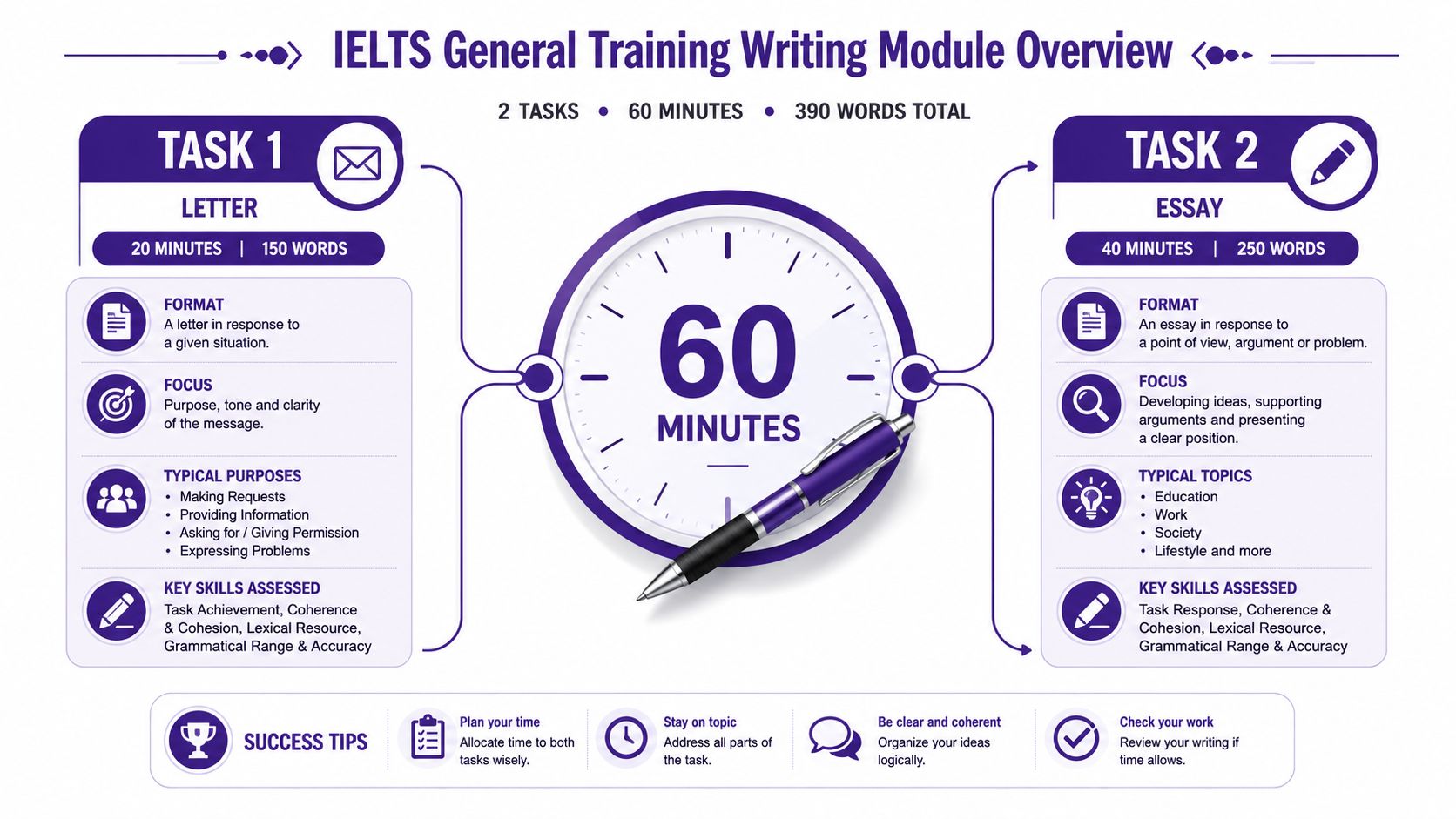
Task 1 is always a situation-based letter, not a chart, graph, map, or diagram description. The prompt provides a context and three bullet points. Those bullet points are mandatory. They define the content your letter must communicate, so even a fluent response can lose marks if one point is missing, vague, or underdeveloped.
A disciplined reading routine is helpful:
Identify the relationship. Determine whether you are writing to a friend, colleague, manager, landlord, or organization.
Underline the purpose. Clarify whether you are complaining, requesting, apologizing, explaining, inviting, or persuading.
Turn each bullet into a content question. Decide what information must be given and what action the reader is expected to take.
Choose the register before writing. Your greeting, word choice, sentence patterns, and closing should all match the reader appropriately.
Task 2 follows the essay format familiar to many IELTS candidates. You must present and support a response to a point of view, argument, or problem, with at least 250 words in about 40 minutes, as the official guidance explains in this General Training Task 2 overview. Topics often relate to everyday life, including work, neighbourhoods, education, transport, or family decisions. Unlike Task 1, Task 2 requires a clear position that answers the specific question, supported by relevant reasons and examples.
Practical rule: Reserve a short final review period. Confirm that every bullet point has been addressed in Task 1, that your position is explicit in Task 2, and that grammar and spelling errors do not interfere with clarity.
How Examiners Score Your Writing Using the Four Band Criteria
Examiners assess writing using four criteria, although the first criterion differs by task. Task 1 uses Task Achievement. Task 2 uses Task Response. Both tasks are also evaluated for Coherence and Cohesion, Lexical Resource, and Grammatical Range and Accuracy. The official IELTS Writing band descriptors make it clear that strong scores depend on fulfilling the task requirements as well as demonstrating effective language control.
In practice, the difference between a band 7 and a band 8 response is rarely one sophisticated word or one complex sentence. More often, it is the consistency of the response as a whole. A band 7 script is generally clear and well organized, but some ideas may be less fully developed or the language may be less flexible. A band 8 script addresses the task more completely, develops ideas more effectively, and maintains stronger control over tone, vocabulary, and grammar.
| Criterion | Band 7 on the page | Band 8 on the page |
|---|---|---|
| Task 1: Task Achievement | Covers all requirements of the letter, with a clear purpose and tone that is consistent and appropriate, with minimal lapses, though some points may be more fully extended than others. | Covers all requirements of the letter sufficiently, presents a clear purpose throughout, and manages tone consistently and appropriately. |
| Task 2: Task Response | Addresses all parts of the prompt, presents a clear position throughout, and supports main ideas, though some points may be more fully developed than others. | Sufficiently addresses all parts of the prompt, presents a well-developed response to the question, and supports ideas relevantly and clearly. |
| Coherence and Cohesion | Organizes information and ideas logically, with clear progression and generally appropriate paragraphing, while using cohesive devices with some flexibility, despite occasional inaccuracies or overuse and underuse. | Sequences information and ideas logically, with clear progression throughout and cohesive devices used well with little strain or repetition. |
| Lexical Resource | Uses a sufficient range of vocabulary with some flexibility and awareness of style and collocation, with occasional errors in word choice, spelling, or word formation. | Uses a wide range of vocabulary fluently and flexibly to convey precise meaning, with only occasional minor slips. |
| Grammatical Range and Accuracy | Uses a variety of complex structures and produces frequent error-free sentences, though some grammar and punctuation mistakes remain. | Uses a wide range of structures flexibly, with the majority of sentences error-free and only occasional unsystematic errors or slips. |
In practical terms, coherence does not mean inserting “firstly” and “finally” into every paragraph. It means making the relationship between ideas easy to follow. Likewise, lexical strength does not come from unusual vocabulary alone. A precise phrase such as “request a refund” is more effective than an ambitious word used inaccurately.
You can also estimate how your results combine with the IELTS band score calculator, while remembering that any automated score is only a practice estimate and cannot replace a criterion-by-criterion review.
Task 1 Letters That Match the Right Tone and Purpose
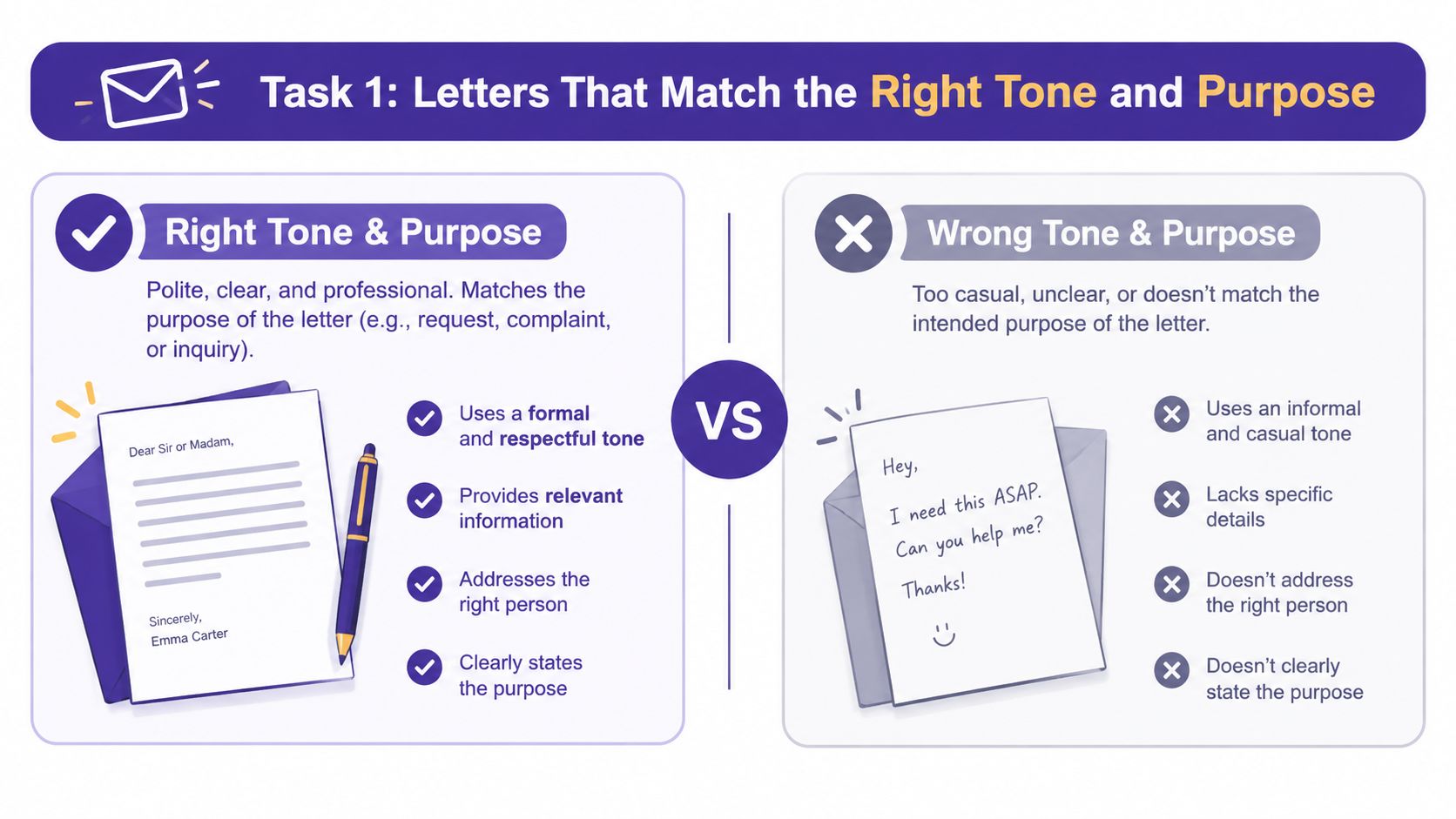
Task 1 evaluates more than knowledge of letter structure. It assesses whether you can control language appropriately according to the relationship between writer and reader. The official descriptors emphasize purpose, appropriate tone, and full development of the key points, which means tone is part of task achievement, not a superficial extra.
Formal letters
Use a formal register when writing to an unknown authority or an organization. A complaint to a builder, a request to a council, or a letter to a service provider typically requires a neutral greeting, full forms rather than casual contractions, and language that is clear, direct, and controlled.
A formal opening might be:
Dear Sir or Madam,
I am writing to complain about the condition of the apartment I recently rented.
This opening is effective because it states the purpose immediately. The rest of the letter should present the relevant facts, explain the impact, and make a reasonable request. Emotional exaggeration and overly conversational phrasing should be avoided. “This situation has caused considerable inconvenience” is more appropriate than “This has been a complete nightmare.”
Semi-formal letters
Semi-formal letters are addressed to someone you know but would not usually write to in a casual way, such as a former manager, neighbour, teacher, or colleague. The tone can be warmer while still remaining respectful. Polite modal phrases such as “I was wondering if you could” allow you to make a request without sounding abrupt.
For example:
Dear Ms Patel,
I hope you're well. I was wondering if you could provide a reference for my new application.
Contractions can appear in a semi-formal letter when they suit the relationship, but they should not make the message sound careless. The tone should show familiarity without weakening the professional purpose of the communication.
Personal letters
A letter to a friend or relative allows a more informal greeting, phrasal verbs, rhetorical questions, and more personal reactions. You might write, “Hi Sam,” or “It was great to hear from you,” and explain your plans in a natural conversational style.
Even so, the task requirements remain fully in force. If the prompt asks you to explain a decision, invite your friend, and suggest an activity, all three points still need clear and adequate development.
The bullet points determine the content. The relationship determines the style.
Many candidates confuse these two decisions. They choose a formal style because the topic feels serious, even when the reader is a friend, or they write too casually to an authority because the situation feels familiar. Read the recipient first, identify the purpose second, and let those two decisions shape the language.
A Sample Task 1 Letter Annotated by Band Criteria
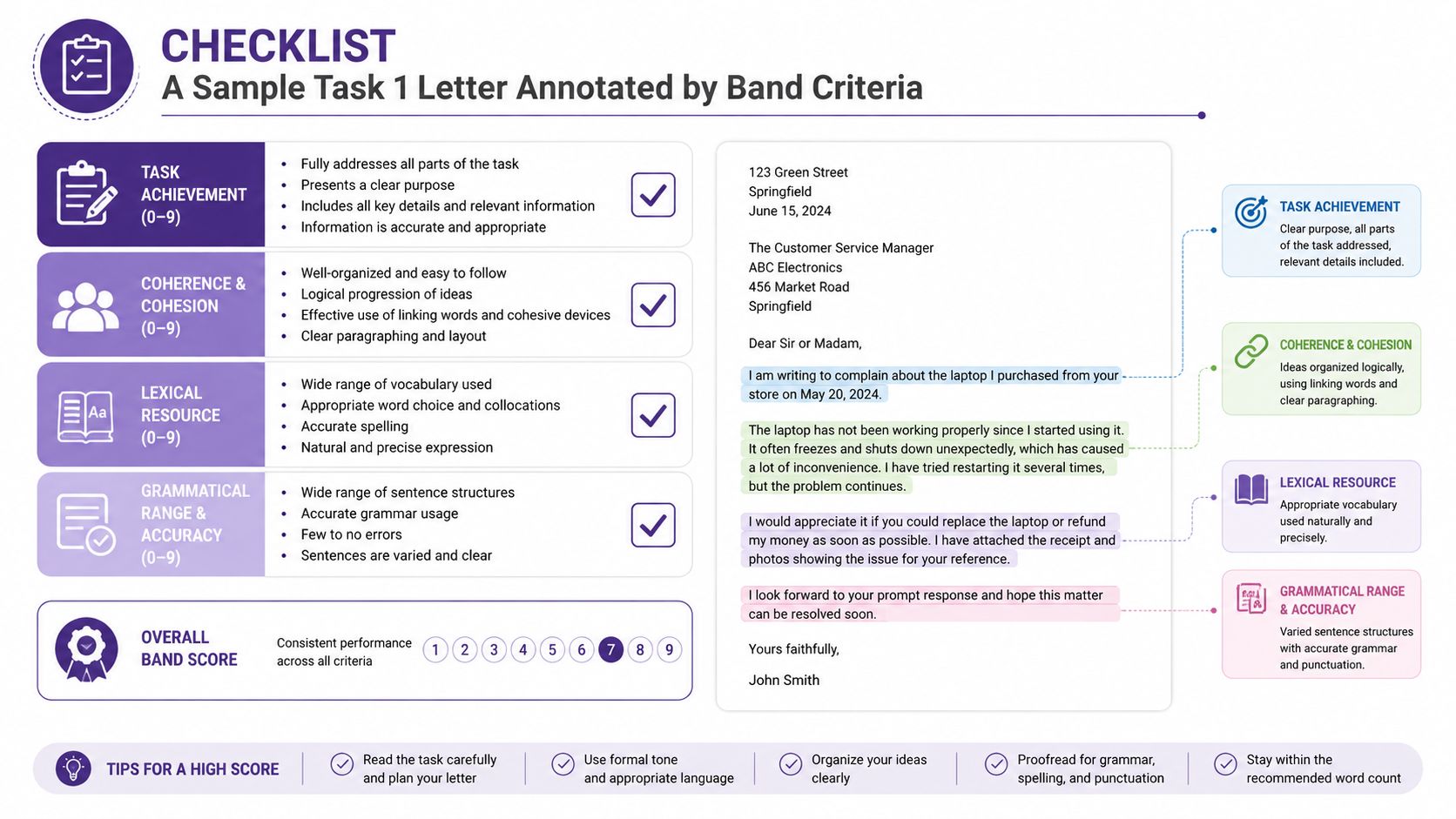
Suppose you are writing to a language exchange coordinator. You need to ask about available programs, explain your current level and goals, and request information about the schedule. The reader is known through an organization, so a semi-formal tone is appropriate.
Dear Mr Lewis,
I am writing to ask for further information about the language exchange programmes offered by your organisation. I am particularly interested in improving my spoken English because I will soon be working with international clients.
Regarding the available programmes, could you tell me whether participants are grouped according to their current level? I have studied English for several years, but I still find spontaneous conversations challenging. I would therefore prefer a group that provides regular speaking practice rather than one focused mainly on written exercises.
Furthermore, I would be grateful if you could explain how often the meetings take place and whether they are held online or at your centre. My work schedule changes from week to week, so this information would help me decide which programme would be most suitable.
Thank you for your assistance. I look forward to hearing from you.
Yours sincerely,
Alex Morgan
The first paragraph establishes the purpose immediately. The second develops the writer’s level and learning goals, while the third requests practical scheduling details. Notice that “regarding” connects the requests naturally without making the letter sound mechanical or formulaic.
The verb choices also contribute precision: “improving,” “grouped,” “find,” “prefer,” “provides,” “explain,” and “decide.” The sentence beginning “My work schedule changes” adds a clear reason for the request, which makes the communication more complete. The conditional structure in “if you could explain” increases politeness while keeping the request direct.
A weaker version might mention all three bullet points in one sentence each. That creates superficial coverage, but not full development. Another common weakness is an inconsistent tone, such as beginning with “Dear Mr Lewis” and ending with “See you soon,” which sends mixed signals about the relationship.
Use this audit after writing:
Task Achievement: Is the purpose clear in the opening, and has each bullet received specific information?
Coherence and Cohesion: Does every paragraph have a clear function, with connections that sound natural?
Lexical Resource: Are the words precise and appropriate, rather than simply advanced?
Grammar: Do sentence structures vary while remaining accurate?
The annotations below the letter show what to evaluate, not what to memorize. The content and phrasing should change when the prompt changes.
Task 2 Essays That Handle Opinion, Discussion, and Problem Questions
Task 2 becomes more manageable when you identify the function of the question before planning your paragraphs. An opinion essay requires a clear position. A discussion essay requires you to present opposing views and then state your own opinion. A problem and solution essay requires you to explain causes or effects and propose workable responses.
The most damaging mistake is to treat every prompt as a general topic and produce a familiar essay from memory. The wording of the question tells you what kind of response and structure the examiner expects. Memorized answers are especially risky because they often respond to the topic area without answering the actual question.
| Question Type | Thesis Placement | Body Structure | Evidence Type |
|---|---|---|---|
| Opinion | State your position in the introduction and reinforce it in the conclusion. | Build paragraphs that support your position, while addressing a relevant limitation if needed. | Reasons, explanations, and focused examples. |
| Discussion | Mention both views in the introduction before stating your own position. | Give each view fair treatment, then make the overall judgment clear. | Contrasting reasons and specific examples. |
| Problem and solution | Identify the central problem and indicate the response you will defend. | Explain causes or effects, then develop practical solutions. | Cause-and-effect reasoning and realistic proposals. |
For an argument question, your paragraphs should answer “why?” and “how?” A claim such as “public transport should improve” is incomplete until you explain how better service affects commuters and why that effect matters. An example may be personal, community-based, or hypothetical, but it should demonstrate the reasoning rather than simply repeat the topic.
Experience prompts require a different approach. If the question asks whether you have benefited from a particular decision or activity, a specific personal experience can add detail and credibility. Do not force an invented statistic into an experience paragraph. Explain what happened, what you learned, and how the experience supports your position.
Making structural decisions quickly
Use the prompt verbs as signals:
“Do you agree or disagree?” Choose a clear position and make each body paragraph support it.
“Discuss both views and give your opinion.” Present both sides before resolving the question.
“What are the problems and solutions?” Separate diagnosis from proposed action unless the ideas depend directly on each other.
Candidates also lose control when they write a conclusion that summarizes both sides but never answers the question. A conclusion should resolve the argument, not reopen it. For additional practice with contrasting viewpoints, use these IELTS discussion essay topics as planning exercises, then write a thesis before drafting the body paragraphs.
A Sample Task 2 Essay Annotated by Band Criteria
Consider this discussion question: Some people believe community service should be compulsory in schools, while others think students should choose whether to participate. Discuss both views and give your opinion.
A strong response might read as follows:
Schools can introduce students to community service either as a compulsory part of education or as a voluntary activity. Although compulsory participation ensures that more students experience civic responsibility, I believe voluntary service is more effective because students are more likely to contribute seriously when they have chosen the activity.
Supporters of compulsory service argue that schools should prepare young people to contribute to the communities in which they live. Requiring students to assist at local projects could expose them to social needs that they might otherwise ignore. For example, helping at a community garden may show students how shared public spaces depend on regular cooperation. Compulsory participation therefore gives every student an opportunity to develop practical awareness of community life.
However, voluntary participation can produce deeper commitment. A student who chooses to help at an animal shelter, for instance, may be willing to learn specific tasks and return regularly because the work matches a personal interest. By contrast, students who are forced to attend may complete only the minimum requirement and may even view the people they are helping as an obligation rather than as members of their community. In addition, voluntary service can help schools build a wider range of partnerships, since students with different interests may contribute to environmental groups, libraries, care homes, or local charities.
In my view, schools should make community service available and encourage participation, but they should not require every student to complete identical activities. Choice can increase motivation, while guidance from teachers can ensure that the experience remains purposeful. This balance would preserve the educational value of service without removing students' responsibility for their own decisions.
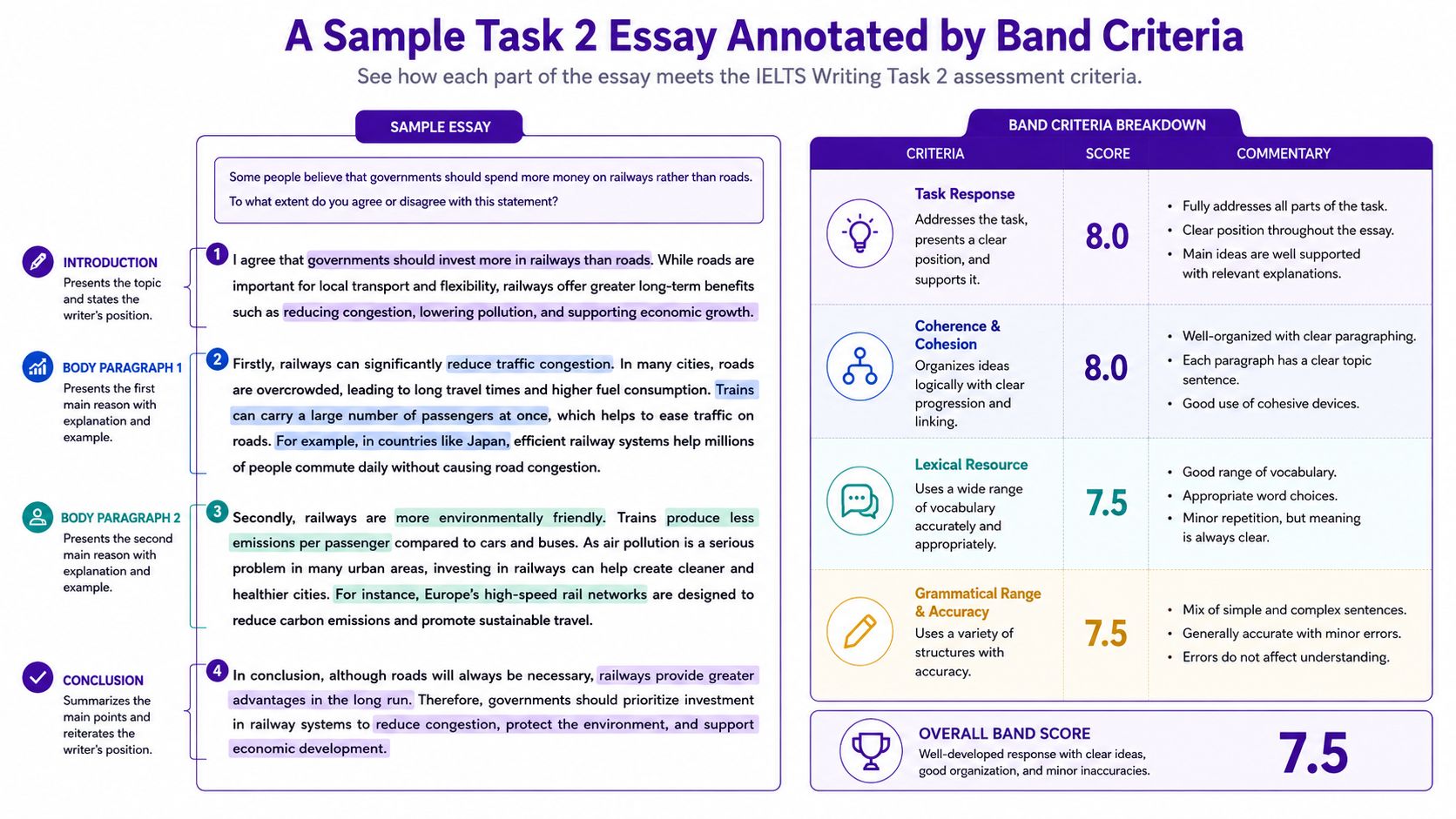
The introduction reflects the question structure by acknowledging both views and stating a clear position. The first body paragraph explains the compulsory model, while the second develops the case for voluntary participation. Each topic sentence signals the paragraph’s function, and the examples support the reasoning rather than appearing as disconnected anecdotes.
The final paragraph does more than repeat the introduction. It provides a qualified recommendation: participation should be encouraged, but students should retain meaningful choice. That qualification demonstrates control of the argument.
A weaker response might discuss only voluntary service, even though the question explicitly asks for both views. Another might rely on memorized phrases such as “In this modern era” without adding meaning. A third might conclude with “both views have advantages” and avoid making a judgment.
For a self-audit, ask:
Task Response: Did I cover both sides and answer the opinion requirement?
Coherence and Cohesion: Does each paragraph develop one central function?
Lexical Resource: Are words such as “civic responsibility,” “compulsory participation,” and “deeper commitment” precise in context?
Grammar: Have I used complex structures to express contrast, condition, and qualification accurately?
Targeted Practice Strategies That Move Your Band Score
Improvement is more reliable when you practise one decision at a time. Begin without a timer. For Task 1, read a prompt and write only the reader, purpose, tone, and one sentence for each bullet point. For Task 2, draft several thesis statements for the same question, then choose the one that answers the wording most directly.
Build control before speed
Work at paragraph level next. Take a weak body paragraph and revise it in three ways:
Make the topic sentence more specific.
Add the explanation between the claim and the example.
Replace repeated connectors or vague vocabulary with more natural alternatives.
Then compare your revision with a suitable model. You are not looking for identical wording. You are checking whether the model makes the logic easier to follow and whether the vocabulary suits the purpose.
Practise register switching
Use one situation, such as a noisy building, and rewrite it for three readers:
A council: formal complaint, precise description, reasonable request.
A neighbour: respectful explanation, cooperative suggestion.
A friend: personal reaction, informal language, direct invitation to help.
This drill develops a skill many candidates overlook, changing the language while keeping the facts consistent.
Review like an examiner
Review each draft against the four criteria, then record one specific weakness. Do not write “my vocabulary is poor.” Write “I repeat the same verb in three paragraphs” or “my conclusion does not state a position.” Specific diagnoses lead to specific practice.
For IELTS-specific revision, Cathoven's IELTS Writing page can be used to review writing against the relevant criteria. Cathoven provides automated feedback for General Training Task 1 letters and Task 2 essays, including criterion-level comments and practice score estimates.
Your Four-Week Study Plan Before Test Day
An effective plan moves from diagnosis to control, then from control to speed. Do not begin by writing full tests every day if you have not yet identified the decisions causing your errors.
Week 1
Complete one full Writing module under timed conditions. Review both tasks using Task Achievement for Task 1, Task Response for Task 2, Coherence and Cohesion, Lexical Resource, and Grammatical Range and Accuracy. Identify the weakest criterion and collect examples from your own writing, such as incomplete bullet coverage, unclear thesis statements, repetitive vocabulary, or sentence errors.
Week 2
Focus on Task 1. Write one letter each study day, rotating through formal, semi-formal, and personal situations. Before drafting, state the relationship and purpose in simple terms. After drafting, compare your response with a model or obtain informed feedback, paying particular attention to whether the register changes appropriately.
Week 3
Turn to Task 2. Alternate between opinion, discussion, and problem-solution prompts. Spend your planning time identifying the question type, writing a thesis, and assigning one clear role to each body paragraph. Practise both argument examples and personal experiences, because the evidence should match the prompt rather than your preferred essay style.
Week 4
Complete two full timed modules. Between them, review your most consistent weakness instead of trying to change everything at once. Before test day, check your word count, timing, handwriting legibility, paragraphing, spelling, and the clarity of your final position.
On the day of the test, read the recipient and purpose before writing Task 1, and read every instruction in Task 2 before deciding on your position. You do not need a perfect template. You need a clear plan, controlled register, relevant development, and enough time to review what you have written.
Use Cathoven's IELTS Writing page to practise IELTS General Training letters and essays with criterion-level feedback, then use the results to target task coverage, organization, vocabulary, or grammar in your next draft. Start with one timed response and turn its feedback into a focused study plan for the coming week.