IELTS General Training Reading Practice Test: A Full Prep Guide
You sit down to an IELTS General Training Reading practice test, start the timer, and feel confident through the first few questions. Then one notice contains unfamiliar wording, a True/False/Not Given item refuses to behave, and Section 3 arrives with far less time than you expected. Most lost marks do not come from a lack of English alone. They come from using the wrong reading method for the section in front of you.
An effective IELTS Reading practice test for General Training should therefore do more than provide questions. It should reflect the exam structure, show how question types work across the paper, and help you decide where every minute goes. The official format gives you three sections, 40 questions, and 60 minutes, with a total reading load of 2,150 to 2,375 words. The official General Training Reading format makes the challenge clear: you must read selectively, track evidence, and keep moving.
Table of Contents
- What the General Training Reading Test Actually Looks Like
- The Three Sections and How Their Difficulty Climbs
- Question Types You May Encounter
- A 60-Minute Timing Plan That Holds Under Pressure
- Working Through a Section 1 Approach
- Building a Four-Week Practice Plan That Targets Weak Spots
- Common Mistakes and What to Do in the Final Week
What the General Training Reading Test Actually Looks Like
You enter the exam with 60 minutes on the clock. Three sections are waiting, and you have 40 questions to answer before time ends. The texts come from practical sources such as notices, advertisements, company handbooks, guidelines, books, magazines, newspapers, and online resources, reflecting the kinds of reading tasks people may encounter in daily life in an English-speaking environment. IELTS describes the General Training reading materials in these everyday terms.
The official text length is 2,150 to 2,375 words. That does not mean you should read every word at the same speed. Short functional texts reward rapid locating, while longer passages demand more careful attention to relationships, claims, and paraphrase.
What each mark means
Every correct answer earns one mark. Final results are reported on the 1 to 9 band scale, in half-band increments such as 6.5 or 8.5, as stated in the official format guidance. The official IELTS structure and scoring information should be your reference point when you review a practice test.
There is no benefit in leaving an answer blank. If you cannot confirm an answer, make your best choice and record it. A blank guarantees no mark, while an informed guess at least gives you an opportunity.
Treat your on-screen answers as part of the task
If you take IELTS on computer, you enter answers directly on screen during the test rather than transferring them to a separate paper answer sheet. Practise with that format in mind. Move comfortably between the passage and the questions, enter answers carefully, and keep checking any stated word limit.
Spelling still matters. A spelling error can cost the mark even when your comprehension was correct. For completion questions, grammar matters too. If the answer requires a plural noun and you write the singular form, your understanding may be close, but the recorded answer still may not be accepted.
IELTS announced that from mid-2026, all IELTS tests will move to computer delivery, while exact timelines will vary by market and test centre. Always confirm the current delivery options in your location before test day. The official IELTS update on test delivery is the best reference point.
Practical rule: Never let practice hide input habits. Enter answers in the same format and under the same pressure you expect to face on test day.
The Three Sections and How Their Difficulty Climbs
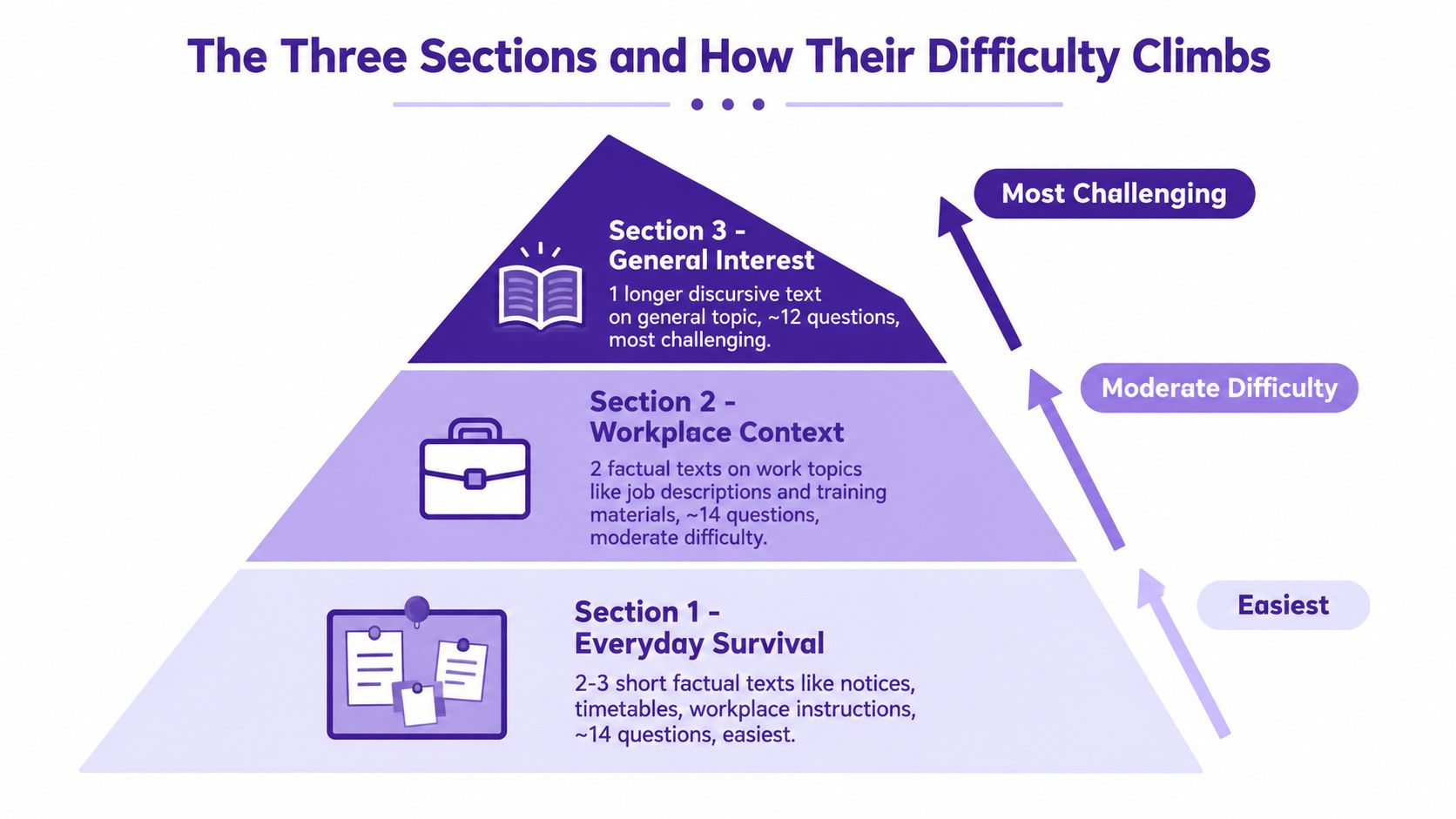
The General Training test is designed as a progression. Section 1 contains two or three short everyday texts, Section 2 contains two work-related texts, and Section 3 contains one longer general-interest text. The official IELTS format confirms this movement from practical reading to sustained comprehension.
Section 1 and everyday survival reading
Section 1 uses short factual texts. You may need to find a date in a notice, identify a service from an advertisement, or connect a timetable detail with a question. The language is practical, but practical does not mean automatic. Candidates often lose marks here because they rush, assume an answer from general knowledge, or overlook a small qualifier such as “only,” “before,” or “unless.”
Read for purpose. Ask what the text is doing, then locate the exact detail that answers the question.
Section 2 and workplace context
Section 2 presents two work-related texts. These may involve training, workplace procedures, company information, or guidelines. The language often becomes denser because the text explains processes, responsibilities, conditions, or policies.
This section tests whether you can follow information across a document without confusing a general statement with a specific rule. Identifying Information questions are especially useful here because they ask you to match a statement with what the text says.
Section 3 and general-interest comprehension
Section 3 contains one longer general-interest text. Its difficulty comes less from isolated vocabulary than from structure. You must track the writer's direction, distinguish evidence from opinion, and understand how one paragraph develops an idea.
The official sample question resources show why preparation should include more than one text genre. Section 1 trains quick scanning, Section 2 builds workplace reading control, and Section 3 requires sustained comprehension. The first section is also where careless mistakes can damage an otherwise strong performance, so speed should never replace verification.
Question Types You May Encounter
Recognising the task before solving it saves time. Official preparation guidance for General Training Reading includes formats such as multiple choice, True/False/Not Given, Yes/No/Not Given, matching information, matching headings, matching features, matching sentence endings, sentence completion, summary completion, note completion, table completion, flow-chart completion, diagram label completion, and short-answer questions. British Council's General Training Reading practice guidance lists these formats for preparation.
General Training Reading Question Types at a Glance
| Question Type | Officially described skill or task focus |
|---|---|
| Multiple choice | Choose the correct answer from a set of options |
| Identifying information, True/False/Not Given | Decide whether a factual statement agrees with, contradicts, or is not stated in the text |
| Identifying the writer's views or claims, Yes/No/Not Given | Decide whether the writer's view or claim agrees with, contradicts, or is not stated in the text |
| Matching information | Find specific information in the text |
| Matching headings | Match headings to sections or paragraphs based on the main idea |
| Matching features | Match a set of statements or pieces of information to a list of options |
| Matching sentence endings | Complete sentences by choosing the correct ending |
| Sentence completion | Complete sentences using words from the text, subject to the stated word limit |
| Summary completion | Complete a summary using words from the text or a list of options |
| Note completion | Complete notes using words from the text |
| Table completion | Complete a table using information from the text |
| Flow-chart completion | Complete stages in a process using information from the text |
| Diagram label completion | Label parts of a diagram using information from the text |
| Short-answer questions | Answer factual questions using words or numbers from the text |
Some formats deserve special attention. Matching headings and Yes/No/Not Given often require deeper paragraph-level understanding. Completion and short-answer tasks often depend on careful reading of instructions, including any word limit.
For a closer look at one of the most error-prone formats, use this guide to sentence completion questions. The first strategic decision is always the same: identify what the question asks before you search for the answer.
A 60-Minute Timing Plan That Holds Under Pressure
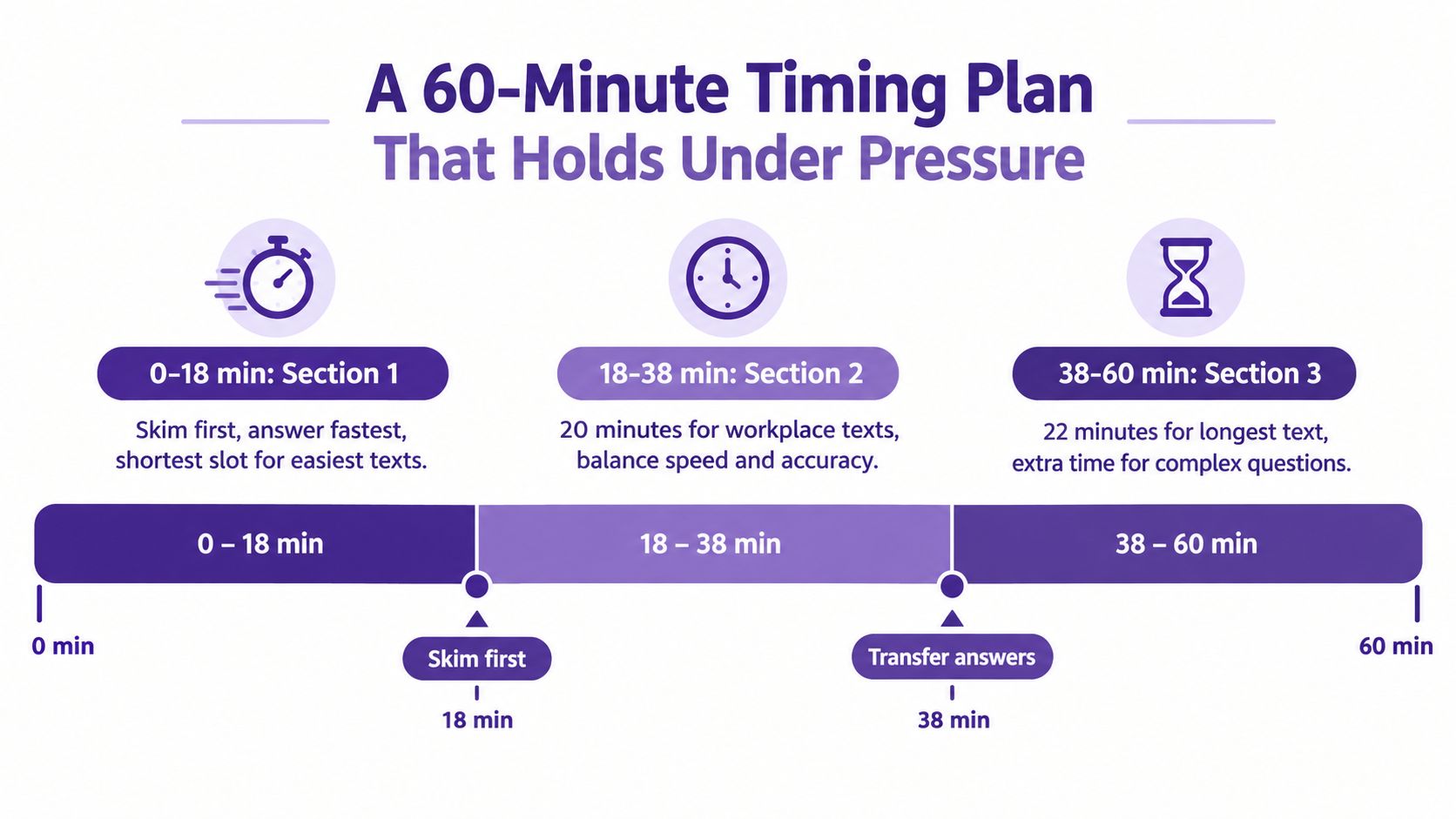
A useful starting plan divides the test into 18 minutes for Section 1, 20 minutes for Section 2, and 22 minutes for Section 3. Section 1 contains shorter, more accessible texts, while Section 3 contains the longest sustained reading task. Giving the final section a little more room protects you from making rushed inference decisions at the end.
Skim first, scan second
Start each passage with a controlled skim. Read the title, headings if available, and the opening sentences of paragraphs to establish the topic and direction. Do not try to memorise details at this stage.
Then scan for the information requested by the question. Mark distinctive keywords such as names, dates, locations, unusual nouns, or technical terms. Expect paraphrase. The passage may say “postpone the appointment,” while the question says “change the scheduled meeting.” Search for meaning, not identical wording.
A practical sequence looks like this:
Read the questions: Notice the answer type and any word limit.
Predict language: Think of possible synonyms before returning to the passage.
Locate the area: Use names, numbers, or unusual terms to narrow the search.
Read around the match: Check the surrounding sentences, not just one phrase.
Record immediately: Enter the answer while the location is fresh.
Keep moving when a question stalls
If one question has consumed about 90 seconds, make a provisional choice, mark it for review, and continue. A difficult item should not take time away from several questions you could answer confidently.
Record answers as you work. Leaving every decision until the end creates extra pressure when your attention is already stretched. Before relying on this timing plan, test it in a full IELTS Reading mock test online and review not just your score, but where the minutes disappeared.
Working Through a Section 1 Approach
Consider a typical workplace noticeboard task. You may have several short notices and a set of descriptions. Your job is to match each notice with the description that reflects its main purpose.
Do not begin by reading every notice word for word. First, skim all of them and label them mentally: one concerns a training session, another announces a room change, one gives a safety instruction, one advertises a staff service, and one explains a deadline. You are building a map before hunting for details.
Start with the purpose
Read the descriptions next. Underline the words that distinguish them. “A change to a scheduled activity” is different from “information about a required procedure,” even if both notices mention a date and a location.
Now return to the first notice. Suppose it says that a fire drill will take place near the rear entrance and asks staff to follow the supervisor's instructions. The correct description may not repeat “fire drill” exactly. It may describe mandatory safety action during an emergency exercise.
Eliminate distractors carefully
A distractor often contains information that appears in the notice but changes its purpose. A notice may mention a training room, for example, while its real function is to announce a timetable change. Match the central action, not the most familiar word.
Use a simple evidence check:
Main purpose: What does the notice ask, announce, or provide?
Exact support: Which phrase in the notice proves the match?
Contradiction: Does the option add a condition the notice does not support?
Paraphrase: Has the same idea been expressed with different wording?
If two options seem possible, compare the complete meaning. Do not choose because one option shares more vocabulary. IELTS questions often reward the stronger semantic match, not the most obvious repeated term.
Evidence before intuition: If you cannot point to the phrase or idea that supports your choice, keep searching.
For a question that appears to fit two notices, return to the task wording and check whether the option describes an event, a service, a rule, or a location. That category often separates the correct match from a tempting near-match. The same habit transfers well to tables, forms, and short-answer questions.
Building a Four-Week Practice Plan That Targets Weak Spots
A strong month of preparation is not a pile of random tests. It moves from diagnosis to focused repair, then returns to complete exam-format performance. Keep an error log with the question type, your answer, the correct answer, the evidence location, and the reason your decision failed.
A progression that protects your practice value
| Week | Core Activity | Checkpoint |
|---|---|---|
| Week 1 | Complete a baseline timed test and audit errors by question type | Identify the two weakest formats and the section where each error occurs |
| Week 2 | Drill the two weakest types with short exam-format extracts | Explain why each correct answer is supported and each distractor fails |
| Week 3 | Complete full timed mocks and review them deeply | Confirm whether accuracy holds across all three sections |
| Week 4 | Complete a final mock early in the week, then review lightly | Finish with an organised error log and a stable timing routine |
During Week 1, do not just record the total result. Separate errors caused by vocabulary, misreading, poor locating, incorrect inference, spelling, and timing. A candidate who misses matching headings for different reasons needs a different remedy from someone who understands the headings but runs out of time.
Week 2 should feel narrower. If True/False/Not Given and matching headings are weak, make those the main drills and use another format only for light maintenance. In Week 3, use complete tests to check whether your new decisions survive pressure, rather than assuming isolated improvement will transfer automatically.
Keep the Reading plan specific to your own error patterns.
In Week 4, avoid filling every day with fresh material. Use one final full test as a checkpoint, then revise vocabulary from your error log, rehearse on-screen answer habits, and revisit the question types that still cause hesitation. If you want structured guidance while analysing those patterns, IELTS exam coaching can provide a framework for targeted support.
Common Mistakes and What to Do in the Final Week
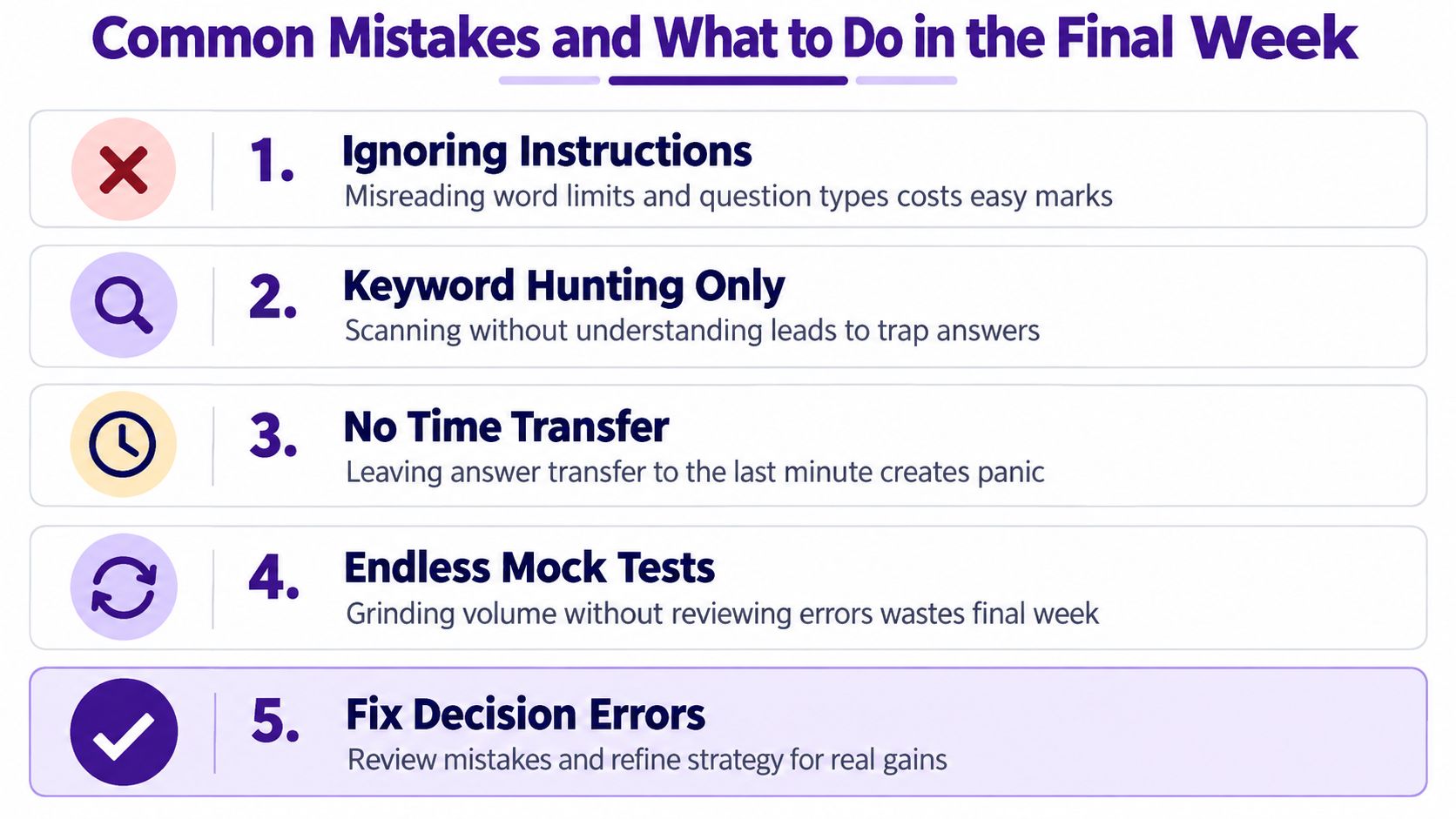
More practice tests do not automatically produce a higher result. In the final week, candidates often gain more from correcting decision errors than from completing another unreviewed paper. A test only becomes useful when you understand why you chose the wrong answer and what action would have prevented that choice.
Five habits that quietly cost marks
Overspending on Section 1: If you give the easiest section too much time, you reduce the opportunity to process Section 3 properly. Follow your planned limit and move on.
Treating Not Given as False: “False” means the passage contradicts the statement. “Not Given” means the passage does not provide enough information to decide.
Ignoring time markers: Dates, places, conditions, and sequence words can change an answer. Circle them when they appear in the question.
Entering the wrong answer in the wrong place: Check that each response matches the correct question number on screen.
Leaving True/False/Not Given until last: Delaying a question type you dislike often turns it into a rushed guessing exercise. Practise it under normal timing instead.
A useful final-week countdown looks like this:
Day 7: Complete one full Reading test under strict conditions.
Day 6: Review every error and classify the cause.
Day 5: Drill the question type that produced the most avoidable mistakes.
Day 4: Complete a focused Section 3 deep dive, paying attention to claims and paragraph purpose.
Day 3: Rehearse the complete timing plan with shorter targeted tasks.
Day 2: Review your error log, spelling patterns, and answer instructions.
Day 1: Practise your test-day routine and prepare your identification documents only. Do not start a demanding new test.
Cathoven provides IELTS-format Reading practice, including General Training modules, along with scoring and explanations that can help you connect an answer to the skill it tests. Use any platform or study method in the same deliberate way: practise, diagnose, correct, and then verify.
Final-week principle: Reduce uncertainty, not just your remaining study time.
If your test is approaching, use the next session to complete one timed General Training Reading paper, record every error by question type, and choose the two decisions you most need to fix. Visit Cathoven to practise IELTS-format General Training Reading with structured tests, scoring, and explanations that support this targeted review. Build your final preparation around evidence from your own answers, not the number of tests you finish.