Sentence Completion Questions: IELTS Strategies and Tips
The most popular advice about sentence completion questions is also the least useful: learn more vocabulary and fill in the blank. Vocabulary matters, but it doesn't explain why capable English users lose marks on answers they understand. The challenge is tracking logic, predicting grammar, locating the right information, and reproducing the answer with exact precision.
In IELTS, a completion can fail because the answer has the wrong grammatical form, comes from the wrong part of the passage, changes the meaning, contains a spelling error, or exceeds the permitted word count. Treat the task as a reasoning problem rather than a vocabulary quiz, and your practice becomes far more targeted.
Table of Contents
- Why Sentence Completion Questions Are Harder Than They Look
- Meaning isn't enough
- The high-scoring mindset
- How Sentence Completion Works in IELTS Reading and Listening
- A Step-by-Step Strategy for Answering Every Question
- Common Traps That Cost You Marks
- Worked Examples With Full Reasoning
- Building a Practice Routine That Targets Your Weakness
- Connecting Sentence Completion to Your Overall IELTS Score
Why Sentence Completion Questions Are Harder Than They Look
Sentence completion questions look familiar because the sentence frame gives you a strong feeling of control. You see a blank, think of a word that makes sense, and move on. That instinct causes many avoidable errors. The answer must satisfy several conditions at the same time, not just express a plausible idea.
First, you need to understand the relationship between the parts of the sentence. Words such as however, although, yet, and because tell you how the ideas connect. A sentence may begin with a positive description and then introduce a contrast. If you ignore the signal word, you may choose an answer that matches the first idea but contradicts the second.
Consider this frame:
Although the first method was simple, the second method was ______.
The word although prepares you for a contrast. The missing word may need to describe the second method as more complicated, more expensive, or less convenient. You can't decide from the word method alone. You need to read the sentence's internal logic.
Meaning isn't enough
A correct answer must also have morphosyntactic fit, meaning it must work grammatically inside the sentence. If the frame says “the main cause was,” the blank probably needs a noun phrase. If it says “the results were,” an adjective or adjective phrase may be required. In Listening, official guidance asks candidates to predict whether the missing item is a noun, adjective, verb, or number before the audio reaches the answer, as explained in the British Council's sentence completion guidance.
The answer also has to obey the instruction. A phrase can communicate the right meaning and still receive no mark if it uses more words than permitted or changes the required form. Strong candidates pause before writing and ask, “What kind of word belongs here, and what exact evidence supports it?”
The high-scoring mindset
Instead of asking, “What word do I know that fits?”, ask three narrower questions:
What does the sentence require grammatically?
What relationship does the connector create?
Where is the exact supporting information?
That shift matters because IELTS-format sentence completion rewards controlled reading and listening. You aren't being invited to invent a natural completion. You're extracting a precise answer from evidence and fitting it into a fixed frame.
How Sentence Completion Works in IELTS Reading and Listening
Sentence completion is a long-established IELTS question type that appears in both Reading and Listening. The basic appearance is similar, but the source of the answer changes the way you should work.
Reading requires exact passage language
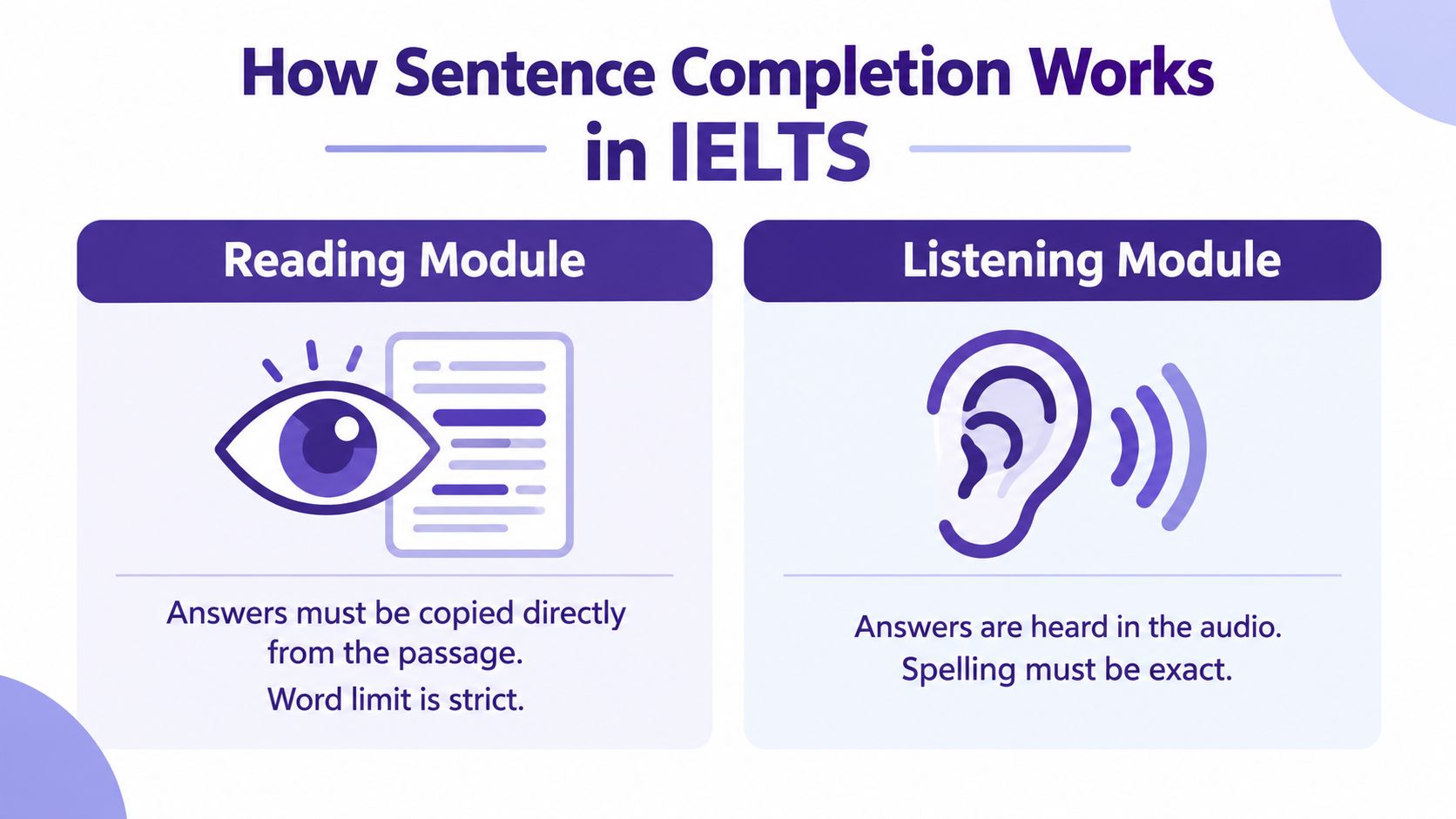
In Reading, the sentence frame summarizes or restates information from the passage. You must locate the relevant part of the text and copy the answer directly from it. You shouldn't replace the passage's wording with a synonym just because the synonym sounds more natural.
The instruction might say “NO MORE THAN TWO WORDS AND/OR A NUMBER.” Other tasks may use “NO MORE THAN THREE WORDS AND/OR A NUMBER.” The instruction is part of the question, not a suggestion. IELTS format guidance states that writing more than the word limit loses the mark IELTS Reading sentence completion guidance.
Reading completion tasks may appear as a short group of sentences. In official materials, the number of questions can vary by task, so focus on the instructions and layout printed above the questions rather than expecting a fixed set size official IELTS Reading test format.
Listening tests what you hear
In Listening, the answer should match the recording and the task requirements. In some cases, official answer keys may accept more than one valid form, but you still need to predict the blank before the audio arrives, follow the speaker's meaning, and write the answer accurately. Spelling matters because the examiner assesses the written response, not your intention.
A speaker may mention several related words before making the final point. They may also correct themselves, qualify an earlier statement, or give a number followed by a different number. Don't write the first plausible term automatically. Wait for the information that completes the sentence logically.
For dedicated practice, use this IELTS Listening practice test to rehearse prediction, attention, and answer checking under exam-format conditions.
The rule that applies to both modules
Whether you read the answer or hear it, check four things before moving on:
Does the answer fit the sentence grammatically?
Does it express the intended meaning?
Is the spelling correct?
Does it obey the word limit?
One weak check can cancel strong comprehension. Precision is part of the task.
A Step-by-Step Strategy for Answering Every Question
A repeatable process prevents panic and reduces guessing. Use the same sequence until it becomes automatic.
Start with the sentence, not the passage
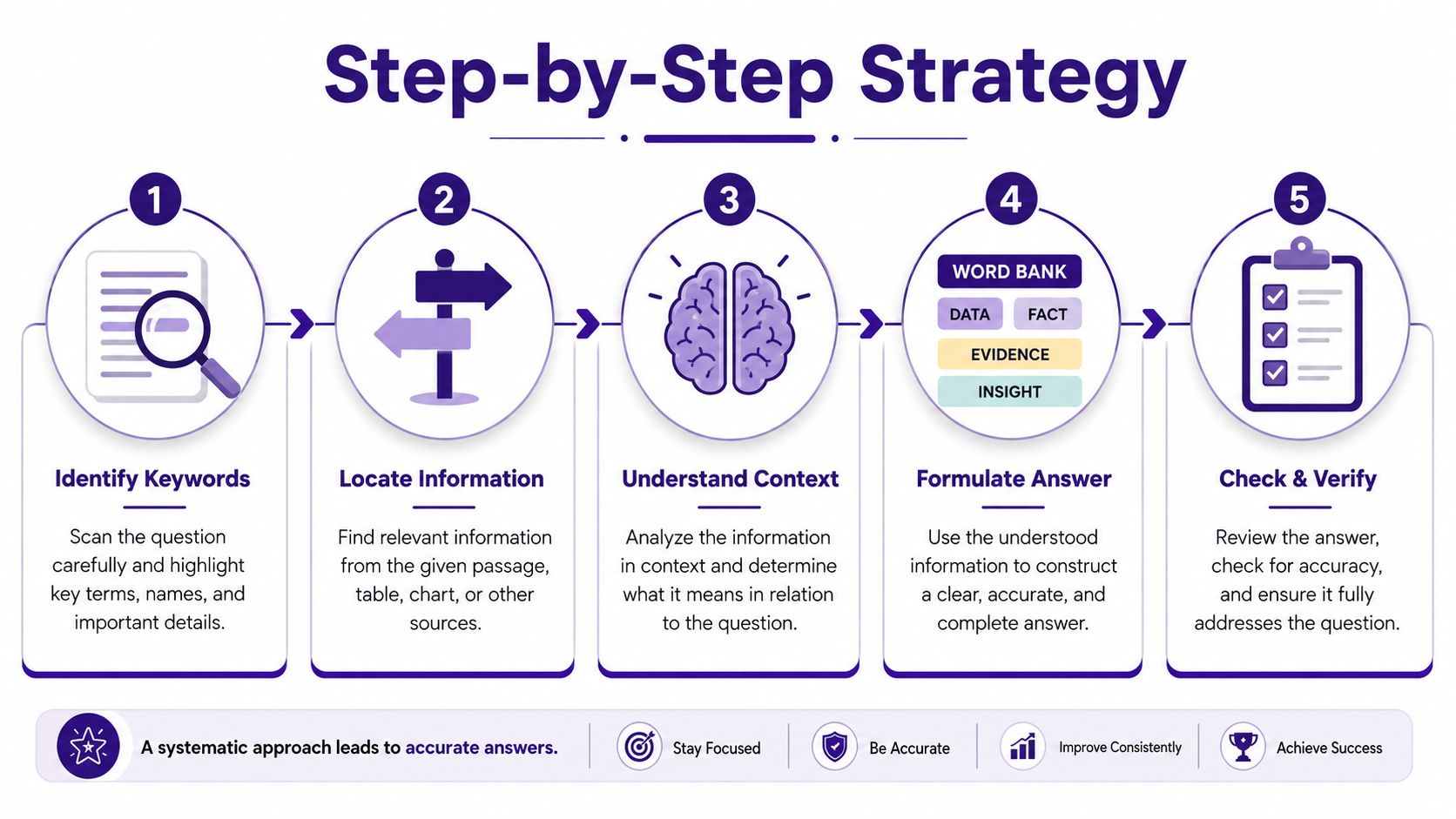
Step one, identify keywords. Underline the content words that will help you locate the idea. Names, technical terms, unusual nouns, dates, and distinctive verbs are usually more useful than common words. Also mark a contrast or cause connector because it can change the meaning of the blank.
Step two, predict the part of speech. Read the words immediately before and after the blank. “The project requires ______” suggests a noun or noun phrase. “The results were ______” suggests an adjective. “Researchers ______ the samples” suggests a verb. This prediction narrows the search before you encounter distracting vocabulary.
Locate evidence and test the logic
Step three, find the matching information. In Reading, scan for the keywords or likely paraphrases. Don't expect the question to repeat the passage word for word. Once you find a possible location, read around it rather than extracting an isolated phrase.
In Listening, use the question order and your prediction to prepare for the answer. Keep your eyes moving to the next item when the speaker has clearly completed the idea. Losing several questions because you remain stuck on one is more damaging than leaving a temporary gap.
Step four, select the exact answer. Copy the smallest complete answer that satisfies the sentence. If the passage says “seasonal flooding,” don't write a longer phrase that includes unnecessary surrounding words. If the audio gives a specific noun, don't substitute a synonym you prefer.
Finish with a mechanical check
Step five, verify. Place the answer back into the sentence and read it. Check singular and plural forms, verb tense, articles, spelling, and the word limit. Official guidance recommends identifying keywords, locating the matching text, reading around that area, and checking grammar and word count, as outlined in the British Council's completion questions guide.
Practical rule: If your answer makes sense but doesn't fit the grammar of the sentence, treat that mismatch as evidence that you've chosen the wrong form or wrong phrase.
Discourse markers help at every stage. Because points toward a reason. However introduces a contrast. Although tells you that the second idea may not follow the expectation created by the first. Yet often signals an unexpected result. These words don't give you the answer, but they define the direction in which the answer must work.
Common Traps That Cost You Marks
Most wrong answers aren't random. They come from a small set of habits that feel reasonable during a timed test.
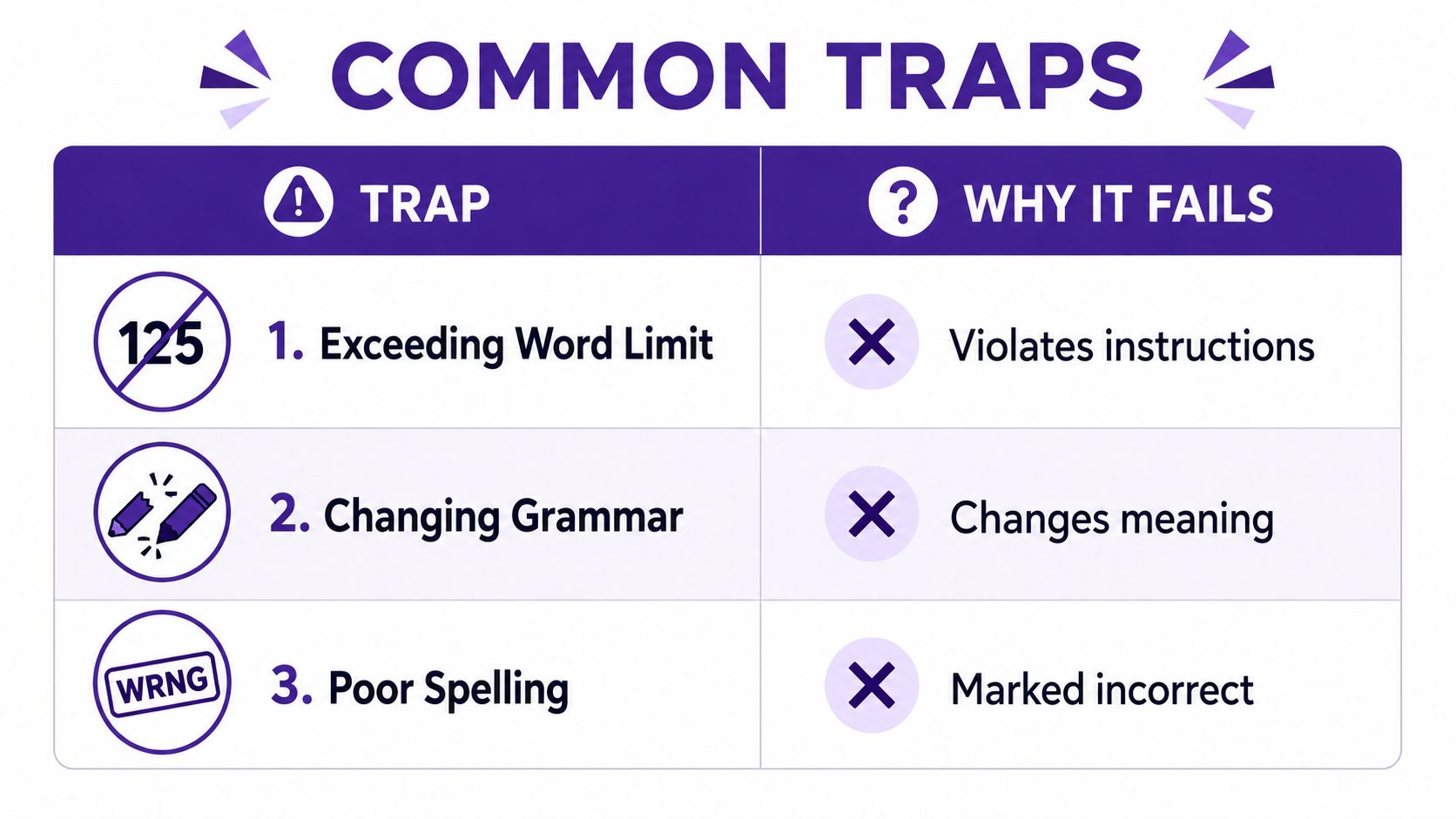
The word-limit trap
Suppose the instruction says “NO MORE THAN TWO WORDS AND/OR A NUMBER.” The passage contains “a rapid decline in coastal vegetation,” and the sentence is:
Coastal vegetation experienced a ______.
The answer “rapid decline” fits. “a rapid decline” exceeds the useful answer structure because the article is already supplied in the question. “rapid decline in coastal vegetation” is even less appropriate because it repeats information and may violate the limit.
| Your choice | Problem | Better response |
|---|---|---|
| a rapid decline | Includes an unnecessary article | rapid decline |
| rapid decline in coastal vegetation | Adds repeated information | rapid decline |
| rapid decline | Fits meaning and grammar | rapid decline |
Count the words exactly as the instructions require. Don't assume that a longer answer is safer.
The synonym trap
In Reading, the passage is your answer bank. If the text says “reduced energy consumption,” and the sentence asks for the result, “reduced energy consumption” is safer than “lowered power use.” Your synonym may be logically accurate, but the task requires extraction from the passage.
General vocabulary training can create the wrong reflex. In ordinary writing, paraphrasing is useful. In an exam-format completion, copying the correct passage wording is usually the precise behavior the question demands.
The grammar trap
Meaning alone can't rescue a grammatical mismatch. Compare these frames:
The device was ______.
The device ______ energy.
The first blank calls for an adjective, such as efficient. The second calls for a verb, such as uses or conserves, depending on the evidence. A noun like efficiency may relate to the same idea but cannot complete both frames.
The error is morphosyntactic fit, not vocabulary knowledge. Before accepting an answer, read the complete sentence, including the words after the blank.
The spelling trap
A familiar answer can still fail if you spell it incorrectly. Watch for doubled consonants, suffixes, vowel order, and singular or plural endings. In Listening, write carefully while preserving your attention for the next item, then use the final checking time to review uncertain spellings.
Worked Examples With Full Reasoning
The following examples are original practice frames. They demonstrate the reasoning process without relying on a memorized answer pattern.

Reading example with a direct match
Question:
Complete the sentence with NO MORE THAN TWO WORDS.
The community garden reduced local ______.
Passage:
“After the garden opened, residents produced more vegetables locally, reducing food transport.”
The keyword community garden gives you the location. The blank follows local, so you need a noun that names something reduced. The passage supplies food transport. It fits the meaning and grammar, and it stays within the two-word limit.
A tempting answer is transport emissions. That phrase might be sensible in a different text, but it isn't the wording supported here. The correct method is to extract the exact relevant phrase, not to improve the writer's language.
Reading example with contrast
Question:
Complete the sentence with NO MORE THAN TWO WORDS.
Although the first survey was inexpensive, the follow-up survey was ______.
Passage:
“The initial questionnaire required little funding. The later interviews were more costly, involving travel, specialist equipment, and extended staff time.”
The connector although predicts a contrast. The first clause presents low cost, so the second clause must describe a higher cost or greater expense. Here, the passage states that the follow-up work was more costly.
The phrase fits grammatically after was, captures the contrast, and stays within the two-word limit. Don't choose specialist equipment just because it appears in the passage. It doesn't answer the relationship created by the sentence.
Listening example with prediction
Question:
Complete the sentence with NO MORE THAN TWO WORDS.
Visitors should collect their ______ at the reception desk.
Before listening, predict a plural noun. A place such as a reception desk commonly distributes tickets, maps, badges, or keys, but prediction isn't proof. When the speaker says, “Please pick up your visitor badges at reception,” write visitor badges if that wording matches the recording and stays within the word limit.
If the sentence already says “their,” the answer must still make grammatical sense: “their visitor badges.” Don't write badge unless the audio and sentence clearly require the singular form.
A final diagnostic question
When an answer seems obvious, ask:
Did I find it in the correct section of the passage or recording?
Does the connector support my interpretation?
Does the answer have the required part of speech?
Does it match the passage or recording and an accepted answer form?
Have I counted the words?
That checklist catches the difference between an answer that sounds good and one that earns the mark.
Building a Practice Routine That Targets Your Weakness
Random practice creates a misleading impression of progress. You may complete many questions without discovering whether you failed because you didn't know the word, misread the sentence, chose the wrong passage location, or ignored the instruction.
Keep an error log with four categories:
Vocabulary gap: You located the right evidence but didn't understand the key word or phrase.
Syntactic mismatch: You understood the idea but chose the wrong grammatical form.
Passage-linking error: You searched in the wrong place or connected the question to a similar but irrelevant detail.
Instruction error: Your answer exceeded the word limit or included a spelling mistake.
Record the question, your answer, the accepted answer, and the exact reason for the mistake. “Wrong” isn't an explanation. “I chose a noun, but the sentence required an adjective” gives you something to practise.
Turn mistakes into targeted drills
For a vocabulary gap, build a short list from the passage and write new sentence frames using the same words. For syntactic errors, hide the answer and label each blank as noun, adjective, verb, or number before checking the text. For passage-linking problems, practise locating paraphrases and read the surrounding sentences instead of scanning for identical words.
Instruction errors need a mechanical routine. Circle the word limit before you begin, count multiword phrases, and reserve time to inspect spelling and endings. This work feels less academic than vocabulary study, but it addresses the actual cause of the lost mark.
A full practice session should include both questions and diagnosis. Cathoven provides IELTS-format Reading and Listening practice, instant scoring, detailed explanations, and progress tracking that can help learners review recurring mistakes more systematically. You can also use focused practice for IELTS Reading and IELTS Listening to see whether the same weakness appears under realistic timing.
A useful record is more valuable than another unexamined worksheet.
Review your log after several sessions and look for repetition. If the same error category keeps appearing, spend your next practice block on that category rather than completing another mixed set.
Connecting Sentence Completion to Your Overall IELTS Score
Sentence completion questions train more than blank filling. They develop keyword recognition, paraphrase tracking, discourse awareness, grammatical prediction, and exact transcription. Those skills transfer naturally to summary completion, note completion, and short-answer questions in Reading and Listening.
The central mental model is simple:
Predict what the sentence needs.
Track the logic around the blank.
Locate the supporting information.
Copy or write the exact answer.
Check grammar, spelling, and word count.
A vocabulary-only approach misses the interaction between these steps. A learner may know every important word and still lose marks by choosing an answer from the wrong sentence or by overlooking however.
Use the same diagnostic discipline across your wider preparation. The IELTS Academic preparation guidance can help you place this question type within a broader study plan, but your next practice session should begin with one clear target, such as grammatical form, passage location, or word-limit accuracy.
Cathoven offers IELTS-format Reading practice and Listening practice with instant scoring, detailed explanations, and progress tracking. Use these tools to practise sentence completion questions, review why an answer was wrong, and turn that evidence into your next study task.