Discuss Both Views Essay: Structure, Examples & Band Tips
You've stared at the prompt, read the words “discuss both views”, and still felt the same small panic many candidates feel at the exam desk. Should you argue? Should you stay neutral? Should you give your opinion now or hide it until the end?
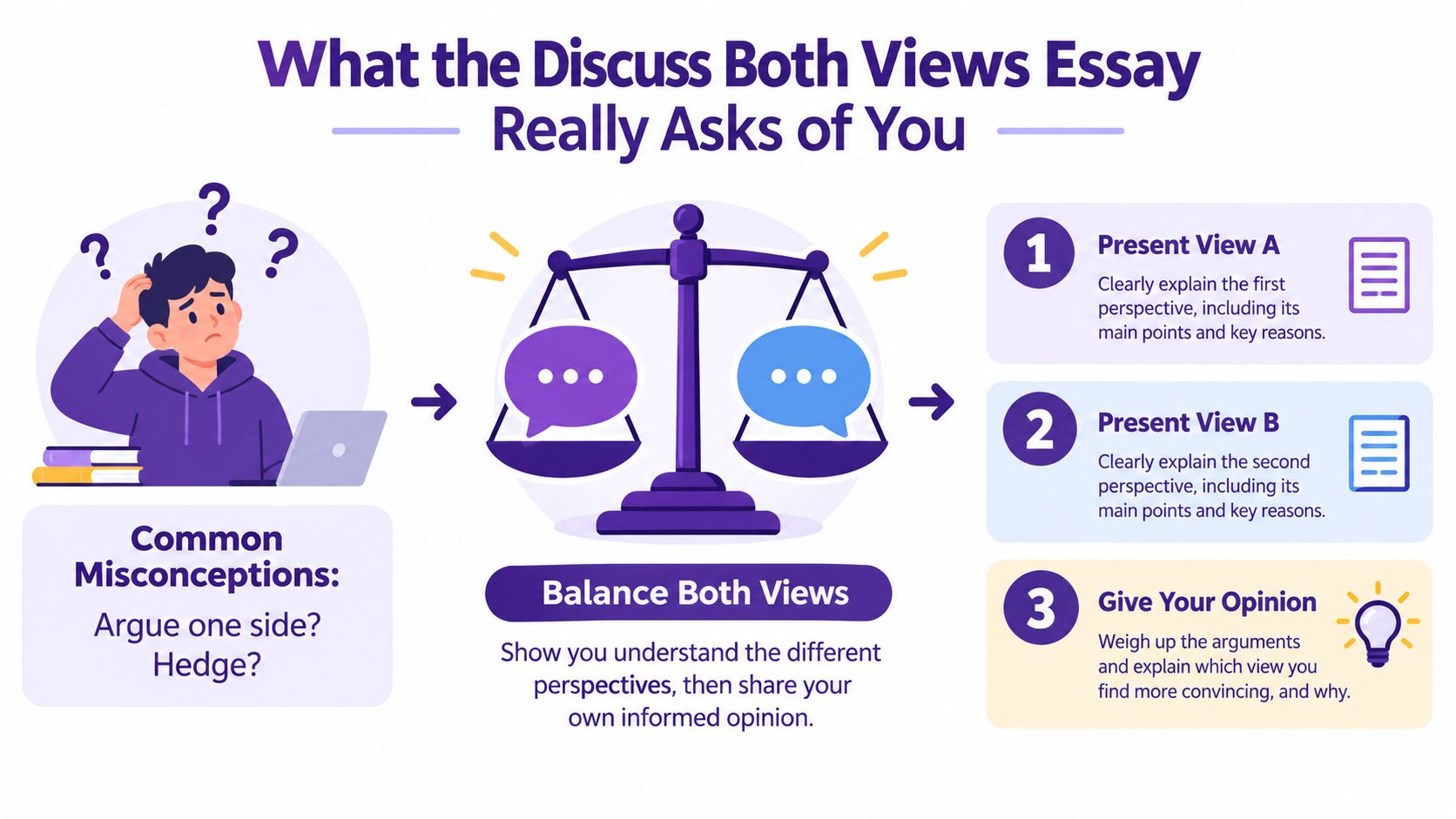
The answer is simpler than it looks. A strong discuss both views essay asks you to do three things in order, present View A clearly, present View B clearly, and state your own position with a reason when the task asks for it. Official IELTS scoring makes that balance matter, because Task 2 is judged on four equally weighted criteria, Task Response, Coherence and Cohesion, Lexical Resource, and Grammatical Range and Accuracy, each on a 0 to 9 band scale (official IELTS scoring guidance). Since Task 2 should be at least 250 words, it carries more weight than Task 1 in practical terms, so a weak structure can drag down the whole writing score.
The good news is that this essay type is one of the most predictable in the exam, because the prompt itself already gives you the two sides. Your job is not to invent a debate from scratch. Your job is to explain both sides fairly, then make a clear judgment that fits the wording of the question.
Table of Contents
- What the Discuss Both Views Essay Really Asks of You
- How the Band Descriptors Shape Your Structure
- The Paragraph Blueprint That Earns Higher Bands
- Planning Your Essay in the First Five Minutes
What the Discuss Both Views Essay Really Asks of You
A candidate sees a prompt about university lectures versus online classes and freezes for a moment. One side sounds persuasive, the other sounds reasonable, and the instinct is to pick a winner too quickly. That reaction is common, but it comes from treating the prompt like a debate, not a writing task.
The prompt already gives you the argument. Your job is to organize it. In a discuss both views essay, the examiner expects two viewpoints to be treated as real positions, not as small side notes.
Practical rule: if the question names two views, your essay needs two body paragraphs that give those views fair space before you bring in your own position.
The structure is straightforward. View A goes in one paragraph. View B goes in another. Your opinion comes after you have shown that you understand both sides. That is different from an opinion essay, where the whole essay supports one position, and different from a problem-solution essay, where you identify a problem and explain fixes.
A weak middle ground often sounds “safe,” but IELTS does not reward safe if it avoids the task. It rewards an answer that fits the wording exactly. If the prompt says discuss both views and give your own opinion, then the examiner wants balance first and judgment second.
The main test is simple. Show both sides clearly, then give a position that fits the question without sounding forced.
How the Band Descriptors Shape Your Structure
The four IELTS Task 2 descriptors don't just score your language, they reward or punish your structure. Task Response rewards you for answering all parts of the prompt, which is why a balanced treatment of both views is essential. If one side is thin, the response feels incomplete even when the grammar is good.
Coherence and Cohesion rewards clear organization and linking, so the examiner wants to see a reader-friendly map. That's why signals such as “Those who argue...”, “By contrast...”, and “On the other hand...” are more than decorative phrases. They tell the examiner exactly where each view begins and ends.
Lexical Resource matters too, but it's easier to improve once the essay is structurally sound. The same is true for Grammatical Range and Accuracy. Rich grammar won't rescue an essay that forgot to cover both sides, but a clean structure gives your language room to work.
The official band framework makes this even clearer. Each criterion counts for 25% of the Task 2 score (IELTS Writing band descriptors and key assessment criteria). That means planning for balance is not just a cosmetic choice, it gives you a stronger chance of covering the task clearly before you start polishing vocabulary.
| Band Descriptor | What It Rewards | Structural Decision |
|---|---|---|
| Task Response | Full coverage of both views and a clear position when required | One paragraph per view, plus a direct opinion |
| Coherence and Cohesion | Easy-to-follow organization and linking | Clear signposting between paragraphs |
| Lexical Resource | Precise vocabulary and natural collocations | Topic-specific language in each body paragraph |
| Grammatical Range and Accuracy | Controlled sentence variety and accuracy | Mix simple and complex sentences without losing clarity |
A Band 7 response usually looks organised before it looks impressive. That's the useful truth here. If your structure is solid, your language can breathe. If your structure is weak, your language has to work twice as hard.
The Paragraph Blueprint That Earns Higher Bands
A four-paragraph layout is a useful option for many discuss both views essay questions, not an IELTS requirement. It gives you enough space to cover both sides without turning the essay into a list. It also fits the usual 250 to 300 word target without forcing you to pad sentences.
The opening paragraph should do three jobs fast. It should restate the topic, name both views briefly, and end with a thesis that shows your position and main reason. A model sentence could be, “While some people believe X, others argue Y, and I believe Y is more convincing because...” That sentence works because it acknowledges both sides and still gives the reader a clear map.
What each paragraph must do
Paragraph 2 should develop View A with one clear topic sentence, one main reason, one explanation, and one example. The most common weakness is over-explaining the topic sentence and forgetting the example. Paragraph 3 should mirror that structure for View B, but use a contrasting linker so the shift feels deliberate, not sudden.
Paragraph 4 should restate your opinion, justify it by reinforcing the strongest reason already introduced earlier in the essay, and close with a forward-looking sentence. The common weakness here is adding a brand-new idea. Don't do that. The conclusion should resolve the discussion, not reopen it.
A useful pattern looks like this:
Introduction: paraphrase the topic, show both sides, state your opinion clearly.
Body 1: explain View A with one main reason, explanation, and example.
Body 2: explain View B with one main reason, explanation, and example, while keeping your thesis in mind.
Conclusion: restate your position and close cleanly.
The main idea is simple. Each paragraph should do one job. When a paragraph tries to do three jobs, the essay usually loses balance.
Planning Your Essay in the First Five Minutes
The first five minutes can decide whether the essay feels controlled or improvised. The planning routine should be short, visible on the page, and easy to trust under pressure. If you spend those minutes making one clear map, the writing stage becomes much calmer.
Start by decoding the prompt and circling the two viewpoints. If the topic is technology in classrooms, identify the side that says devices improve learning and the side that says they distract students. Then choose which view you want to place first in the body paragraphs, not because it is “right,” but because order helps you stay organized.
Next, draft a two-line thesis. One line names both views. The second line shows your position. A clean version might be, “Although technology can make lessons more engaging, I believe its value depends on careful classroom control because distraction is a real risk.”
Then lock one well-developed reason per view. Do not write everything you know. Choose the strongest point and one supporting example for each side. If you cannot turn a point into a real example, it probably is not ready for the essay.
For a full topic bank and practice directions, see this guide to IELTS discussion essay topics. The point of planning isn't to produce a perfect outline. It's to stop you from wandering.
Here's the difference between a weak opening and a stronger one for the same prompt:
Weak: “Technology in education is a controversial topic.”
Stronger: “Although some people think technology makes classroom learning more effective, others believe it can distract students, and I side with the second view because attention is the basis of learning.”
The weak version names the topic but says nothing useful. The stronger version tells the examiner exactly what the essay will do and where it will land. That is the gap between a generic opening and a more effective one.
The biggest planning mistake is trying to write before the thesis exists. Once the thesis is there, the rest of the essay has a job.
Model Paragraphs From Weaker and Stronger Responses
The same viewpoint can sound ordinary or sharp depending on how you build the paragraph. That is why it helps to compare a weaker version with a stronger one for the same idea. Here, the topic is paid university education, and the viewpoint is that charging tuition helps institutions maintain quality.
The gap is usually mechanical, not magical. Strong writing does not rely on exotic words, it relies on precise wording, clean cohesion, and developed support.
| Feature | Weaker Example | Stronger Example |
|---|---|---|
| Topic sentence | Tuition fees are good for universities. | Tuition fees can help universities maintain teaching quality and campus standards. |
| Vocabulary | Good, important, many things | Maintain, teaching quality, campus standards |
| Cohesion | First, also, and then | For one thing, as a result, this means that |
| Support | Students pay money and the university gets money. | Reliable income lets universities hire experienced lecturers, update facilities, and protect specialist courses that would otherwise disappear. |
| Example | For example, a university can improve. | For example, a business school with steady funding can keep a small seminar group, which is harder to sustain when budgets depend only on irregular public support. |
A weaker paragraph often sounds like this: “Tuition fees are good for universities because they get money. Also, the university can improve facilities and students can have a better learning environment. For example, a university can buy new books and equipment.” The ideas are understandable, but they feel thin and repetitive.
A stronger paragraph is more controlled: “Tuition fees can help universities maintain teaching quality because they create a stable income stream. This allows institutions to hire experienced lecturers, update laboratories, and protect specialist courses that might otherwise be cut. For example, a business school that receives reliable funding can keep small seminar groups, which usually leads to more focused discussion and better academic support.”
The difference is in the sentence work. The stronger paragraph names the claim more precisely, joins ideas smoothly, and stretches the example far enough to feel real.
Upgrade exercise
Take this sentence, “Students pay money and the university gets money.”
Upgrade it to this pattern instead, “When students contribute tuition fees, the university has a steadier budget for staff, materials, and academic support.”
That's the lesson. Better writing is often just better control of the same idea.
For more examples of what drags a response down, the article on common mistakes in IELTS Writing Task 2 is worth reading after you've drafted your own paragraph. The goal is not to memorize polished prose. It's to make your own sentences behave like polished prose.
Where to Place Your Opinion Without Sounding Biased
The opinion question causes the most confusion because different prompts ask for slightly different things. A task that says “Discuss both views” only is not the same as a task that says “Discuss both views and give your own opinion.” The first asks for balance across the essay. The second asks for balance plus a clear personal position.
A dependable approach is to state your position clearly in the introduction, maintain that position consistently while discussing both sides, and restate it in the conclusion. This gives the examiner a clear line of argument from the beginning without turning the body paragraphs into one-sided opinion pieces.
Practical rule: state your position early, keep the discussion fair, and make sure the conclusion clearly returns to the same view.
A clear introduction can do both jobs at once.
“While some people believe children benefit more from learning at home, others think school is essential, and I believe school provides stronger long-term development because children need structured social interaction.”
That position should then stay consistent. You can explain the advantages of home learning in one body paragraph and the case for school in the next, but your examples and emphasis should still support the same overall judgment you gave in the opening.
The conclusion should not introduce a new angle. It should restate the same position in slightly different words and reinforce the main reason behind it.
“Although both home learning and school education have clear advantages, I believe school is ultimately more beneficial because it combines academic guidance with steady social development.”
The most common score-dropping errors are easy to spot once you know what to look for.
Only one view developed in detail. Fix it by allocating one full body paragraph to each side.
The introduction stays neutral but the conclusion suddenly takes a side. Fix it by stating your position clearly from the start.
The strongest opposing argument is ignored. Fix it by restating the opposing view before you respond to it.
The conclusion repeats “in my opinion” without adding value. Fix it by restating the same position with a reason, not just a label.
Question wording is copied too closely. Fix it by paraphrasing with fresh collocations and simpler grammar.
Ideas are listed like notes. Fix it by linking each reason to an explanation and one concrete example.
If you want to practice this under timed conditions, Cathoven's writing tools can be used for IELTS-style drafting and feedback, especially when you want to check whether your response stays balanced across both views and still maintains a clear position from introduction to conclusion. The exact wording of the prompt should always decide your final structure, not a memorized template.
The most reliable habit is simple. State your position early, discuss both views fairly, and restate that same position clearly at the end.
Your Reusable Exam-Day Checklist
The best test-day routine is repeatable. You do not need a new trick every time. You need the same sequence that keeps your essay balanced, clear, and complete.
A full 40-minute plan is more realistic than a rushed 15-minute checklist.
Minutes 1 to 5: read the prompt carefully, identify the two views, and note whether the task asks for your opinion.
Minutes 6 to 10: choose your position, write a simple thesis, and plan one well-developed reason plus one example for each view.
Minutes 11 to 15: write the introduction and make your position clear.
Minutes 16 to 25: write the first body paragraph, explain one view fully, and support it with a relevant example.
Minutes 26 to 35: write the second body paragraph and the conclusion, keeping your position consistent and restating it clearly at the end.
Minutes 36 to 40: check task response, paragraph balance, linking, sentence clarity, grammar, and word choice.
That order matters because it prevents the most common collapse points. If the structure is fixed early, the later checks are easier. If the structure is shaky, the proofreading stage becomes damage control.
Final check: each body paragraph should have one main idea, one explanation, and one example. If any paragraph has two of those but not the third, it probably is not finished.
Before you stop writing, ask yourself five quick questions. Did I cover both views equally? Did I answer the exact wording of the task? Is my opinion clear if the prompt asked for it? Did I avoid repeating the same point in different words? Does the conclusion sound like a conclusion, not a new body paragraph?
If the answer to any of those is no, fix that first. Score gains in this essay type usually come from discipline, not drama.
If you want more practice with IELTS-format writing and feedback that helps you see where your structure slips, visit Cathoven and work through a new discuss both views prompt today. You can draft, check, and refine your response with a clearer eye on balance, opinion placement, and paragraph control.