CEFR Level Test: How to Assess Your English Level

You can feel confident reading English, then freeze when someone asks you to speak. Or you might rate yourself at B2, only to see B1 on a placement test and wonder which result matters. That confusion is common, and it usually starts with one misunderstanding: CEFR is a reference framework, not one single official test.
A CEFR level test is any assessment that a provider has aligned to the CEFR through documented procedures. Depending on its purpose, it may measure one skill, several skills, or all four main skills. Results from A1 to C2 should be read as reference levels that describe what a learner can typically do, not as one universal score shared identically across all tests. A short online screener can be useful for rough placement, while a recognized high-stakes assessment usually involves tighter administration, clearer score use, and stronger validation evidence.
How to Choose a CEFR Level Test
Before you pick a test, check these five points:
- Purpose: placement or self-assessment, school admission, a job, or a visa or certificate.
- Skills measured: reading and listening only, or speaking and writing as well.
- Duration: a few minutes for a quick screener, or several hours for a full exam.
- Proctoring: an unsupervised online test, or a supervised session with identity checks.
- Certificate acceptance: whether the organization you need to show the result to accepts it. Confirm this with them directly.
There is no single official CEFR test, so check what the provider has done to align its test to the CEFR before relying on the result.
Table of Contents
The CEFR itself grew out of Council of Europe work that began with the 1991 Rüschlikon symposium in Switzerland and later developed into the published framework in 2001. The Council of Europe also released the CEFR Companion Volume in 2020, which expanded and updated descriptor scales, including areas such as mediation, online interaction, and plurilingual and pluricultural competence (Council of Europe CEFR history, CEFR Companion Volume 2020). That wide adoption is why universities, teachers, employers, and test providers use CEFR labels when they need a shared way to describe English ability.
Why Your English Level Matters More Than You Think
You might be strong in one part of English and shaky in another, and that mix can stay hidden for a long time. A learner may follow news articles comfortably, then struggle to explain an opinion in a meeting. Another person may write emails with confidence, then stumble in a spoken interview. A CEFR level test can turn that messy picture into something easier to discuss, if the test is appropriate for the decision you need to make.
The CEFR helps because it does not start with grammar labels or course grades. It starts with can-do descriptors, meaning observable abilities such as handling familiar tasks, following clear speech, participating in interaction, mediating meaning, or producing detailed writing (CEFR descriptors, CEFR Companion Volume 2020). That makes the framework useful for study planning, university placement, workplace screening, and test development.
Practical rule: If your current level changes the book, class, or test strategy you choose, then the level result matters more than the number itself.
That is the point many learners miss. A label like B2 only helps if it reflects the abilities a particular assessment was designed to sample. If the result is inflated, you may spend weeks on material that is too hard. If it is too low, you can waste time reviewing content you already control.
The best way to think about CEFR is as a common reference, not a trophy and not a single exam. It gives you a cleaner answer to questions like, “Am I ready for higher-level reading?” or “Do I still need to build speaking fluency for formal tasks?” That clarity is what makes a CEFR level test valuable before exam day, before admissions decisions, and before you lock in a study plan.
Understanding the Six CEFR Levels and What They Mean
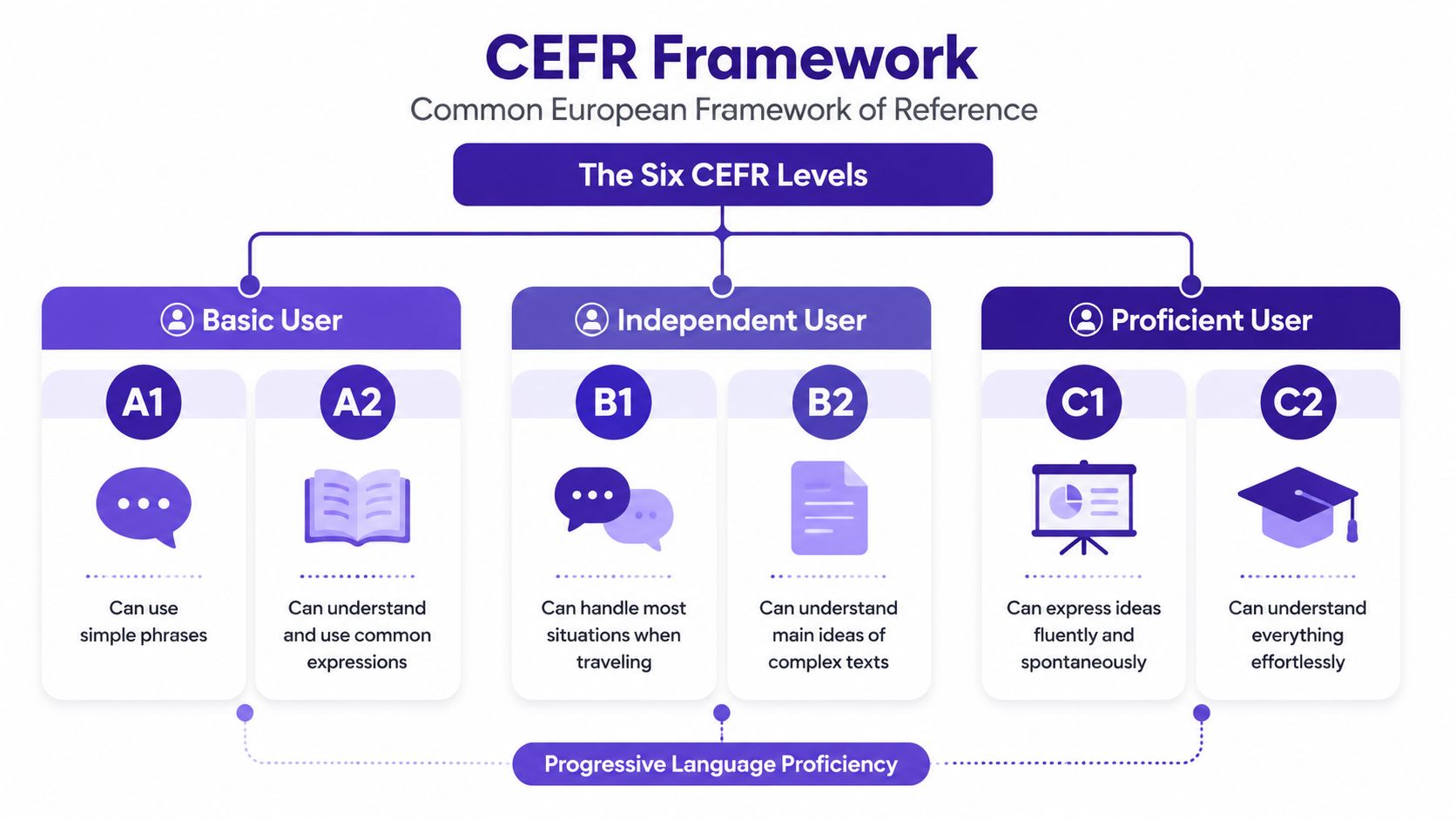
A learner may feel “pretty good at English” and still be placed in a band that looks lower or higher than expected. That gap is common, because the CEFR groups performance into six levels, from A1 to C2, and three broader bands, Basic User, Independent User, and Proficient User (Council of Europe level descriptions). For a fuller explanation of how the bands are separated, see Cathoven's guide to detailed language levels for CEFR.
The challenge is that each band covers a wide range. A label can sound precise, but the abilities inside that label can vary a lot across skills, contexts, and tasks.
A1 and A2, the basic user stages
At A1, a learner can handle very simple, familiar exchanges, greetings, personal details, and basic needs. At A2, that learner can manage routine situations with more confidence, such as shopping, travel basics, simple online exchanges, or short conversations about family and work. The language remains limited, but it works for straightforward daily communication.
B1 and B2, the independent user stages
B1 is the stage where many learners begin to function with some independence in familiar situations. They can describe experiences, deal with common travel problems, participate in routine online interaction, and discuss everyday topics with some detail. B2 asks for more. It usually means understanding normal-speed speech, following the main ideas of more complex texts, mediating information with reasonable control, and writing clear, detailed texts on familiar or subject-specific topics (CEFR descriptors, CEFR Companion Volume 2020). In a university seminar, a B2 learner may follow the discussion and add relevant points, even if fluency is still uneven.
C1 and C2, the proficient user stages
C1 signals strong control. The learner can work with demanding texts, speak fluently, interact effectively online and in person, and use English for academic or professional tasks with nuance. C2 goes further, with very high-level comprehension, coherent argumentation, and flexible language use in complex situations. In professional settings, C1 usually means you can present ideas clearly and deal with unexpected questions, while C2 suggests you can do the same with greater ease and precision.
Teacher's shortcut: If a task only feels manageable when the topic is familiar, the level is probably not the same as for someone who can handle unfamiliar topics too.
For learners checking their own level, this structure is more useful than vague labels like “advanced” or “fluent.” Those words sound reassuring, but they hide the key question: what can you do with English on a normal day, across the kinds of tasks that matter to you?
How CEFR-Aligned Tests Are Built and Validated
A trustworthy CEFR level test is not just a quiz with a level label at the end. Just as importantly, there is no single mandatory official process that every provider must follow in one identical sequence. In practice, test developers document how their assessment relates to the CEFR through a combination of test specification, standardisation or standard setting, and empirical or external validation evidence.
That means a provider should be able to show what the test is designed to measure, how tasks reflect CEFR-relevant abilities, how cut scores or rating decisions were established, and what outside evidence supports the interpretation of the result. Depending on the test, that outside evidence may include expert judgments, teacher ratings, performance data, score comparisons, or studies of how well the test supports its intended use (Council of Europe guidance on assessing CEFR level).
It is also important to keep the Council of Europe’s role in scope. The Council of Europe publishes the framework and guidance, but it does not centrally validate, certify, or approve every test that claims CEFR alignment. Responsibility for alignment claims and supporting evidence sits with the test provider, not with the Council of Europe.
This is why two assessments can both say “B2” yet feel very different. One may place more weight on reading and language knowledge, another on listening, another on speaking, and another on integrated tasks that reflect mediation or interaction. The CEFR itself is a reference framework built on observable abilities, so the quality of the result depends on how clearly the assessment samples those abilities and how well the provider has documented the alignment (CEFR descriptors, CEFR Companion Volume 2020).
Why validation depends on test purpose
Reliability expectations also depend on purpose. Brian North notes in guidance on assessing CEFR level that very high reliability may be appropriate for placement decisions, while lower coefficients may be acceptable for more limited classroom uses. For example, values above 0.95 for placement and around 0.80 for a shorter task-based reading or listening test are often cited as guidance points, not as universal Council of Europe requirements for every CEFR-related assessment (Council of Europe guidance on assessing CEFR level).
Practical rule: A short test can be useful for sorting learners roughly, but it is not automatically strong enough for certification, admission where a specific provider is required, licensure contexts that define their own accepted tests, or any other final high-stakes decision.
This is why you should ask what skills a test measures, how it was validated, and whether it was designed for quick screening, classroom placement, progress monitoring, or formal reporting. For deeper reading on defensible design, the internal guide on CEFR-aligned and defensible test design is a useful companion.
A reliable CEFR level test does not just hand out a label. It provides a level interpretation that fits the test's purpose, evidence base, and score use.
Why CEFR Scores Are Not Directly Comparable Across Tests
A learner can feel confident about a B2 label and still see a different result on another exam. That mismatch is normal, because CEFR alignment is test-specific. Different exams map to the framework through documented studies, expert judgment, and score interpretation work, not through one universal score scale that makes every provider interchangeable (mapping study in ERIC).
The same CEFR level can sit at different cut scores depending on the assessment. A CEFR label only means something when the tasks, scoring rules, and validation evidence have been considered together.
A historical ETS mapping study
One useful example comes from ETS linkage work, but it helps to separate historical study findings from current product guidance.
In the 2008 ETS linkage study summarized in later ETS CEFR materials, TOEFL iBT was linked to B1, B2, and C1, while TOEIC Listening and Reading and TOEIC Speaking and Writing were linked across A1 through C1, with the specific note that TOEIC Reading did not reach C1 in that study (mapping study in ERIC, ETS CEFR overview).
Current ETS guidance for TOEIC Bridge should be read separately from that older linkage work. ETS materials for the older TOEIC Bridge describe it as mapped to A1 to B1 (TOEIC Bridge mapping materials). A separate ETS report for the redesigned TOEIC Bridge tests, RM-21-01 (2021), reports mapping to Pre-A1, A1, A2, and B1, with skill-specific minimum cut scores for A1, A2, and B1 on the 15 to 50 scale (ETS RM-21-01 report, ETS TOEIC Bridge CEFR mapping chart).
A CEFR level test from one platform can still be suitable for its own purpose without matching another exam directly. That is why you should not treat CEFR labels from different providers as interchangeable unless there is a documented concordance or linkage study. For admissions or other formal decisions, acceptance rules are usually set by the institution, employer, or authority involved.
A broad band can also hide a lot of detail. One test may place a learner near the lower edge of B2, while another may place the same learner near the upper edge of B1, even though both labels look tidy on paper. For readers trying to connect CEFR and IELTS-format goals, the internal guide on how to convert your CEFR level to IELTS can help you set targets without assuming every score lines up exactly.
The Gap Between Self-Assessment and Tested Performance

Self-assessment often feels convincing because you know your own strengths. You know which podcasts you follow, which emails you can write, and which conversations you manage. But the official CEFR self-assessment grid is built on broad can-do statements, not controlled test administration, and that is one reason people are surprised when their self-rated level does not match a test result (CEFR self-assessment grid).
The main problem is that everyday language use and formal assessment do not ask for exactly the same thing. You may understand a text while reading at your own pace, then lose control when the clock is running. You may feel fluent in casual conversation, then struggle when the task asks for structure, precision, interaction management, or broader vocabulary. The gap is often sharpest in speaking and writing, because productive skills often lag behind receptive skills for many learners.
Why skill balance changes the result
The CEFR does not reduce English to one single ability. The framework and its later descriptor work cover multiple scales across listening, reading, spoken interaction, spoken production, writing, mediation, online communication, and plurilingual or pluricultural competence, so uneven performance is normal (CEFR self-assessment grid, CEFR Companion Volume 2020). A person may handle B2-level input but still produce B1-level output, especially under pressure.
That is why skill-specific score interpretation matters. If a report gives separate results for reading, listening, speaking, or writing, those subscores often explain more than the headline band. A learner with B2 reading and B1 speaking should not read that profile as a contradiction. It usually means the learner can process more complex language than they can yet produce in real time. For classroom placement, that can affect which activities will feel manageable. For formal uses, the relevant question is often whether the accepting institution or body cares about the overall result, minimum skill scores, or both.
The cleanest interpretation is this: self-assessment is a starting point, while a validated, purpose-appropriate assessment should carry more weight when a formal decision depends on it. If the two disagree, the next step is not to assume one is always right, but to check which tool was designed and validated for the decision you are making.
When Broad CEFR Bands Are Not Precise Enough
The standard CEFR scale has only six main levels, and that can be too coarse for some placement decisions. The Council of Europe notes that the levels can be subdivided or elaborated for local needs, and official materials also recognize plus levels such as A2+, B1+, and B2+ where institutions need a finer distinction within the main bands (Council of Europe level descriptions, CEFR Companion Volume 2020).
That matters most in universities, pathway programs, and language schools. If a class groups together students who all sit somewhere near B1, the strongest ones may feel held back while the weakest ones struggle to keep up. Finer reporting can reduce that mismatch and give teachers a more realistic picture of what the group can handle.
Official plus levels and local reporting choices
A single broad band is often enough for decisions like “Can this learner join a general intermediate class?” But if the decision is more sensitive, such as whether a student belongs in a pathway program or an advanced section, local reporting practices may add more detail.
The important point is that extra precision should be documented, not assumed. Official A2+, B1+, and B2+ labels are easier to justify than provider-specific micro-levels when you want to stay close to the CEFR itself. A CEFR level test is most useful when the score report explains what the finer distinction means and how it should be used.
Using Your CEFR Results to Plan Your Next Steps
Once you know your level, use it to make decisions, not just to file away a score. A CEFR level test is most valuable when it changes what you do next, what you study, and how you measure progress.
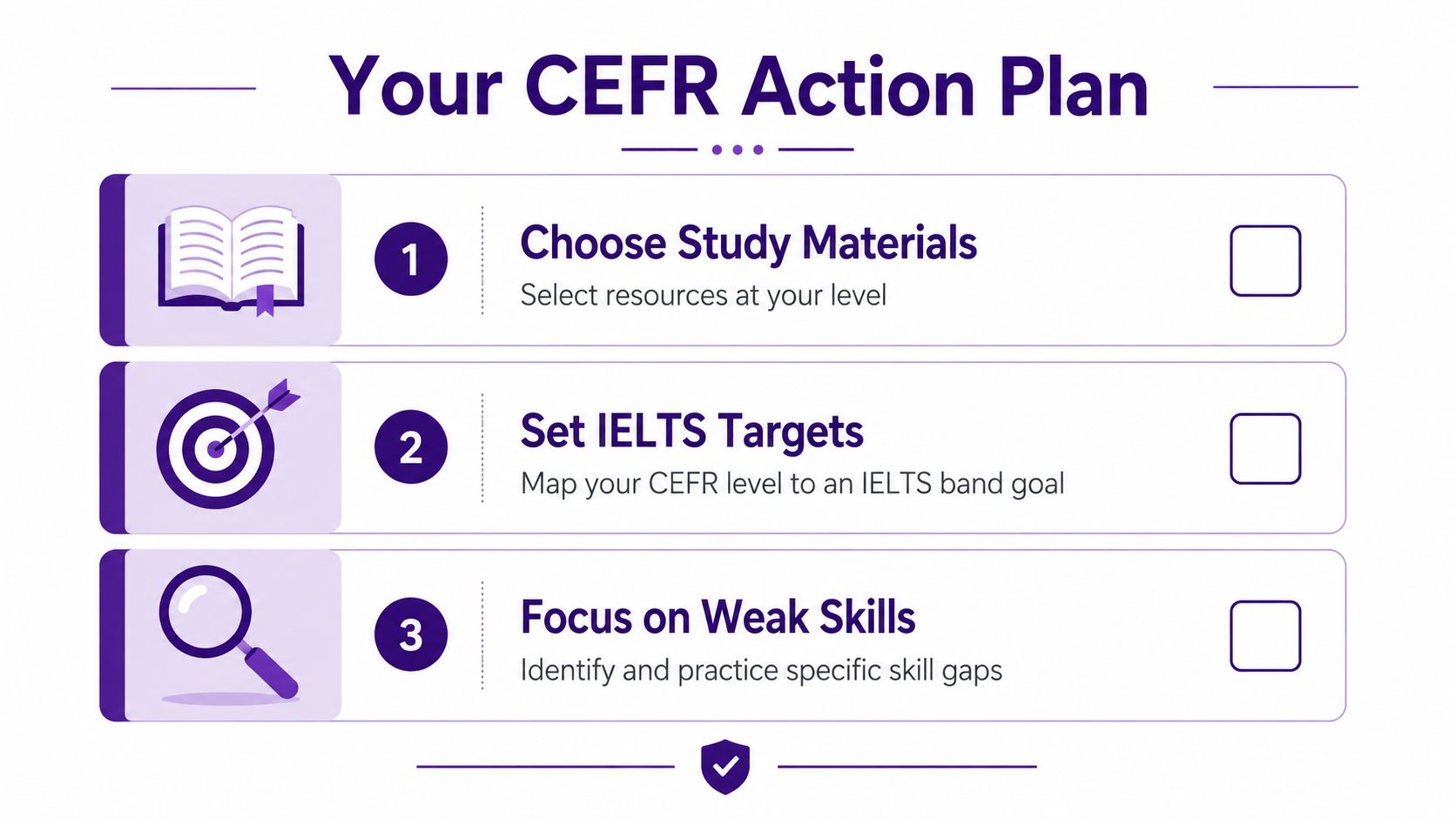
Your CEFR action plan
Choose study materials: Pick resources that match your current level, so the reading, listening, and practice tasks are challenging without being overwhelming.
Check which skills were measured: Before acting on a score, confirm whether the test covered reading, listening, speaking, writing, or only a subset.
Read the skill profile, not just the headline level: If the report includes subscores, use them to identify whether comprehension, spoken production, writing control, or interaction is holding you back.
Match the result to the decision: Use short placement screeners for rough routing, and use recognized, validated assessments when a school, employer, or authority requires a specific kind of result.
Focus on weak skills: If one skill sits clearly below the others, build that area first instead of spreading effort evenly across skills you already control.
For learners who want practical tools, Cathoven offers a CEFR Checker that estimates text difficulty and Cathoven Speaking that estimates speaking proficiency on the CEFR scale, along with feedback that can support study planning. Those tools can be useful for targeted insight, but they should not be described as a complete four-skill test, an official certificate, or an admissions result.
The right next step depends on your goal. A university applicant may need a stronger writing score. A professional candidate may need steadier speaking. An adult learner may need a more balanced skill profile. Whatever the target, the level result should point you toward the weakest link first.
If you're ready to turn a CEFR result into a real plan, start with an assessment that matches your purpose, then use the feedback to choose materials that fit your level and your target. Explore Cathoven's CEFR Checker and Cathoven Speaking for targeted feedback that can help you build a clearer study plan.