IELTS Speaking Part 3: Expert Strategies for Success
You've just finished Part 2 feeling confident. You spoke continuously, used your preparation time well, and gave a clear personal story. Then the examiner asks what role that activity plays in society, how it might change in the future, or whether governments should support it. Suddenly, you're no longer describing your own experience. You're trying to form an argument in English while the clock is running.
That shift is the heart of IELTS Speaking Part 3. Success doesn't come from memorizing longer answers or collecting endless topic lists. It comes from learning how to move from a personal example to a broader idea, then explain, qualify, compare, or evaluate that idea clearly.
Table of Contents
- Why Part 3 Feels So Different
- The Four Question Types You Will Face
- Building Extended Answers That Stay Focused
- Coherence and Fluency Strategies Under Pressure
- What Examiners Listen For
- Practice Methods That Actually Work
- Your Part 3 Preparation Action Plan
Why Part 3 Feels So Different
A student I coached once answered a Part 2 question about a memorable journey with energy and detail. She described the location, explained who went with her, and told the story in a natural sequence. In Part 3, the examiner asked whether international travel benefits local communities. Her first response was, “Yes, I think travel is good because people enjoy it.” She stopped almost immediately.
Her English hadn't disappeared. The task had changed. In Part 2, she had a familiar personal experience to guide her vocabulary and structure. In Part 3, she needed to decide what “benefits” meant, identify a cause, and consider the wider effects on communities. That requires abstract reasoning, not just language recall.
The official IELTS format describes Part 3 as the final section of the Speaking test. It lasts 4–5 minutes, while the full Speaking test lasts 11–14 minutes. As a result, Part 3 usually represents roughly 29%–45% of the total speaking time. The section is linked to the Part 2 topic, but the examiner moves toward broader and more analytical discussion. The official Speaking format confirms that candidates must discuss related issues in a more general way.
Personal stories versus public reasoning
Personal questions give you ready-made content:
- where you live
- what you enjoy
- what happened on a particular occasion
- who influenced you
Part 3 questions remove that support. You may need to discuss:
- how society has changed
- why people behave differently
- whether an idea has advantages and disadvantages
- what could happen in the future
- how two groups or periods compare
You don't need specialist knowledge. The examiner isn't testing whether you know the perfect policy on artificial intelligence or environmental protection. They're listening to whether you can make a reasonable point, develop it, and show control while doing so.
Memorized answers fail because the question can change direction quickly. A prepared paragraph about technology may contain impressive vocabulary, but it won't help if the examiner asks you to compare generations, evaluate regulation, or imagine a future consequence. A flexible reasoning pattern is more valuable than a polished script.
Practical rule: Treat Part 3 like a short conversation with an intelligent listener. Give an answer, explain your thinking, and show that you can see beyond your first idea.
The Four Question Types You Will Face
Part 3 questions can take many forms, but their reasoning demands are familiar. Recognizing the pattern gives you a quick mental route into the answer.
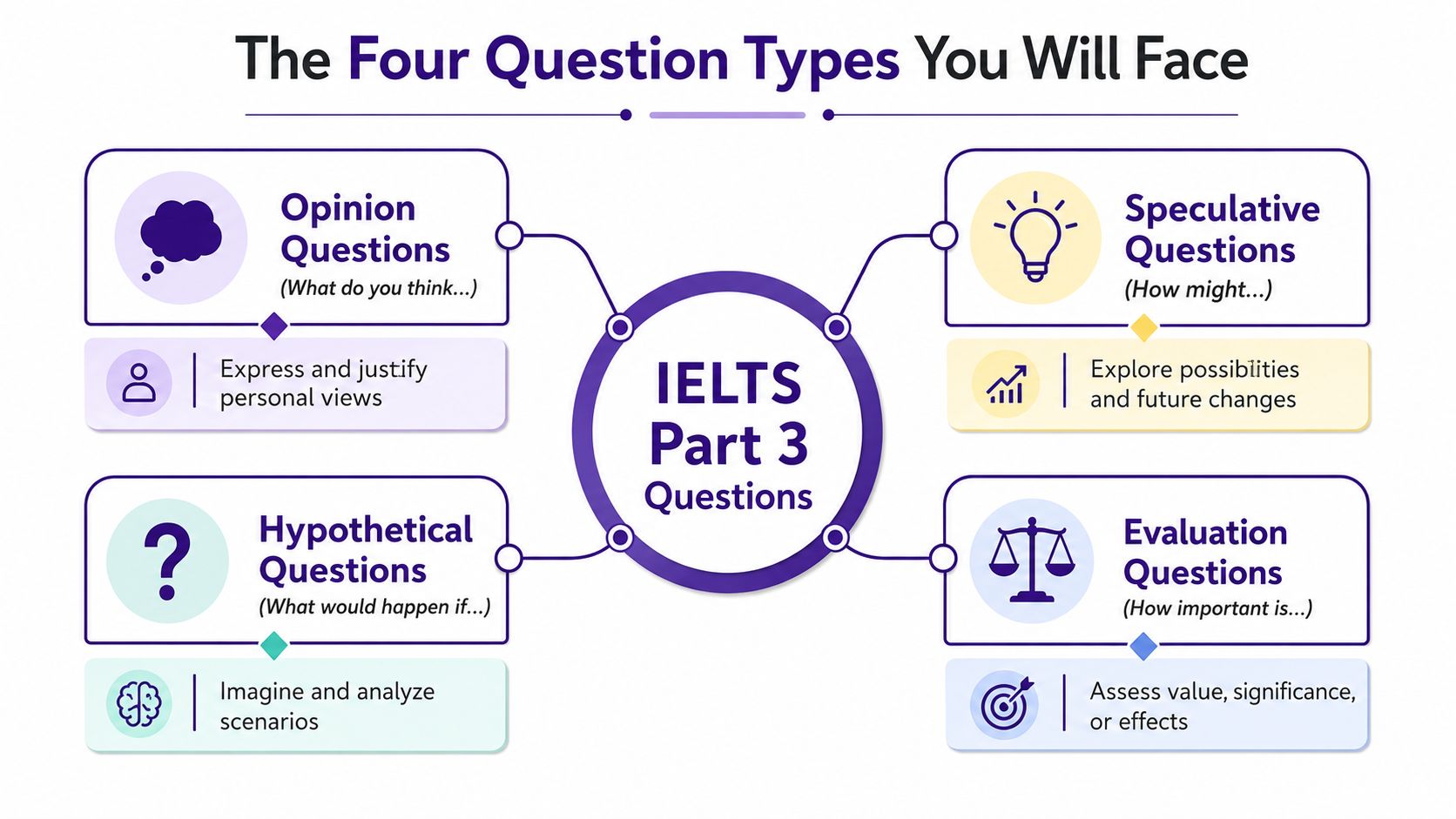
Opinion questions
These ask for your position:
Do you think people should spend less time on social media?
Don't answer only “yes” or “no.” State your view, then identify the main reason. You can add a condition if your opinion isn't absolute.
A useful mental sequence is:
- Take a clear position.
- Explain the strongest reason.
- Add a limit or exception.
For example, you might say that people should probably reduce unnecessary use because constant notifications can interrupt concentration, although social media remains useful for maintaining contact across distance.
Comparison questions
These ask you to examine differences between groups, periods, or approaches:
How is the way people learn today different from the way people learned in the past?
The fastest route is to choose one clear comparison point, such as access, flexibility, cost, or social interaction. Then describe the earlier situation, the current situation, and the consequence.
Avoid producing a list of disconnected differences. One developed comparison is stronger than several vague observations because it shows a relationship between ideas.
Speculative questions
These explore possibility and future change:
How might technology affect employment in the future?
Use cautious language. You aren't expected to predict the future with certainty. Words such as may, could, is likely to, and provided that let you discuss possibilities without making your answer sound extreme.
Build the response around a likely effect, a reason for it, and a condition that could change the outcome. This approach is especially useful for questions about technology, work, education, and the environment.
Evaluation questions
These ask you to judge value, importance, or consequences:
How important is it for governments to protect traditional culture?
Evaluation requires a standard. Decide whether you're judging cultural value, social unity, economic benefit, individual identity, or long-term effects. Then acknowledge a competing priority.
The official IELTS guidance explains that follow-up questions commonly ask candidates to elaborate, give examples, compare and contrast, or speculate about future developments. The official overview of the three Speaking parts reflects this movement from personal experience toward analysis and justification.
Building Extended Answers That Stay Focused
A developed answer isn't a long answer. Speaking for longer while repeating the same point won't demonstrate much. You need a visible line of thought, so the examiner can hear how one idea leads to the next.
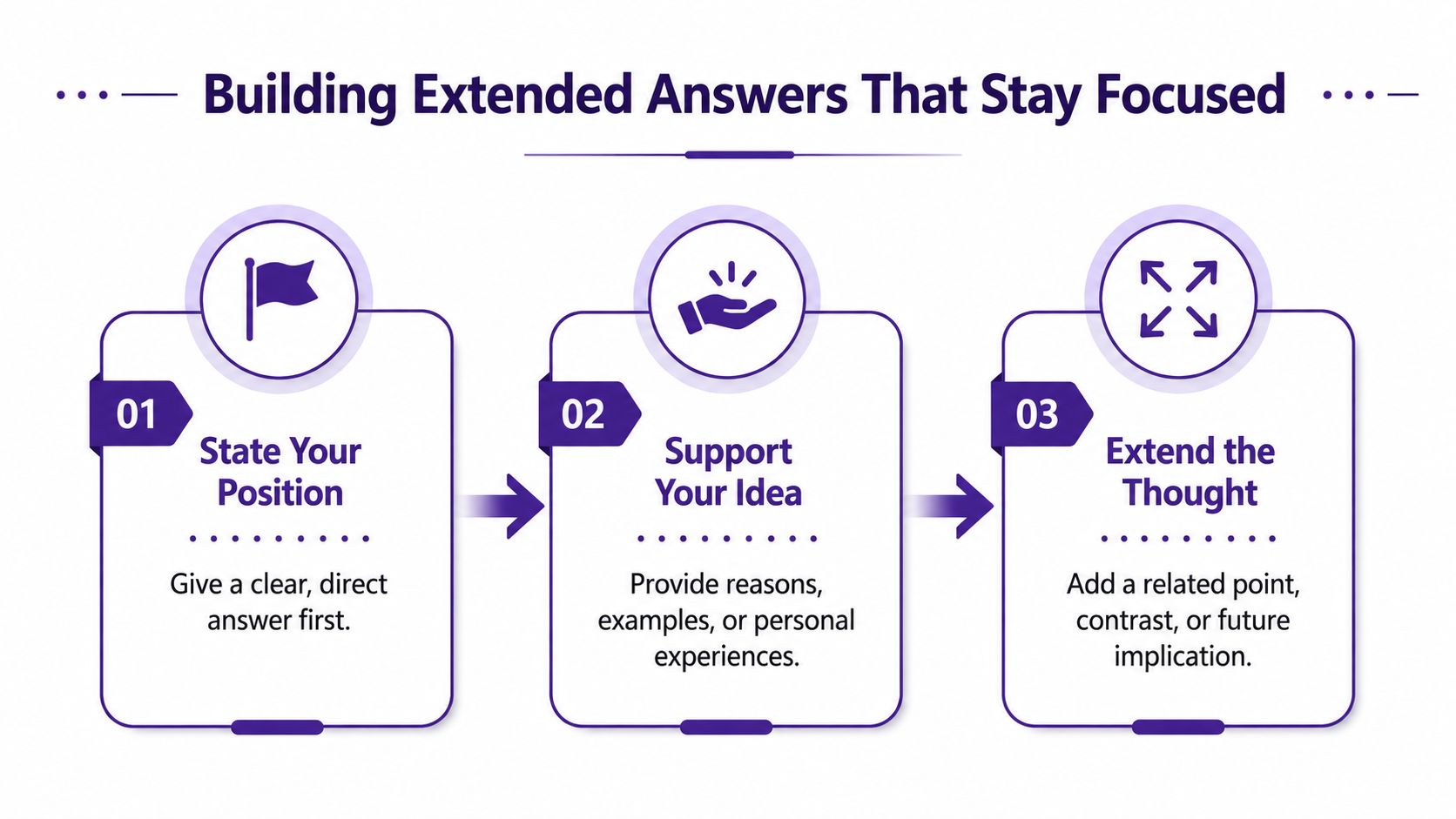
Use this three-part structure:
- State your position
- Support your idea
- Extend the thought
Start with a direct answer
Answer the actual question in your first sentence. If the examiner asks whether children should use digital devices in class, don't begin with a broad history of education.
A focused opening could be:
I think digital devices can be useful in class, but they need to be controlled carefully.
That sentence gives your position and introduces nuance. It also creates a natural path for the next idea.
Add a reason and concrete support
Explain why you hold that view. Then support it with a general or concrete example. Your example doesn't have to be a personal story. It can describe a plausible situation, a school, a workplace, or a group of people.
They can give students quick access to visual explanations and interactive exercises, which may help learners who struggle with purely verbal instruction. For example, a science class could use a simulation to show a process that would be difficult to demonstrate in a classroom.
Notice the logic. The device is useful, the reason is access to visual learning, and the example shows what that means in practice.
Extend rather than repeat
Finish by adding a qualification, contrast, or future implication:
However, if students use them without clear limits, the devices may create distraction rather than improve learning, so the teacher still needs to control when and how they're used.
That final move makes the answer more analytical. It shows that you can hold two connected ideas at once.
A thin response might say, “Devices are useful because students can learn online.” A developed response explains the position, gives the mechanism, illustrates it, and identifies a condition. You can find additional practice with current IELTS-format discussion themes in this guide to recent IELTS Speaking topics, but use the questions to practise reasoning rather than memorizing model language.
A strong Part 3 answer is not a speech you prepared earlier. It's a small argument built in real time.
Coherence and Fluency Strategies Under Pressure
Many candidates know what they want to say but lose control while searching for vocabulary. They begin with one idea, add an unrelated example, correct a verb, and then forget the original point. The solution isn't to eliminate every pause. It's to give your thinking a simple visible structure.
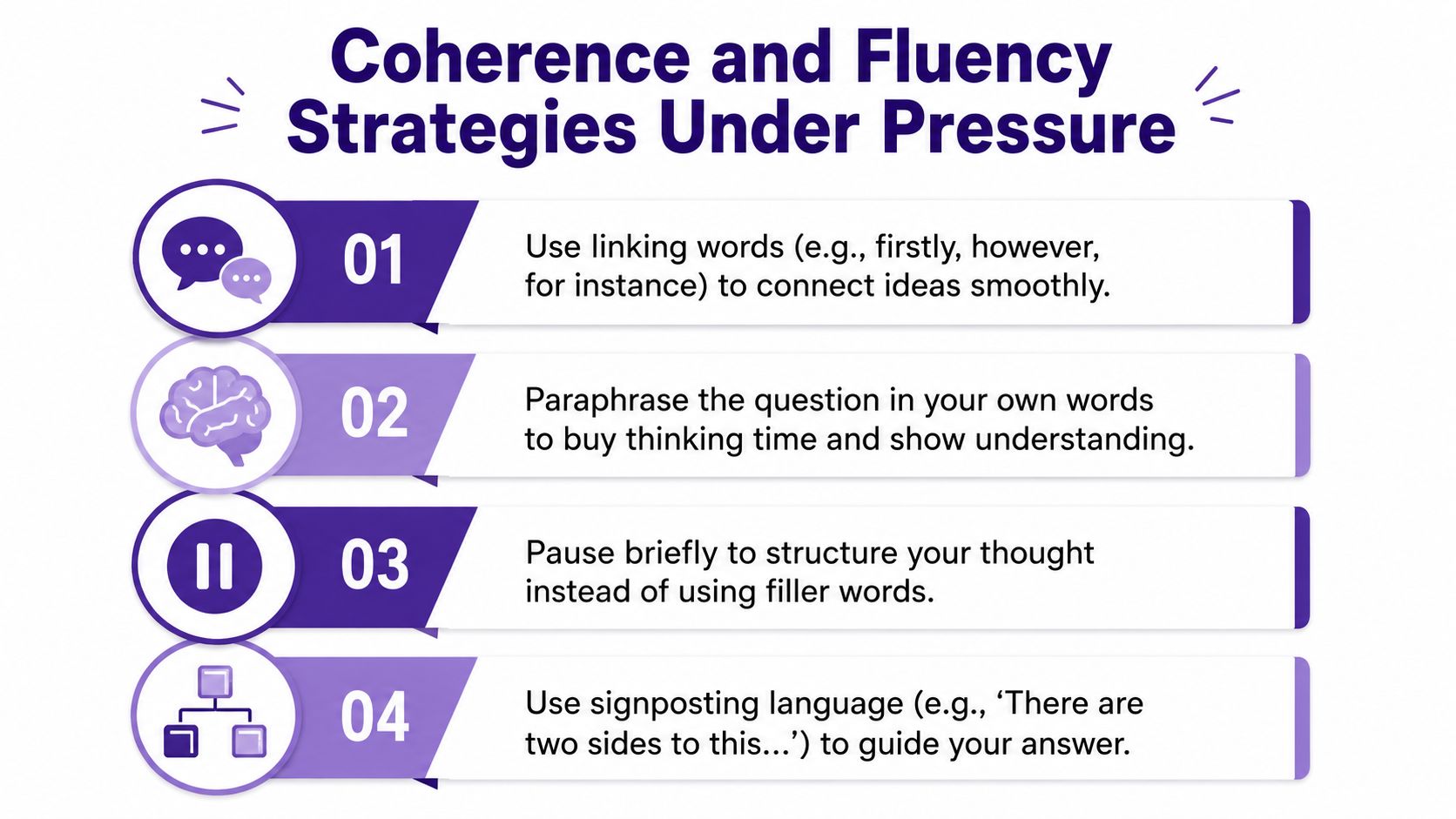
Use linking language as signposts
Words such as firstly, however, for instance, as a result, and in contrast help the listener follow the relationship between ideas. Don't insert them mechanically at the start of every sentence. Use them when the relationship matters.
For cause and effect, try:
- “The main reason is that…”
- “This can lead to…”
- “As a result…”
- “That tends to happen because…”
For contrast and qualification:
- “On the other hand…”
- “That said…”
- “This depends on…”
- “To some extent…”
Paraphrase when you need thinking time
Repeating the question word for word can sound rehearsed, but a brief paraphrase shows understanding and gives you a moment to plan.
Question: Why are some people reluctant to work remotely?
Opening:
Some people may avoid remote work because they prefer direct contact with colleagues and clearer separation between their job and home life.
You've already transformed the question into a position. The answer now has direction.
Pause deliberately
A short silent pause is better than a chain of “um,” “you know,” and “like.” Before you speak, choose your first idea. During the answer, pause at a natural boundary before introducing a new point.
If you lose your train of thought, don't restart the entire response. Use a repair phrase:
- “The main point I'm trying to make is…”
- “Put another way…”
- “What I mean is…”
- “A related issue is…”
These phrases let you reorganize without apologizing or abandoning the answer.
Give the examiner a map
Signposting language makes longer answers easier to control:
There are two sides to this. It can improve access, but it may also reduce personal interaction.
You can then discuss one side, add an example, and move to the other. The examiner hears the structure, and you gain a clear route through the response.
What Examiners Listen For
You give a clear answer to a Part 3 question, then the examiner listens for evidence that you can develop and control an abstract discussion. IELTS Speaking is assessed through four criteria: Fluency and Coherence, Lexical Resource, Grammatical Range and Accuracy, and Pronunciation. Each contributes 25% of the final speaking band score, according to the official IELTS Speaking band descriptors. Part 3 has no separate scoring system. The same framework applies, while the broader questions create more chances to show flexible thinking.
Consider two answers to the question, Should cities invest more in public transport?
The weaker answer is:
Yes, I think they should because public transport is good. It helps people and reduces traffic.
The response is relevant, but it gives limited evidence. The vocabulary remains general, the grammar is mostly simple, and the connection between the ideas is difficult to follow.
A stronger answer might be:
Cities should invest more in public transport because reliable services can reduce dependence on private cars and make employment easier to access. This is particularly important for people who live far from business districts or can't afford a car. However, investment needs to include maintenance and safety, otherwise passengers may continue to prefer private vehicles.
This answer succeeds through its reasoning. The speaker states a position, explains how the policy could work, identifies a group affected by it, and qualifies the recommendation. Unusual vocabulary is unnecessary when the ideas are precise and connected.
The four criteria in practical terms
- Fluency and Coherence: Can you sustain an answer, connect ideas, and recover without frequent breakdowns?
- Lexical Resource: Can you choose precise words for abstract relationships, such as access, regulation, inequality, efficiency, or social pressure?
- Grammatical Range and Accuracy: Can you combine clauses, use conditionals, compare ideas, and express cause while maintaining control?
- Pronunciation: Can the examiner understand your sounds, word stress, rhythm, and connected speech without repeated effort?
The official band descriptors also support a practical preparation principle. Examiners need enough language and development to judge your performance against each criterion, so brief answers leave fewer opportunities to demonstrate control. A developed answer gives them clearer evidence of how you organize ideas, select vocabulary, form sentences, and communicate meaning.
| Band Level | Fluency Features | Lexical Features | Grammar Features |
|---|---|---|---|
| Developing response | Ideas may stop after a direct answer, with noticeable hesitation when the topic becomes abstract. | Relies heavily on familiar words and may repeat the same expression. | Uses mostly simple forms, with limited control when linking ideas. |
| More effective response | Maintains a clear line of thought and uses pauses to plan rather than frequently breaking down. | Selects more precise topic language and explains unfamiliar ideas through paraphrase. | Combines clauses, comparisons, conditions, and qualifications with generally controlled accuracy. |
Your target is clear communication with enough range across all four criteria. Treat each answer like a short argument: give the position, show the reasoning, and add a condition or consequence when it helps clarify the point.
Practice Methods That Actually Work
Generic topic lists can help you notice recurring themes, but they don't train the mental movement Part 3 requires. You need practice that forces you to explain causes, compare situations, evaluate trade-offs, and speculate without relying on a memorized paragraph.
Train one reasoning skill at a time
Choose a broad theme such as technology or education, then create four prompts:
- Opinion: Should schools limit device use?
- Comparison: How is learning different now?
- Speculation: How might artificial intelligence change classrooms?
- Evaluation: How important is teacher-led instruction?
Answer each prompt using a different reasoning route. This prevents you from giving the same “benefits and drawbacks” response to every question.
Use a recording and review cycle
Record one answer, listen once for meaning, and listen again for language. Write down:
- where your main position became clear
- whether you gave a reason
- whether your example supported the reason
- where you repeated vocabulary
- where a pause became a breakdown
The important point is active speaking. Silent reading of model answers won't reveal whether you can build an argument under pressure.
Ask for useful feedback
A practice partner shouldn't just say, “Your English is good.” Give them a checklist and ask them to identify one strength and one priority:
- Did the answer address the question directly?
- Was the reason clear?
- Did the example prove the point?
- Did the speaker include a qualification?
- Which sentence was difficult to follow?
If you use an AI scoring tool, treat the result as evidence for practice decisions, not as a guaranteed test outcome. Cathoven offers IELTS Speaking practice with Part 3 prompts and feedback across the four assessment criteria. You can also explore the Cathoven IELTS Lab speaking course for structured practice ideas.
Your Part 3 Preparation Action Plan
Improvement becomes easier when each practice session has one job. Don't spend every day answering random questions and hoping fluency will appear. Rotate the demands so you build reasoning, language control, and recovery skills together.
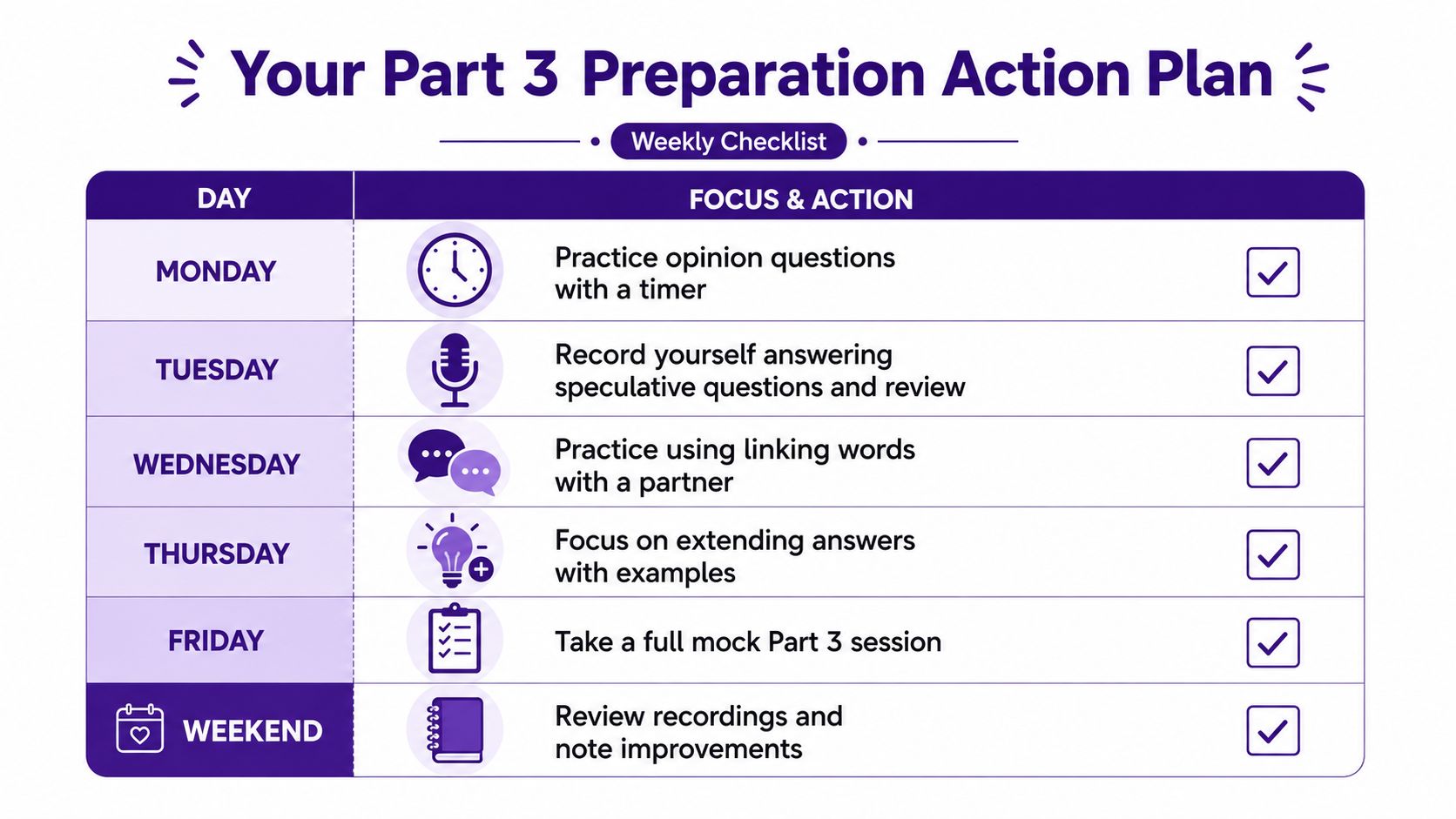
A practical weekly cycle
- Monday: Practise opinion questions with a timer. Focus on stating your position immediately.
- Tuesday: Record speculative answers and review your use of cautious language.
- Wednesday: Practise linking words with a partner. Ask them to note where connections sound natural or forced.
- Thursday: Extend answers with examples, then add one qualification.
- Friday: Complete a full mock Part 3 session so you experience changing follow-up questions.
- Weekend: Review recordings and write down improvements in fluency, vocabulary, grammar, and pronunciation.
Keep a simple progress record. For each answer, mark whether you included an expanded idea, concrete support, and a qualifying phrase. This benchmark aligns with the cognitive demands of Part 3 described in independent examiner-focused guidance, particularly its emphasis on development, nuance, hedging, and controlled complexity. The Part 3 scoring guidance explains why one-line responses provide too little evidence for a strong performance.
Know when you're ready
You're moving in the right direction when you can respond to an unfamiliar abstract question without waiting for a memorized idea. You should be able to:
- give a direct answer without a long introduction
- explain one clear cause or consequence
- provide a relevant example
- compare or qualify when the question invites it
- continue after a small pause
- correct yourself briefly without losing the main point
Don't neglect the rest of the Speaking test. Part 3 uses the same four criteria as the other parts, so pronunciation, vocabulary development, and grammatical control need regular attention throughout your preparation.
If Part 3 still feels unpredictable, stop collecting answers and start collecting reasoning patterns. Take a question, identify its type, state a position, support it, and add a condition or consequence. That process is what turns a personal English speaker into a confident discussion participant.
Use Cathoven to practise IELTS Speaking Part 3 with exam-format prompts and criterion-based feedback across Fluency and Coherence, Lexical Resource, Grammatical Range and Accuracy, and Pronunciation. Visit Cathoven to record responses, review your performance, and build a preparation routine around the areas that need the most attention.