How Improve English Speaking: A Practical Daily Plan
Most advice on how improve English speaking sounds simple because it skips the hard part. “Speak every day” is useful only if you know what you're fixing, because unstructured speaking can keep the same pauses, the same rushed sentences, and the same weak delivery in place for months.
Real progress comes from training the speaking subskill that's limiting your score or your confidence. For some learners, that's fluency and coherence. For others, it's pronunciation hesitation, weak discourse management, or grammar that breaks under pressure. IELTS-speaking research points in that direction, too, showing that progress is uneven and that diagnostic, subskill-based feedback can produce gains across vocabulary, syntax, pronunciation, discourse management, and organization, including a 45% reduction in phonemic errors and a 1.5-band average improvement with targeted feedback (North Arizona University research summary).
The practical lesson is blunt. If you practice everything at once, you usually improve nothing clearly. If you isolate the bottleneck, record it, review it, and repeat it under pressure, you can make visible progress without adding more hours.
Table of Contents
- Why Speaking More Is Not Enough
- The Four Subskills That Drive Speaking Performance
- Building a Daily Speaking Routine That Actually Works
- Using AI Feedback to Replace Guesswork
- Overcoming Speaking Anxiety and Building Confidence
- Spaced Practice and Long-Term Retention Strategies
Why Speaking More Is Not Enough
“Just speak every day” sounds sensible, but it often rewards comfort instead of change. Learners get used to their own errors, especially when practice is casual, unrecorded, and never reviewed. They build familiarity with English output, but not control over the parts that matter in a test or a real conversation.
Exposure is not deliberate practice
Exposure helps, but it is not the same as training. Deliberate practice needs a clear target, a short feedback loop, and a reason to repeat the same task until the output changes. If you speak freely for 30 minutes and never check what happened, you may have trained confidence. You probably have not trained precision.
Practical rule: if a speaking session does not give you something measurable to fix, it is entertainment, not practice.
That is why subskill-specific practice matters. IELTS-specific research shows that fluency tends to improve fastest over a few months, while the relationship between background factors and speaking gains is more complex than one-size-fits-all advice suggests. One learner's bottleneck may be pauses, another's may be lexical gaps, and another's may be shaky structure under time pressure.
What to train instead
A better approach is to ask four questions after every recording.
- Do I pause too often? That points to fluency.
- Do my ideas wander? That points to discourse management and coherence.
- Do I keep repeating the same simple words? That points to lexical range.
- Do my sentences break when I get nervous? That points to grammar under pressure.
A 12-week IELTS speaking study found that speech rate, filled pauses, and silent pauses all changed significantly, and that fluency and coherence sub-scores improved significantly over the program. That is a strong signal that smoother delivery matters more than random extra output.
The common mistake is to assume pronunciation alone will solve everything. It matters, but isolated pronunciation work often does not move speaking performance as much as learners expect. The higher-yield move is to identify the exact subskill dragging your delivery down, then practice that one with purpose.
For a closer look at how learners change across speaking areas, see the North Arizona University research summary and the IELTS speaking study.
The Four Subskills That Drive Speaking Performance
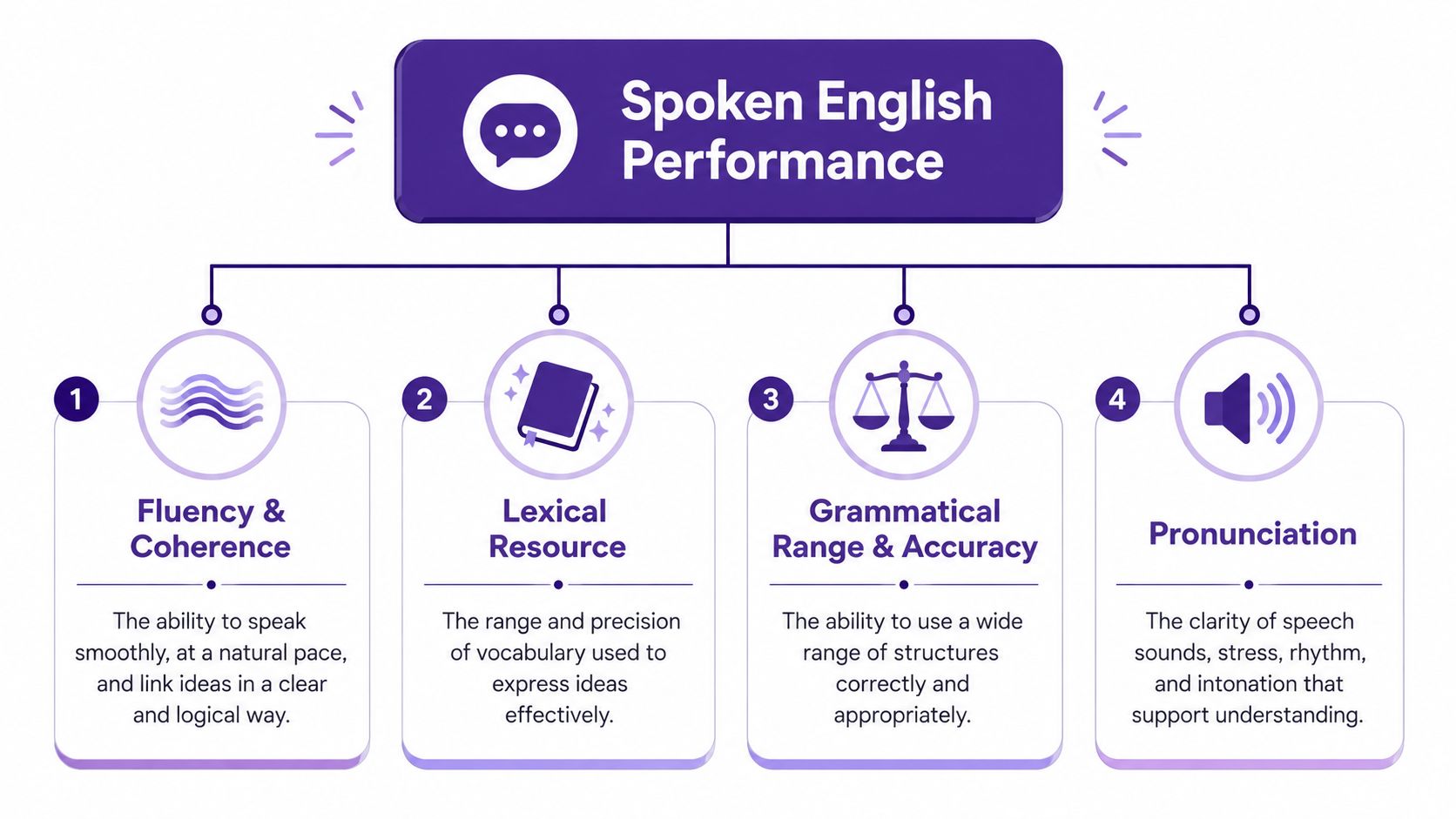
Spoken English is usually judged through four moving parts, and each one behaves differently in practice. If you treat them as one blurry skill, you end up practicing in a vague way and hoping improvement appears. If you separate them, the work gets clearer fast.
Fluency and coherence first
Fluency and coherence are about whether your speech flows and whether your ideas connect. In IELTS-style speaking, this is often the biggest lever because the examiner has to follow your meaning in real time. A regression study found that fluency and coherence were the strongest predictor of success, ahead of grammar and lexical resource, while pronunciation contributed the least unique variance (IELTS speaking study).
That doesn't mean pronunciation is unimportant. It means a learner with smooth, well-linked speech usually scores better than someone with perfect sounds but broken delivery. If your answers stall, restart, or drift, that's where to work first.
Vocabulary, grammar, and pronunciation each need a different drill
Lexical resource shows up when you can reach for a precise word quickly instead of circling around it. Grammatical range and accuracy show up when your sentence structures stay stable even in longer answers. Pronunciation matters when sounds, stress, or rhythm make your message harder to follow.
The trap is to train all three with the same method. They don't respond the same way. Vocabulary improves when you retrieve language under time pressure. Grammar improves when you transform sentences and reuse patterns in speaking. Pronunciation improves when you isolate the exact sound, stress pattern, or linking issue that keeps surfacing in recordings.
A simple self-diagnosis method
Record a one-minute answer, then listen once without stopping. On the second pass, mark only one problem per category. If your answer feels smooth but generic, the issue is vocabulary. If your ideas jump without transitions, it's coherence. If you keep self-correcting mid-sentence, it's grammar pressure. If listeners would struggle to catch key words, pronunciation needs work.
If you can't name the bottleneck, you'll keep practicing the wrong thing.
That's why a lot of learners feel busy but don't feel better. They're speaking, but they're not sorting the speech into parts that can be improved separately.
Building a Daily Speaking Routine That Actually Works
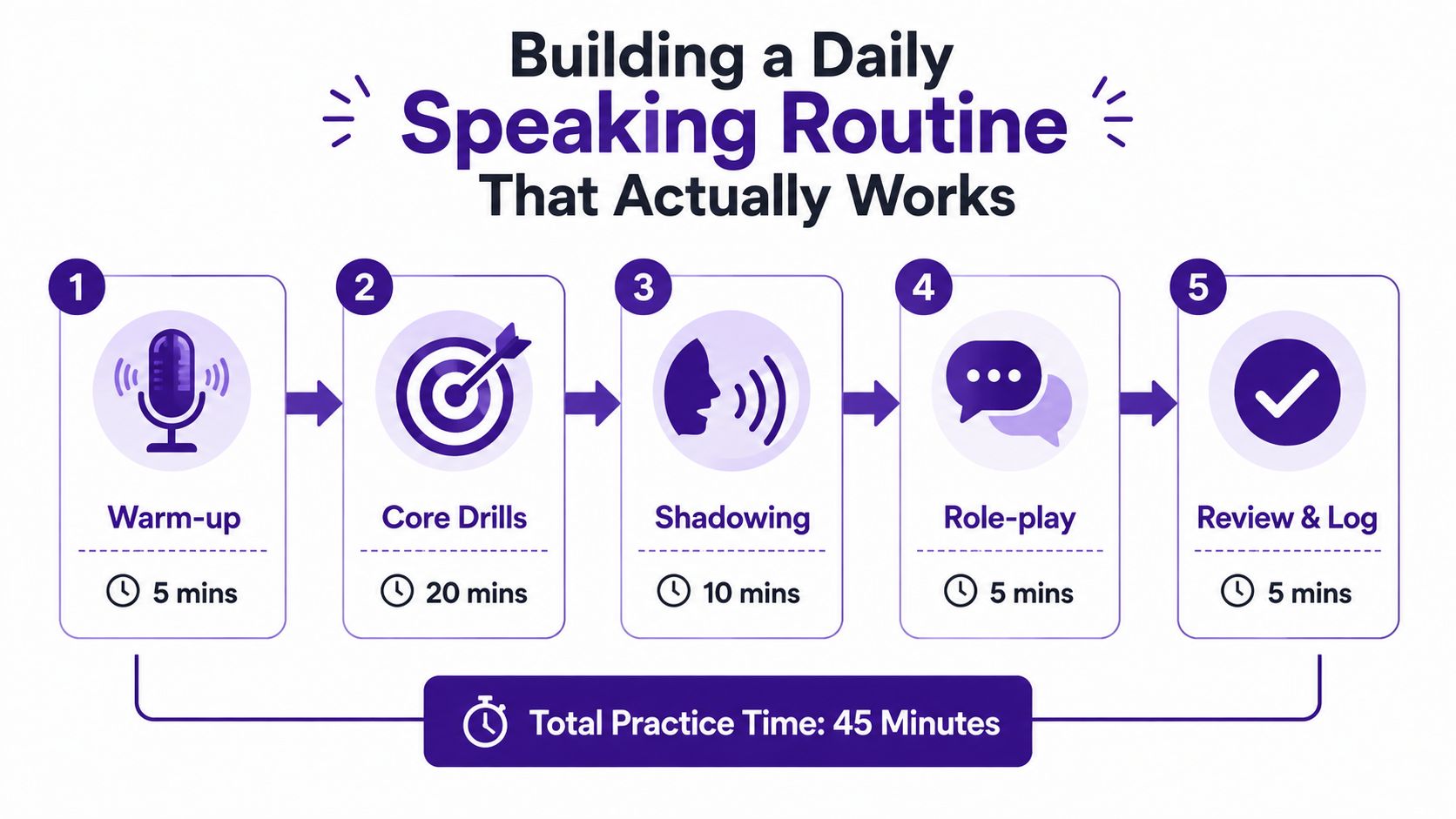
A routine works when it's short enough to repeat and structured enough to expose weaknesses. The most reliable speaking gains come from sessions that force retrieval, not from endless chat. A 45-minute block is a strong default because it's long enough to do real work and short enough to protect consistency.
Start with a short warm-up
Spend the first few minutes getting the mouth and mind moving. Read a prompt aloud, paraphrase a short note, or answer an easy question with no pressure to be impressive. The point is to reduce friction, not to perform.
Then move into a timed answer. Choose one question and speak for a fixed stretch, even if the response feels messy. That pressure matters because it reveals where you hesitate, where you repeat yourself, and where your structure collapses.
Use repetition instead of random variety
After the first attempt, replay the answer in your head or from the recording and speak it again with one target in mind. Keep the target narrow. Maybe you're cutting silent pauses. Maybe you're replacing filler words. Maybe you're adding a clearer opener and conclusion.
A strong daily block often looks like this:
- Warm-up: get comfortable with easy speaking.
- Core drill: answer one prompt under time pressure.
- Shadowing: copy the rhythm and pacing of a clean model.
- Role-play: handle a more realistic exchange.
- Review and log: write down the one issue that showed up most.
The review step is where most learners underperform. Don't grade the whole answer emotionally. Mark only the repeatable issue. If the same pause pattern appears three days in a row, you've found a real training target.
Cathoven's IELTS speaking practice flow is built around examiner-style prompts, instant scoring, and criterion-level feedback, which fits this kind of routine when you want a structured speaking loop instead of guessing from feel alone. The platform's instant-feedback approach is described in its IELTS prep guidance, and it's most useful when you use the report to decide what tomorrow's drill should fix.
Using AI Feedback to Replace Guesswork
Self-study breaks down when learners cannot tell whether they are improving. A recording may sound better, but that does not show whether fluency, pronunciation, or coherence changed in a meaningful way. AI feedback helps because it turns vague impressions into criterion-level signals.
What to look at first
Do not chase every score on the page. Start with the subskill that keeps showing up in your own recordings. If the report keeps flagging long pauses, work on fluency. If it flags weak lexical variety, add retrieval drills. If sentence control keeps slipping, use transformation practice.
The point is simple. A structured feedback loop beats vague “speak every day” advice because it shows what to fix next.
How to use the feedback well
Read the report, then make one adjustment only. If three issues show up, choose the one that most affects clarity. A learner who speaks too slowly and pauses too much should not spend the next session obsessing over a rare grammar article. That is how people waste a week.
Use the report as a decision tool:
- If fluency is weak, shorten the answer time and repeat the same prompt twice.
- If pronunciation is unclear, isolate one troublesome sound or stress pattern.
- If coherence is messy, rehearse a three-part structure, then speak again.
- If grammar breaks down, practice sentence reshaping before another full response.
Cathoven's IELTS speaking practice flow uses examiner-style prompts, instant scoring, and criterion-level feedback, which fits this kind of routine when you want a tighter speaking loop instead of guessing from feel alone. The platform's instant-feedback approach is described in its IELTS prep guidance on instant feedback. Use the report to decide what tomorrow's drill should fix, then record again. Occasional human review still matters for nuance, but the day-to-day progress loop should stay tight and objective.
Overcoming Speaking Anxiety and Building Confidence
Fear of mistakes is often the hidden brake on speaking progress. As noted earlier, a mixed-methods study found that fear of making mistakes was the top source of speaking anxiety, with formal speaking situations and pronunciation concerns close behind. That matches what learners often feel but rarely say aloud. They are not lazy. They are avoiding embarrassment.
Reduce threat before you demand speed
Confidence grows faster in low-pressure rehearsal than in high-stakes improvisation. Start with private recording, move to short prompted answers, then build toward longer timed responses. If a learner jumps straight into full mock tests, anxiety often makes the speech worse than it really is.
Low-pressure repetition is not a shortcut around real speaking, it's the bridge to it.
Pronunciation fear can be just as sticky. Many learners hear every flaw as proof that they are “bad at English,” so they stop taking risks. The better move is to treat pronunciation as one training lane, not a verdict on ability.
Build safety into the session
Use a few simple constraints. Keep one session private. Keep the prompt familiar. Keep the first attempt short enough that failure feels survivable. Then repeat the same task once the nervous system has settled.
A judgment-free practice environment helps, especially for introverted learners and people who freeze in front of strangers. A structured self-study setup, or a format built for introverted students in ESL classes, lets them rehearse without the social cost of visible mistakes, which makes real speaking feel less threatening when it counts.
The goal is not a perfect accent or flawless delivery. It is fewer avoidable pauses, less panic, and more willingness to stay in the conversation when a sentence goes wrong. Once that changes, confidence usually follows behavior, not the other way around.
Spaced Practice and Long-Term Retention Strategies
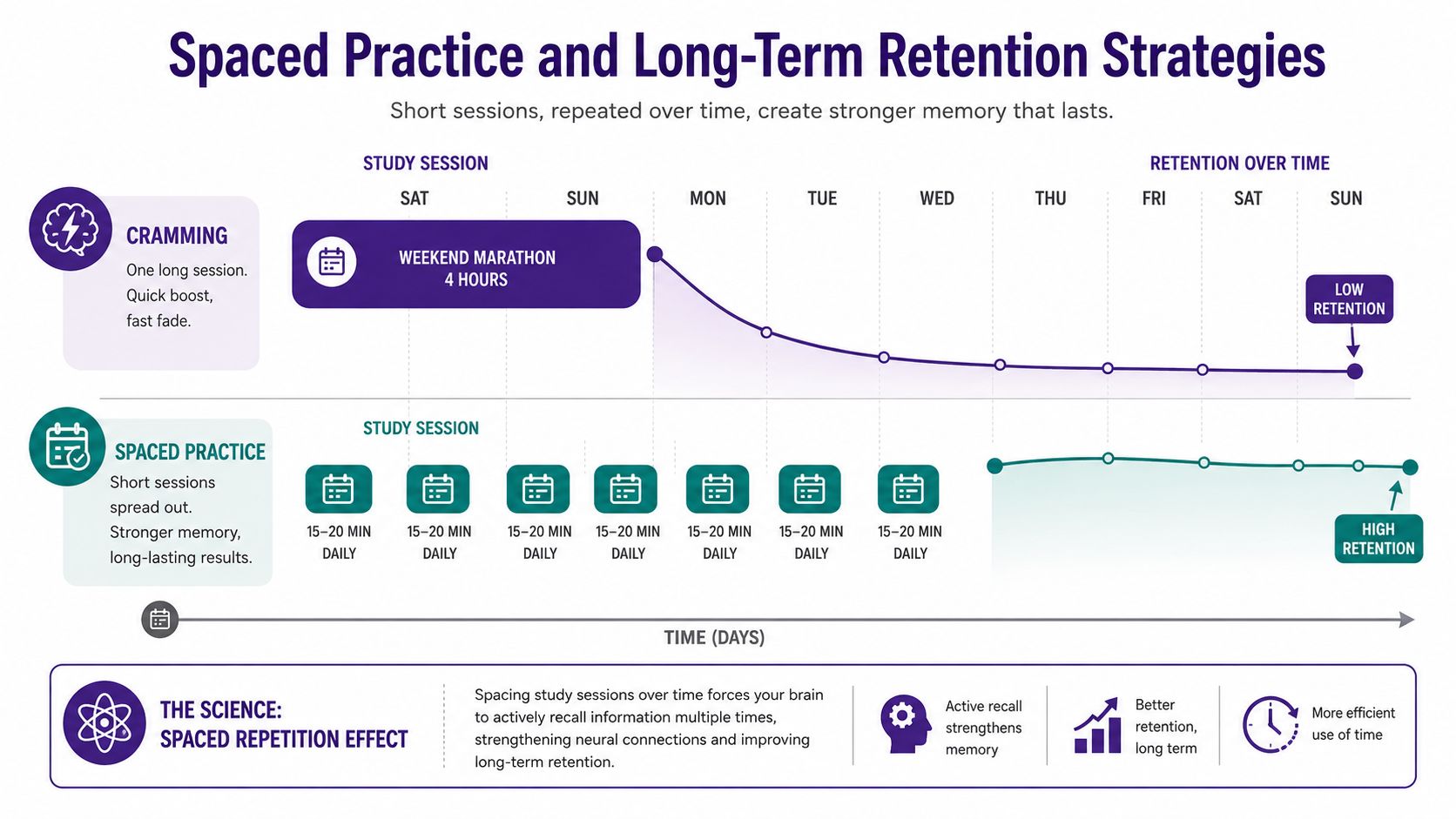
Long practice sessions feel serious, but they often create a false sense of progress. You remember the session itself, not the language. Spaced practice solves that by separating repetitions over time, so the brain has to retrieve the material again instead of only recognizing it.
Why distribution beats marathons
Research on spaced practice meta-analysis shows that spacing helps second-language learning, and longer gaps tend to help delayed recall more than cramming (spaced practice meta-analysis). Shorter spacing can help with immediate checks. Longer spacing is better if the goal is to keep the language available later.
The practical lesson is simple. The exact schedule matters less than the distribution. Review the same speaking pattern daily for a week, or every other day with widening gaps. A long session once in a while feels productive, but it fades fast because the learner never has to retrieve the language again.
A weekly rotation that actually fits life
Use the week to rotate subskills instead of trying to fix everything at once. One day can target fluency and timing. Another can focus on vocabulary retrieval. Another can work on grammar reshaping. Keep each task small enough to finish before fatigue turns the session into noise.
A workable weekly shape looks like this:
- Day 1: timed answers with pause control.
- Day 2: vocabulary recycling through new prompts.
- Day 3: sentence transformation and longer turns.
- Day 4: pronunciation cleanup from recordings.
- Day 5: mixed mock speaking.
- Day 6: repeat the weakest subskill.
- Day 7: light review and reflection.
The signs of progress are concrete. Recordings sound cleaner. Self-corrections drop. Recovery after mistakes gets faster. If answers sound more continuous and less fragmented, the routine is doing its job.
Cathoven gives learners a way to turn speaking practice into a feedback loop instead of a guessing game. If you want examiner-style prompts, criterion-level scoring, and a way to target the exact subskill holding you back, visit Cathoven and use it to build a speaking routine that shows you what to fix next.