AI Grading Tools for Teachers, 2025 Comparison and Practical Selection Guide
At the end of a writing-heavy week, the problem rarely looks like a lack of grading ability. It looks like a queue of essays, short answers, speaking responses, and revision requests waiting for the same limited teacher attention. An AI grading tool for teachers can reduce that queue, but the important question is not whether it produces a score quickly. The question is whether it produces useful, rubric-aligned feedback while preserving teacher judgment and student trust.
That distinction matters because automated assessment has been developing for decades. The field moved from early essay-scoring systems toward criterion-level feedback, formative assessment, and teacher-facing workflows. Today, educators can evaluate tools by their ability to support a complete process, from importing student work to reviewing suggested scores, editing comments, and returning feedback through an existing learning environment.
This guide examines that process through four lenses: capability, operational fit, evidence of agreement with human grading, and governance. It also separates use cases that are often treated as interchangeable. A language teacher evaluating exam-format writing needs different controls from a STEM instructor checking short answers, while a university lecturer reviewing argumentative essays needs more protection against shallow or homogenized feedback.
The strongest choice will not necessarily be the tool with the most impressive accuracy claim. It will be the one whose rubric controls, review workflow, integrations, privacy practices, and feedback style match the decisions a teacher makes.
Table of Contents
- Introduction Why Grading Workload Needs a Smarter Approach
- What an AI Grading Tool for Teachers Actually Does Today
- How to Compare AI Grading Tools on What Matters Most
- Accuracy Human Oversight and Trust in Automated Scoring
- Classroom Use Cases That Show Where Each Tool Fits Best
- Implementing an AI Grading Tool Without Losing Privacy or Control
- Recommendation Choosing the Right AI Grading Tool for Your Teaching Context
Introduction Why Grading Workload Needs a Smarter Approach
A teacher can begin an assignment with a clear rubric and still end the week unsure whether every student received equally specific feedback. The first essays often receive careful comments. Later submissions may receive shorter notes because fatigue changes how much attention remains. That is not a character flaw. It is a workflow problem created when every response requires the same amount of manual processing, even when many errors repeat.
An AI grading tool for teachers can help by preparing a first pass. It can identify recurring language problems, map responses against criteria, group similar patterns, or draft comments for review. But those functions solve different problems. A tool that checks an answer against a key is not equivalent to one that evaluates argument quality, and a generated paragraph of feedback is not automatically formative instruction.
The evaluation therefore needs to start with the teacher's decision, not the vendor's feature list.
| Teaching need | Capability to examine | Risk to test |
|---|---|---|
| Writing assessment | Criterion-level rubric scoring and feedback | Shallow treatment of argument or context |
| Language learning | Grammar, vocabulary, fluency, and task response analysis | Feedback that sounds generic or ignores proficiency level |
| Short-answer assessment | Batch processing and answer grouping | Similar wording mistaken for equivalent understanding |
| High-stakes or consequential work | Teacher approval and score override | Automation becoming the de facto final decision |
| School-wide deployment | LMS connectivity, exports, privacy controls, and training | Technical friction or inconsistent governance |
The guide's practical standard is simple: AI should prepare evidence for a teacher's decision, not replace the decision. That means testing real student work, checking whether comments match the rubric, and watching for feedback that rewards formulaic writing over genuine thinking.
The rest of the analysis follows that standard. It considers how these systems developed, which operational features determine classroom adoption, what accuracy benchmarks can and cannot prove, where different classroom scenarios fit, and how schools can introduce automation without surrendering control.
What an AI Grading Tool for Teachers Actually Does Today
A teacher uploads a class set of essays after a writing task. The system groups responses, applies a configured rubric, suggests criterion-level scores, drafts comments, and may return results through the school's existing workflow. The teacher still has to decide whether the evidence supports each judgment.
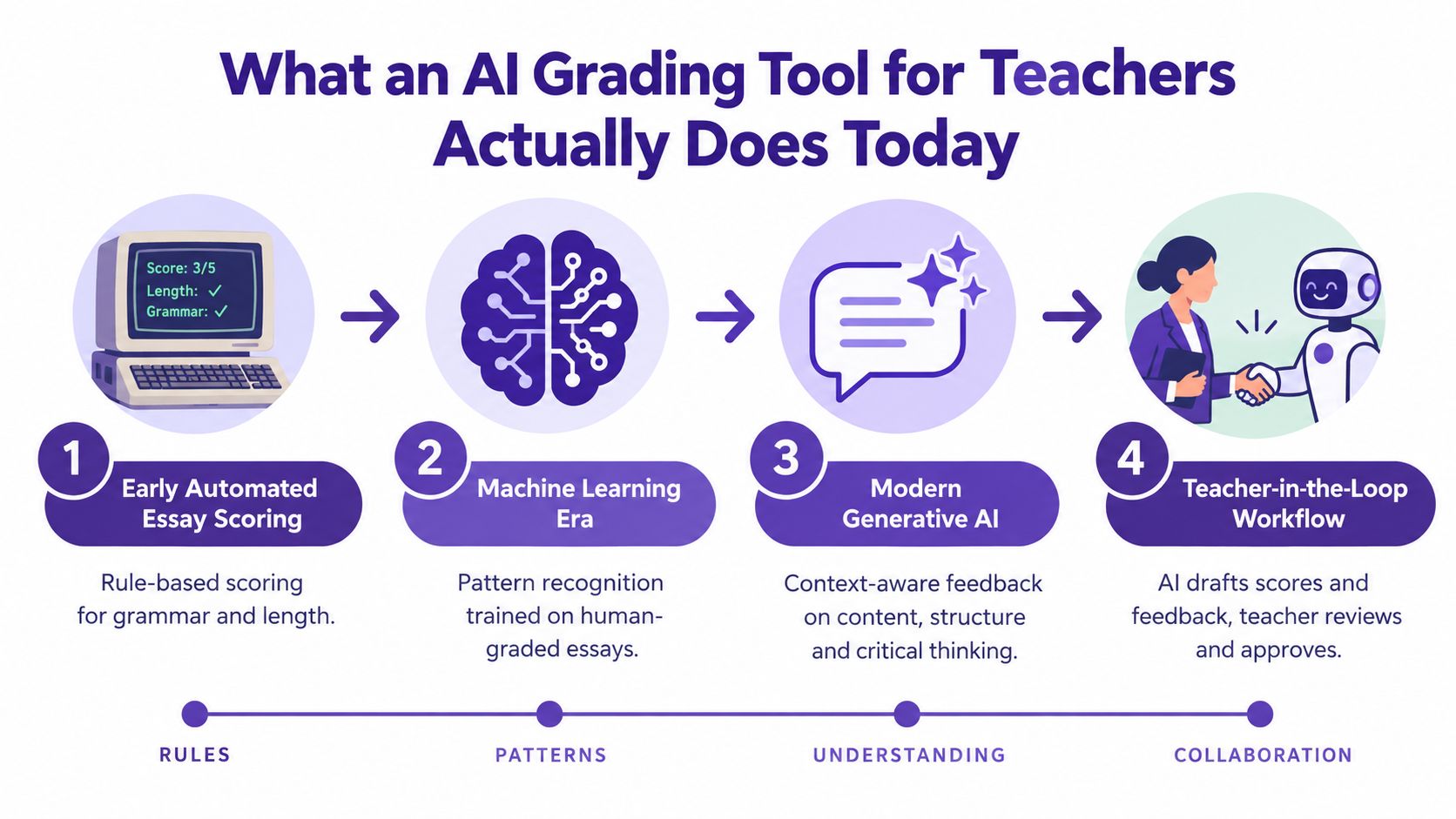
The phrase AI grading covers several levels of automation. A basic system checks whether a response matches an expected answer. More advanced systems identify patterns in writing. Current teacher-facing systems may assess organization, task response, vocabulary, reasoning, and other rubric criteria, then produce feedback or process a batch of submissions.
The field has a long research history. Early rule-based essay scoring systems appeared in the 1960s, followed by machine-learning approaches used in large-scale assessment and classroom writing instruction.
From answer checking to criterion-level feedback
Early automated scoring focused on visible features such as grammar, length, and recurring language patterns. Machine learning broadened the analysis by connecting text features with human-assigned scores. Generative systems can now write more natural comments about organization, task response, vocabulary, and reasoning. Natural language, however, does not guarantee sound assessment.
The deciding issue is rubric alignment. A score supports instruction when the teacher can identify the criterion involved, inspect the evidence behind the judgment, and see what the student should improve. A polished explanation that ignores the assigned learning objective creates the appearance of precision without dependable guidance.
Writing-heavy subjects expose this trade-off clearly. Language teachers may assess grammar, vocabulary, fluency, and task achievement. Writing instructors may prioritize thesis development, evidence, coherence, and rhetorical choices. STEM teachers may need short-answer evaluation that distinguishes genuine reasoning from answers sharing similar wording. The system must let teachers set those priorities and override a judgment when context changes its meaning.
Practical distinction: A fast score is an output. A rubric-linked explanation is part of a teaching workflow.
Teacher review and governance can matter more than raw scoring accuracy. If an explanation cannot be reviewed, a score cannot be changed, or student data cannot be handled under school policy, higher automated accuracy does not resolve the implementation problem. The grading question is whether model output remains visible, reviewable, and connected to the teacher's rubric.
2025 Snapshot of Named AI Grading Tools
The market is crowded, but the most useful comparison is still operational: what rubric controls exist, how feedback moves through the LMS, what privacy documentation is available, and whether teachers remain in charge of final decisions. The table below is a 2025 snapshot based on official product documentation and help materials where available.
| Tool | Best fit | Evidence for rubric or grading workflow | LMS or standards notes | Privacy or governance notes |
|---|---|---|---|---|
| Gradescope by Turnitin | STEM problem sets, short answers, rubric-based review | Official documentation describes rubric-based grading, rubric editing permissions, and anonymous grading workflows | Official product updates indicate admins can require LMS or SSO-only course access, which is useful for institutional control | Official documentation states the service does not claim rights to assignments or rubrics beyond operating the service and can delete student records on request |
| Turnitin Feedback Studio | Essay marking, similarity review, rubric-based writing feedback | Official documentation describes rubric and grading-form use in Feedback Studio | Official documentation describes LTI 1.3 integration and use of the 1EdTech security framework for data exchange | Stronger fit for institutions already using Turnitin governance, permissions, and audit processes |
| Khanmigo | Teacher assistance, classroom support, lighter formative use | Public documentation emphasizes teacher support more than a formal rubric-grading workflow | LMS specifics are less central in public-facing materials than in enterprise assessment platforms | Khan Academy provides dedicated safety and security information for Khanmigo, including educator-facing privacy resources |
| Cathoven | Language learning, IELTS-style writing and speaking evaluation | Best fit where teachers want criterion-level language feedback tied to writing or speaking performance | Review LMS fit directly against your school workflow and export needs | Best evaluated through a pilot with real language samples and teacher review of criterion-level comments |
Two cautions matter here. First, named products are often strongest in different categories, so a single winner is rarely the right conclusion. Second, public documentation is uneven. Some platforms publish detailed help-center evidence for rubric control and privacy, while others require a hands-on pilot or sales conversation before institutions can verify operational fit.
How to Compare AI Grading Tools on What Matters Most
A useful comparison follows one submission through the teacher's actual workflow. Can the teacher define criteria, process a class set of responses, inspect suggested scores, revise a decision, and return feedback without moving between disconnected systems? These questions reveal more than a long feature list because they test whether automation fits classroom practice.
The main evaluation criteria are rubric alignment, teacher override, batch upload, and LMS integration. Each addresses a different operational risk. Rubric alignment protects the learning objective. Override controls preserve professional judgment. Batch processing determines whether the tool works at class scale. Integration determines whether feedback can reach students through existing systems. A broader overview of AI tools for teachers is useful when these features are assessed as parts of a workflow rather than as isolated functions.
| Criterion | What to Look For | Why It Matters for Teachers |
|---|---|---|
| Rubric alignment | Custom criteria, criterion-level suggestions, visible evidence, adjustable weighting | The tool evaluates the assigned task rather than a generic definition of good work |
| Teacher override | Editable scores, comments, and final approval settings | The teacher can correct context errors and retain responsibility for consequential decisions |
| Batch upload | Class-level import, response organization, and consistent processing | Teachers can review patterns across a group instead of handling each response as an isolated file |
| LMS integration | Reliable import and export, gradebook compatibility, and standards-based connections | Feedback reaches students through systems they already use |
Rubric alignment changes the value of automation
A prompt such as “grade this essay” leaves the assessment model undefined. Teachers need to specify whether the system is judging task fulfillment, organization, language accuracy, evidence, or a combination of criteria. Criterion-level suggestions and visible evidence make the result easier to audit. Adjustable rubrics also let one course support different assignment goals without forcing every class into the same scoring model.
For language learning, this distinction affects instruction directly. Students may need to separate a grammar error from weak task response, limited vocabulary, or disorganized ideas. Feedback that reduces every weakness to “improve grammar” can identify a surface problem while still giving the teacher little guidance for the next lesson.
Override controls determine who owns the decision
Teacher override should extend beyond editing the final score. Teachers may need to revise a comment, reject a rationale, adjust one criterion, or add context the model could not infer. An unconventional structure may still satisfy the assignment. A response may follow an oral instruction or demonstrate understanding elsewhere in the work.
This makes override a governance feature, not a cosmetic setting. For writing-heavy courses, the teacher should be able to see how a recommendation was produced, change it efficiently, and explain the final judgment to a student or administrator.
Integration determines whether adoption lasts
An isolated grading dashboard may work in a trial and create extra administration during a term. Teachers need predictable data flows, clear permissions, and exports that match institutional requirements. LTI is the main interoperability standard for connecting a tool to an LMS so rosters, launches, and grade return can work smoothly. SCORM and xAPI serve different roles. They are more relevant to packaging learning content or recording learning activity than to teacher grading workflows themselves.
The right priority changes by use case:
| Use case | Highest-priority criteria | Practical decision rule |
|---|---|---|
| Writing | Rubric alignment, evidence visibility, teacher review | Prefer controllable feedback over a faster generic score |
| Language learning | Criterion-level feedback, adjustable weighting, batch review | Choose the system that separates language form from task performance |
| STEM | Reasoning evidence, configurable criteria, final approval | Require review controls for answers that share wording but differ in method |
The key differentiator is whether a teacher can review, revise, and return grading inside a trustworthy workflow.
Accuracy Human Oversight and Trust in Automated Scoring
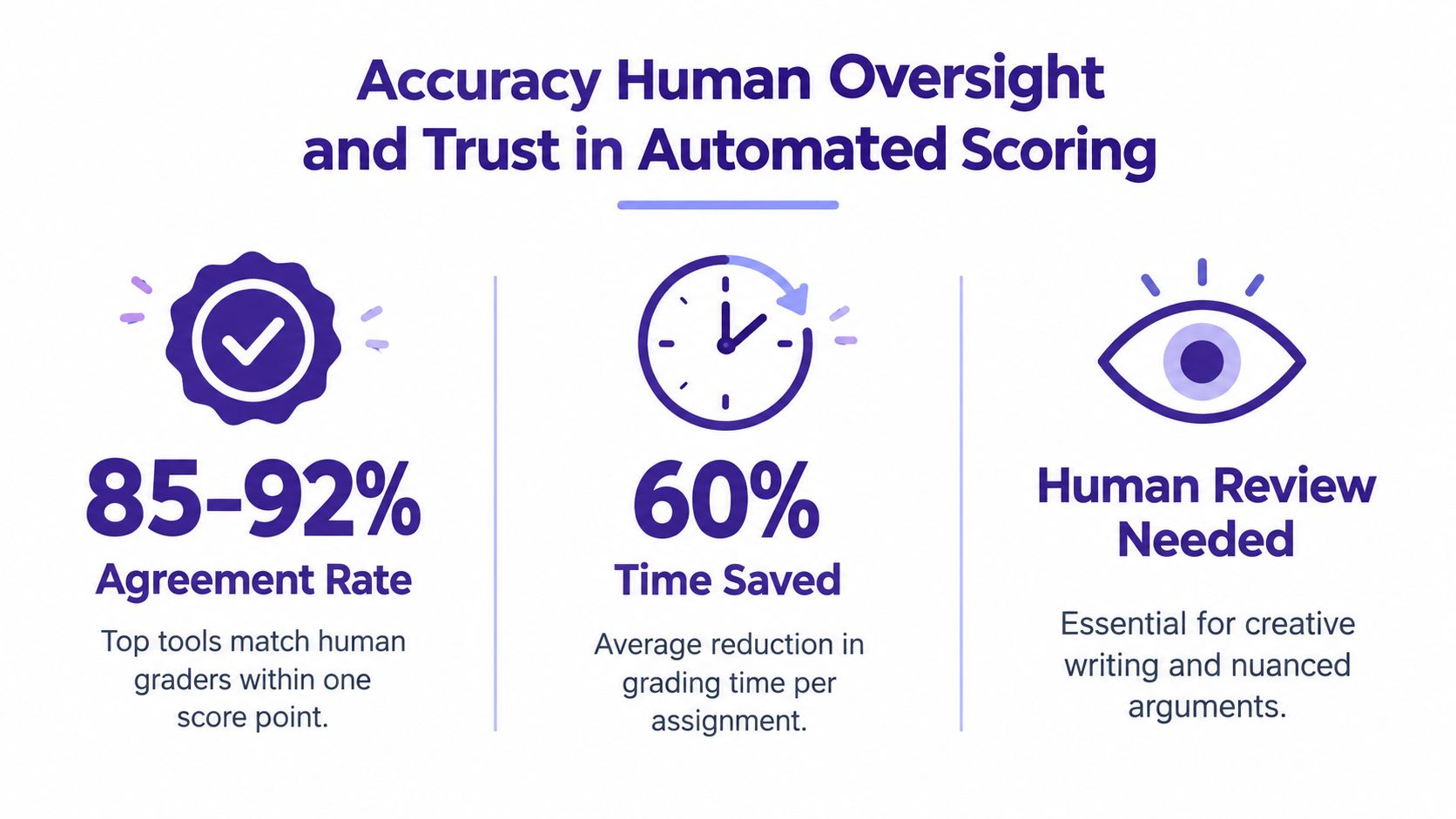
A high agreement score can hide a serious instructional gap. Automated scoring may handle predictable language patterns well while missing an original argument, a culturally specific reference, unconventional organization, or evidence that requires subject knowledge. Teachers therefore need evidence of how a score was produced, not only the score itself.
Research does support cautious claims about human agreement, but only when the source is named and the context is narrow. For example, a validation study reported that automated essay scores correlated with human scores to roughly the same degree that human raters correlated with one another, while also warning that consistency is not the same as validity (validation study summary). That is a much safer conclusion than saying automated systems generally match human grading across formats.
Human approval remains especially important for open responses, where a numerical agreement measure cannot capture every acceptable interpretation. The practical standard is controlled assistance: the system proposes a judgment, and the teacher can inspect, revise, and explain it.
Surface accuracy is not instructional depth
A systematic review of AI-based and teacher-based writing assessment found that automated systems are generally consistent and efficient with surface language features. Coherence, argumentation, and rhetorical structure are harder to judge reliably. Teachers provide more contextual feedback, although their decisions can vary and are difficult to scale.
For example, an AI system can flag repeated grammar patterns or suggest an explanation of vocabulary choice. A teacher still needs to decide whether evidence supports the central claim, whether an unusual rhetorical choice is deliberate, and whether nonstandard phrasing reflects genuine learning. That is also why accurate language proficiency assessment and lesson tailoring matter more when feedback is used to plan instruction, not just assign a score.
A study of automated writing evaluation alongside teacher feedback found no significant change in the amount of high-level teacher feedback. Teachers without automated support tended to give more low-level feedback, while students revised teacher-provided low-level comments more often than computer-generated comments. Automated evaluation also supported the retention of accuracy gains over time (teacher and automated writing feedback study).
Trust can be affected before grading begins
Algorithmic signals can change human judgment before a teacher reads the work closely. A 2026 NIH-hosted experimental study found that a high AI-detection warning increased perceived AI authorship risk and lowered ratings of the same paper's overall quality, originality, language expression, and logical structure (algorithmic warnings and teacher evaluation). The implication applies to grading cues generally. Interfaces should display supporting evidence and uncertainty rather than encourage suspicion through unexplained labels.
Students and teachers also need a clear process for reviewing automated feedback, correcting errors, and challenging a final decision. Policies should define which judgments remain with the teacher and how AI use relates to academic integrity policy. Trust depends on consistent expectations, documented overrides, and an explanation students can understand.
Raw accuracy matters, but review quality, rubric alignment, and governance determine whether automated scoring remains trustworthy in classroom use.
Classroom Use Cases That Show Where Each Tool Fits Best
A teacher grading a short formative response needs different controls from one assessing a research essay. The right AI grading tool for teachers therefore depends on the judgment being automated, the evidence it must expose, and how easily a teacher can override its result. Raw scoring accuracy matters less when the rubric is poorly aligned or the system offers no usable review path.
A small 2025 pilot study of automated classroom formative assessment reported substantial AI scoring coverage in participating classrooms, including frequent use with short-answer tasks and high median grading coverage.
Writing and exam-format language practice
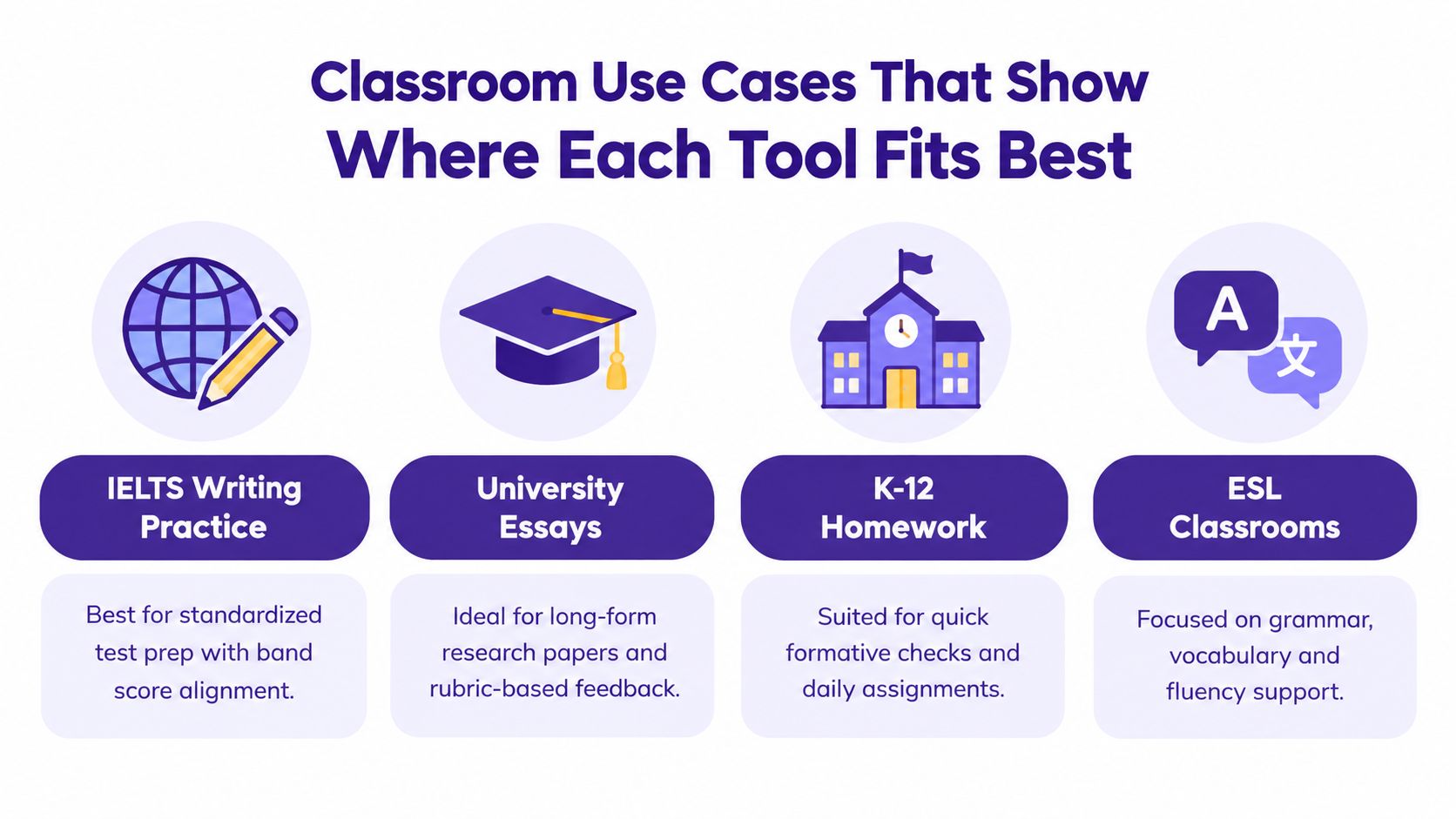
For exam-format writing, criterion-level feedback is more useful than one overall score. Teachers may need separate signals for task achievement, organization, vocabulary, and grammar, followed by a revision task focused on one priority.
The main risk is formulaic feedback. Review responses with similar scores but different structures, especially when students are learning flexible expression rather than reproducing a template. A suitable system should allow rubric changes, teacher edits, and visible evidence for each judgment.
University essays and extended arguments
Long essays require assessment of claims, evidence, reasoning, and rhetorical structure. Automated analysis can sort submissions, flag recurring issues, and prepare an initial rubric view. Final decisions about originality and intellectual quality should remain with the teacher.
A selective workflow works better than automatic acceptance of every score. Use the system to identify essays that need closer reading, then spend professional attention on argument quality, disciplinary context, and feedback that advances the student's thinking.
K-12 homework and formative checks
Daily assignments are a strong fit for rapid pattern detection. An AI system can group short answers by likely misconception, helping a teacher decide whether to revisit a concept or continue with the planned lesson.
Answer grouping still needs inspection. Similar wording can conceal different levels of understanding, so borderline responses should be checked for reasoning rather than word matches alone. Teacher override matters most where a response falls between categories.
ESL classrooms and adaptive materials
Language teachers can use automated feedback to identify recurring grammar and vocabulary needs, then adjust practice materials to the class's level. Text analysis may also help select reading passages that are appropriately challenging.
Written scores cannot represent every learning outcome. Fluency, confidence, pragmatic appropriateness, and willingness to communicate often require observation beyond the submitted text. IELTS and advanced writing evaluation workflows show why assessment outputs should inform curriculum decisions without replacing teacher interpretation.
Implementing an AI Grading Tool Without Losing Privacy or Control
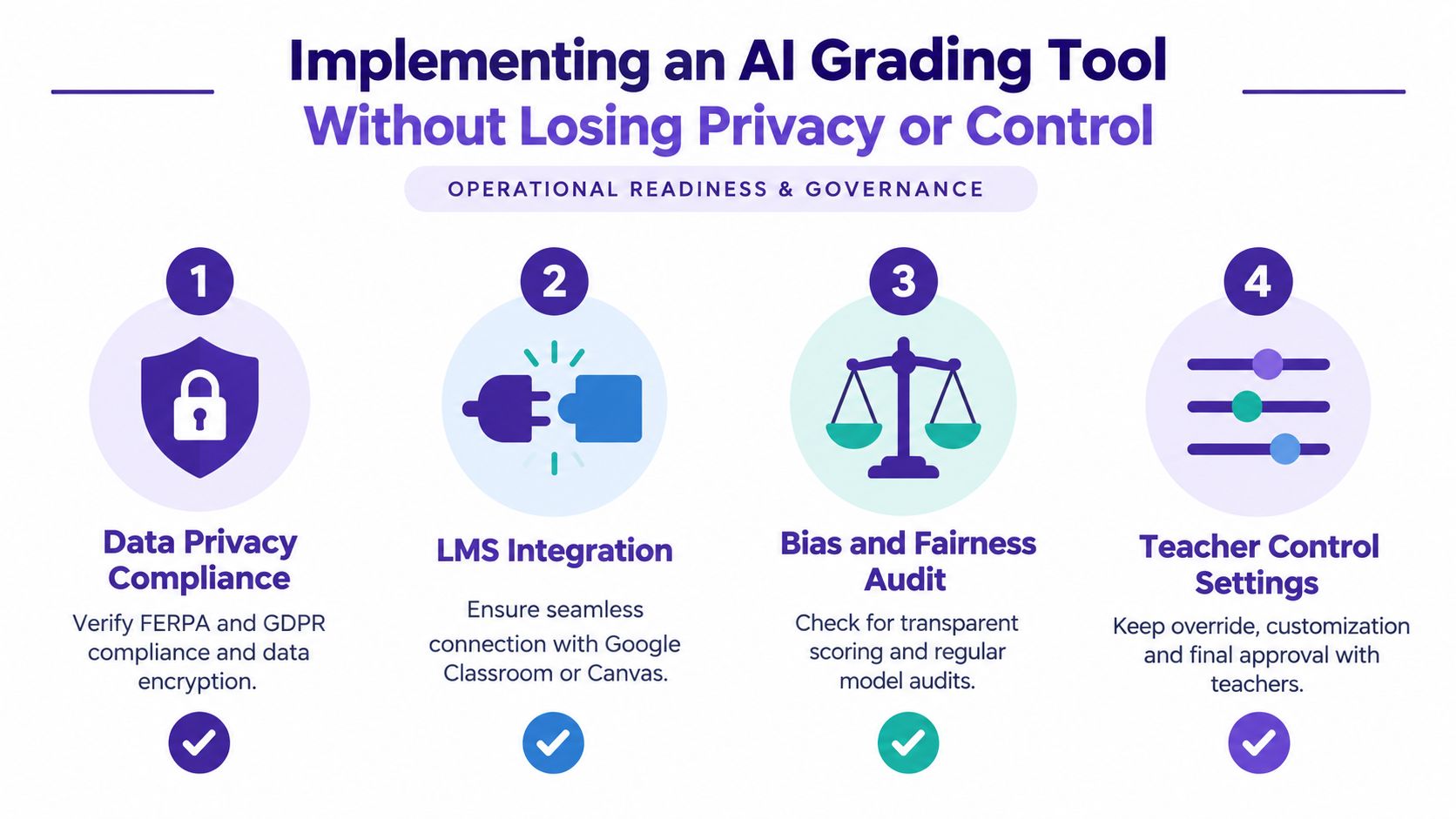
A school can have acceptable scoring accuracy and still lose control of assessment. Those findings point to a wider governance problem: privacy and security, algorithmic fairness, teacher-student relationships, and professional development must be addressed alongside model performance.
The gap between interest in AI and operational readiness matters. General confidence with experimentation does not show that a school has approved data flows, trained reviewers, or a process for challenging automated decisions.
Begin with a controlled pilot
Start with low-stakes formative work, not final grades. Use a representative sample containing strong, weak, multilingual, unconventional, and incomplete responses. Teachers should compare suggested scores with their own rubric decisions and record repeated disagreements. Those disagreements reveal whether the problem is model accuracy, unclear rubric language, or a task that requires disciplinary judgment.
Establish data and access rules
Before uploading student work, confirm what the provider stores, how long it remains available, who can access it, and whether it supports model improvement. Document consent, retention, deletion, and incident procedures in language teachers and students can understand. Apply stricter handling to identifiable work and high-stakes assessments.
Audit fairness and feedback quality
Review outputs across proficiency levels, writing styles, and relevant student groups. Check for score differences, over-penalization of nonstandard language, and comments that recommend one structure to everyone. The audit should test rubric alignment as well as fairness. Teachers also need to examine their own assumptions, since a model can reproduce limitations already present in the rubric or training examples.
Keep final approval with the teacher
Configure the workflow so suggested scores do not become final by default. For writing, require teacher review when meaning, originality, or disciplinary context is difficult to infer from surface features. For language learning, treat automated feedback as evidence about patterns, while teachers judge communication and pragmatic appropriateness. For STEM, allow quicker acceptance of clear answers, but route unsupported guesses and borderline reasoning for review.
If results move through an LMS, verify permissions and export behavior. Prioritize LTI when the main need is launch, roster sync, and grade return. Consider SCORM or xAPI only when the product also needs to package instructional content or record learner activity outside a standard grading flow. Training should cover mechanics and judgment, including when to reject an automated recommendation.
Governance is part of grading quality. A technically capable system still creates risk if teachers cannot review its output or students cannot question a consequential decision.
Recommendation Choosing the Right AI Grading Tool for Your Teaching Context
There is not one universally correct AI grading tool for teachers. The right choice follows the assessment decision.
For language teachers and exam-format writing, prioritize criterion-level scoring, feedback that distinguishes language from task performance, adaptable rubrics, and teacher review. Cathoven offers AI-assisted evaluation for IELTS writing and speaking, with structured feedback across the relevant language criteria, alongside tools for language analysis and materials support. Treat any automated result as a draft for instruction, not as an unchallengeable proficiency verdict.
For STEM teachers checking short answers, prioritize batch processing, answer grouping, clear reasoning requirements, and quick review of borderline responses. Raw throughput matters more here, but a system still needs to distinguish a correct answer from a lucky phrase match or an unsupported guess.
For university writing instructors, choose rubric depth, evidence visibility, review controls, and data export over a polished feedback generator. Extended arguments require human attention to disciplinary meaning and originality.
For school leaders, operational readiness should decide the purchase. Confirm privacy terms, LMS compatibility, teacher training, escalation procedures, and audit responsibilities before expanding beyond a pilot.
Run the same test before committing: upload a small set of real, anonymized responses; compare criterion scores with teacher judgments; inspect comments for specificity; revise the rubric; and see whether the workflow still functions. If teachers cannot explain why the system produced a recommendation, the tool is not ready for consequential grading.
Cathoven helps teachers evaluate IELTS writing and speaking with criterion-level AI-assisted feedback, while its language analysis tools support diagnostics, lesson preparation, and targeted practice. Visit Cathoven to see how its grading and English-learning workflows could fit a teacher-in-the-loop assessment process.