AI English Tutor Explained: How It Works and When to Use It
You've finished a speaking exercise after work, but you're still unsure whether your pronunciation was clear. Your writing practice creates another problem: a correction tool highlights grammar, yet gives you no useful explanation of why your paragraph feels disorganised. A human tutor could help, but regular lessons may not fit your schedule or budget.
An AI English tutor can fill part of that gap. It listens to spoken answers, examines written language, identifies patterns, and suggests targeted practice. The strongest systems do more than imitate conversation. They connect feedback to a learner's goal, recent performance, and, for exam preparation, the criteria used to assess the task.
The practical answer is simple: use AI for frequent practice, immediate corrections, and structured repetition. Use a human tutor when you need emotional support, nuanced judgement, complex discussion, or high-stakes confirmation. This guide shows how the technology works, how adaptive practice changes your routine, and how to decide when AI feedback is sufficient and when a qualified person should review your work. Teachers can also explore how AI supports classroom planning and language instruction in this guide to AI tools for teachers.
Table of Contents
- Introduction to AI English Tutors and Who They Help Most
- How an AI English Tutor Actually Works Behind the Scenes
- Diagnostics reveal the first priority
- Real adaptation changes the practice
Introduction to AI English Tutors and Who They Help Most
An AI English tutor is software that helps you practise English through text, audio, or both. You might answer a question aloud, submit an essay, ask for an explanation, or repeat a sentence after receiving pronunciation guidance. The system then responds based on patterns in your language and the learning objective you selected.
That makes it different from a general chatbot. A general chatbot may continue a conversation, but a purpose-built tutor is designed to observe learning behaviour. It can focus on pronunciation, fluency, grammar, vocabulary, coherence, or task performance, then turn those observations into another exercise.
Who benefits most
AI tutoring suits learners who need regular access to English but can't arrange a lesson every time they want to practise. It can be particularly useful for:
Busy adults: Short sessions can fit around work, commuting, or family responsibilities.
Independent learners: Immediate explanations make it easier to continue without waiting for a teacher.
Speaking-anxious learners: Private rehearsal offers a lower-pressure way to practise before speaking with another person.
IELTS candidates: Criterion-level feedback can make writing and speaking practice more focused than unstructured conversation.
Teachers and tutors: Automated analysis can support lesson planning and help identify recurring class or learner difficulties.
The important distinction is between practice access and expert judgement. An AI tutor can give you many opportunities to produce English, but its comments still need interpretation. If it praises every answer, gives vague corrections, or assigns a score without explaining the reasons, it isn't functioning as a reliable coach.
General fluency or exam preparation
For general English, you may want conversations about travel, work, study, or everyday decisions. For an exam, you need a narrower loop. You must answer the right task, manage time, organise ideas, and meet the assessment criteria.
A useful tutor should therefore begin with your goal, check your current ability, provide a task, analyse the result, and assign the next activity. That cycle helps you decide whether you need more vocabulary, clearer pronunciation, stronger paragraph organisation, or human review.
How an AI English Tutor Actually Works Behind the Scenes
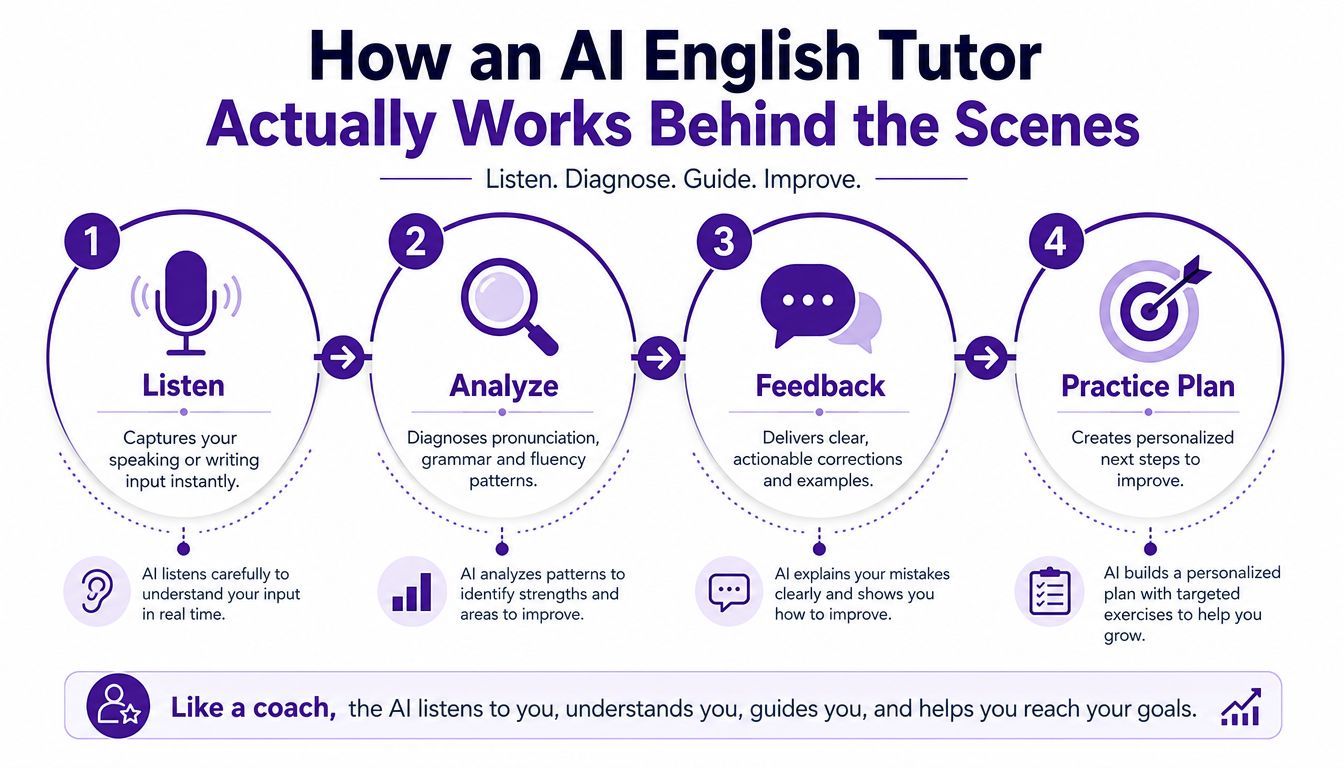
Think of an AI English tutor as a coach with four jobs. It listens to your performance, diagnoses patterns, explains what happened, and chooses a suitable next drill. The software doesn't understand you in the same personal way a teacher does, but it can process features of your speech and writing quickly.
Step one captures your language
For speaking, the system records your voice and converts it into text or measurable sound patterns. This stage may help identify words, pauses, repetitions, pronunciation features, and speech rate. For writing, the input arrives as sentences and paragraphs, so the tutor can examine grammar, word choice, sentence relationships, and response development.
The quality of the input matters. Background noise, an unclear microphone, incomplete writing, or an unsuitable prompt can lead to feedback that misses the core issue. Treat the first result as an informed analysis of a particular performance, not a permanent judgement about your English.
Step two looks for patterns
Language analysis works best when it examines repeated behaviour rather than one isolated mistake. A learner might make occasional article errors while still communicating clearly. Another learner might produce accurate sentences but rely on short, disconnected ideas.
A useful system separates these patterns. It may distinguish a pronunciation problem from a vocabulary gap, or a grammar error from a weakness in sentence linking. In exam preparation, the distinction is especially important because a general comment such as “improve your writing” doesn't tell you what to change.
Models also depend on the data and evaluation framework used to build them. That's why you should ask what the tutor measures, whether it explains its criteria, and whether you can inspect examples behind its advice. Tools for language analysis can also be used beyond a learner-facing tutor, including through Cathoven's AI tools and APIs.
Step three turns diagnosis into action
Good feedback names the problem, shows an example, and gives you a manageable correction. Instead of saying “use better vocabulary,” it might point out that your word is too general for the meaning and offer a more precise alternative. Instead of marking a sentence as wrong, it might explain the tense choice and ask you to produce a similar sentence.
The tutor should support your thinking and revision, not replace the work of developing and expressing your own ideas.
Step four plans the next attempt
The final stage closes the loop. The tutor selects another prompt, adjusts the difficulty, revisits a recurring error, or changes the practice type. Without this planning stage, AI feedback is just correction. With it, feedback becomes a learning routine.
How Adaptive Learning Personalises Your Speaking and Writing Practice
Adaptive learning means the tutor changes what you practise based on evidence from your performance. It doesn't present the next exercise in a fixed sequence. It considers your goal, diagnostic results, recent errors, and progress before choosing the next task.
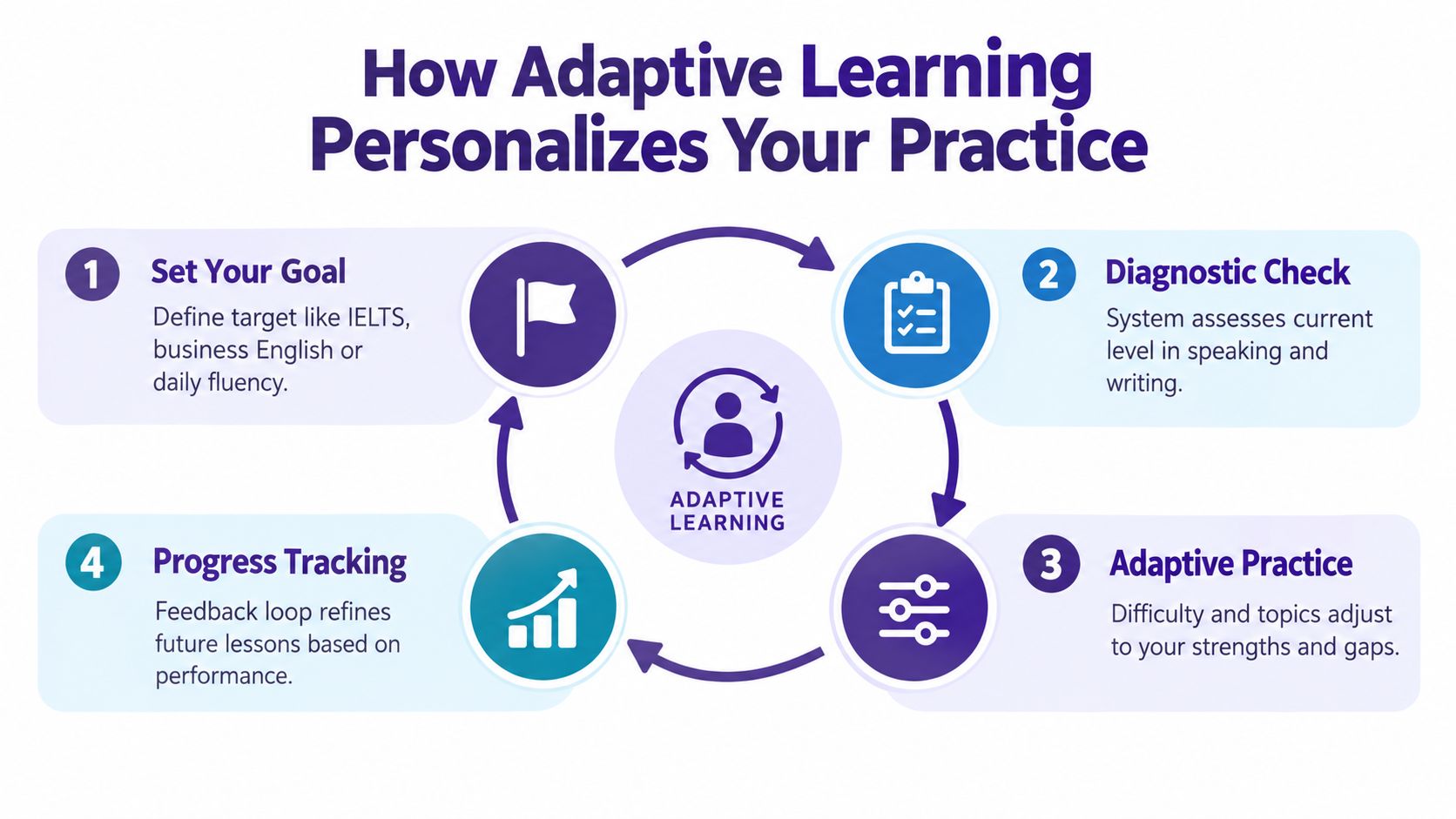
Goal setting changes the target
A learner preparing for workplace meetings needs different practice from someone preparing for IELTS Writing Task 2. The first may need polite interruption, concise explanations, and meeting vocabulary. The second needs to respond directly to a prompt, organise an argument, and control grammar under exam conditions.
A tutor should therefore ask what success means before it chooses activities. A broad goal such as “improve English” can produce broad practice. A specific goal, such as “develop spoken fluency for an exam-format interview,” gives the system a clearer target.
Diagnostics reveal the first priority
A diagnostic task creates a starting picture. You might speak about a familiar topic and write a timed response. The system can then identify the most visible weaknesses, but you should read the feedback as a set of priorities rather than a complete description of your ability.
For example, suppose your writing contains appropriate ideas but weak paragraph connections. An adaptive tutor may reduce time spent on basic vocabulary and assign exercises on topic sentences, logical progression, and linking. If later attempts show stronger organisation but repeated verb errors, the focus can shift.
Real adaptation changes the practice
Static practice gives everyone the same sequence. Adaptive practice changes at least one meaningful element:
Difficulty: Prompts become more demanding after successful attempts or simpler when the task overwhelms you.
Topic: The system uses subjects that support your purpose and expose missing vocabulary.
Feedback focus: It emphasises the weakness that currently limits performance instead of listing every possible error.
Review timing: It returns to troublesome words or structures after a gap, helping you test whether the learning lasts.
Output type: It alternates between recognition, controlled production, free speaking, and extended writing.
Practical rule: If every learner receives the same prompt, the same correction, and the same next lesson, the experience may be digital, but it isn't meaningfully adaptive.
Progress dashboards can make this loop visible. Look for skill-by-skill patterns, examples of recurring errors, and evidence that later tasks respond to earlier performance. Don't chase a single fluctuating score. Compare the quality of your responses, the type of feedback you receive, and whether you can apply a correction in a new context.
AI Tutor Versus Human Tutor and How to Choose the Right Fit
AI and human tutors solve different problems. An AI tutor is strong at access, repetition, and consistent processing. A human tutor is stronger at interpreting meaning, noticing emotion, and responding to a learner whose difficulty isn't obvious from the final answer.
The right choice depends on the task rather than on a general belief that one is superior.
| Criterion | AI English Tutor | Human Tutor |
|---|---|---|
| Availability | Offers practice whenever the system is accessible | Requires a shared appointment |
| Cost consistency | Usually follows a predictable access model | Can vary by tutor, lesson length, and arrangement |
| Immediate correction | Can respond quickly to repeated pronunciation, grammar, or vocabulary patterns | Can explain an issue interactively and adapt through conversation |
| Emotional support | Can provide private, low-pressure rehearsal | Can recognise frustration, anxiety, hesitation, and confidence changes |
| Complex judgement | Can organise feedback around defined criteria | Can evaluate unusual ideas, subtle tone, cultural meaning, and strategy |
Choose AI for repetition
AI is a practical fit when your main obstacle is opportunity. You may know what to practise but lack someone available for daily speaking, short writing drills, or repeated correction. In that situation, the tutor can keep you producing language instead of waiting for the next lesson.
It also works well for targeted routines. You can record an answer, review one fluency issue, repeat the answer, and compare the two versions. In writing, you can revise a paragraph after criterion-level comments and ask for another task that tests the same skill.
Choose a human for judgement
Human guidance becomes more important when the question is not solely whether language is correct. A person can discuss whether an argument is convincing, whether a response sounds appropriate in a particular culture, or why anxiety is affecting your performance. A human tutor can also challenge an idea, ask an unexpected follow-up, and notice that you're avoiding a topic.
For high-stakes preparation, human review adds a valuable second perspective. AI can organise practice and identify patterns, while a qualified tutor can examine whether your response meets the communicative demands of the exam.
Use a blended routine when possible
Many learners benefit from dividing the work. Use AI between lessons for volume and repetition. Use a human tutor for diagnosis, strategy, difficult questions, and accountability.
A simple decision rule helps:
Need more opportunities to speak? Start with AI practice.
Need explanations of recurring mistakes? Use AI first, then bring examples to a tutor.
Need help with argument quality or tone? Ask a human to review the work.
Need exam-format rehearsal? Combine structured AI tasks with human confirmation.
Avoiding practice because you feel nervous? Begin privately, then add live interaction gradually.
Real World Examples of Speaking and Writing Feedback in Action
Feedback becomes useful when it changes your next attempt. Consider a learner practising an exam-format speaking response about a memorable journey. The learner answers the main prompt, then responds to follow-up questions about planning, cost, and whether travel changes people.

Speaking feedback should lead to another recording
An AI tutor might identify frequent pauses before content words, repeated use of one connector, or unclear final sounds. The learner shouldn't try to fix everything at once. A better response is to choose one target, such as grouping ideas into longer thought units, then record the answer again.
The tutor can also compare the second response with the first at the level of observable behaviour. Did the learner complete ideas more smoothly? Did the new pronunciation remain understandable? Did the learner answer the follow-up directly instead of returning to a memorised story?
Speaking feedback earns its value only when you use it in a fresh response, not when you simply read the correction.
The same principle applies to vocabulary. If the learner receives an unfamiliar phrase, they should use it in a new sentence connected to their own experience. Memorising a replacement without producing it can create passive recognition rather than usable speaking ability.
Writing feedback needs criterion-level mapping
official British Council IELTS Writing format guidance
IELTS Writing is scored on four equally weighted criteria: Task Achievement or Task Response, Coherence and Cohesion, Lexical Resource, and Grammatical Range and Accuracy, as explained in the official IELTS scoring explanation.
Suppose a learner writes an opinion essay with a clear position but gives only brief support. Criterion-level feedback should separate that issue from grammar. The learner might receive four different revision actions:
Task Response: Add a specific explanation or example that supports the central position.
Coherence and Cohesion: Make the relationship between the topic sentence and supporting idea clearer.
Lexical Resource: Replace repeated general words only where precision improves meaning.
Grammatical Range and Accuracy: Combine selected short sentences while checking agreement and tense.
A revision tool such as Cathoven Writing Reviser can help organise comments around writing features. The learner still needs to decide which changes preserve the intended meaning and whether the revised paragraph answers the task more effectively.
Band descriptors guide interpretation
IELTS reports results on a 9-band scale, from band 0 to band 9, with half-band results such as 6.5 and 7.5 used for overall performance, according to the official IELTS scoring explanation. A tutor's estimated band isn't a substitute for the official result. It becomes useful when it points to concrete changes connected to the descriptors and when you can test those changes in another response.
Limitations and Common Misconceptions About AI English Tutors
The biggest misconception is that an AI English tutor automatically knows whether an answer is good. It doesn't. The system evaluates input through its design, training, and assessment framework, so its feedback can be incomplete, overly confident, or poorly matched to the task.
Recent discussion of AI in language learning reports concerns about feedback quality, biased assessment, and learner overreliance, as described in this peer-reviewed journal article.
Feedback can be correct but unhelpful
A grammar correction may be technically valid yet irrelevant to your main weakness. If you spend the whole session fixing minor articles while your response lacks a clear position, you may become more accurate without becoming more effective.
Look for feedback that answers three questions:
What happened? The system identifies a specific pattern.
Why does it matter? It connects the pattern to communication or the task criterion.
What should I do next? It provides a realistic revision or practice action.
Generic praise creates a similar problem. “Good job” doesn't tell you which behaviour to repeat.
AI can encourage dependence
If the tutor writes every sentence, supplies every idea, and rewrites every paragraph, your finished work may look better while your independent ability remains unchanged. Use AI as a mirror and training partner, not as the person who completes the performance for you.
Draft first when the learning objective is production. Ask for hints, examples, or targeted explanations before requesting a full rewrite. Keep your original version so you can see which decisions you made and which changes the tool suggested.
Exam estimates need verification
An AI estimate can help you choose practice priorities, but it can't guarantee an official result. IELTS uses detailed assessment scales and public criteria rather than a single impression, so you should compare AI comments with the relevant descriptors and seek human review when the result matters.
Getting the Most From Your AI English Tutor Starting Today
Start with a narrow goal. “Improve English” is too broad for efficient practice, while “speak for two minutes about a familiar topic with fewer pauses” gives you a behaviour to observe. For writing, choose one task type and one feedback priority before you begin.
Use this routine:
Set the purpose: Select general fluency, workplace English, or exam-format preparation.
Complete a diagnostic: Produce a genuine speaking or writing sample without trying to make it perfect.
Choose one priority: Work on organisation, pronunciation, vocabulary precision, or grammatical control.
Repeat with variation: Answer a new prompt that requires the same skill in a different context.
Record the evidence: Save the original, feedback, revision, and new attempt.
Review weekly: Look for recurring patterns instead of reacting to every isolated correction.
Add human review: Ask a qualified tutor to examine complex meaning, strategy, or high-stakes performance.
Choose a system that explains its feedback, adapts practice to your results, and lets you see progress across skills. Be cautious if it gives unexplained scores, produces identical lessons, or encourages you to submit AI-generated work without understanding it.
Cathoven offers AI-supported IELTS preparation with speaking practice, writing evaluation, structured practice across the four skills, adaptive study planning, and progress tracking. If you want criterion-focused English practice that connects feedback to IELTS goals, visit Cathoven AI Tutor and explore the available learning tools.